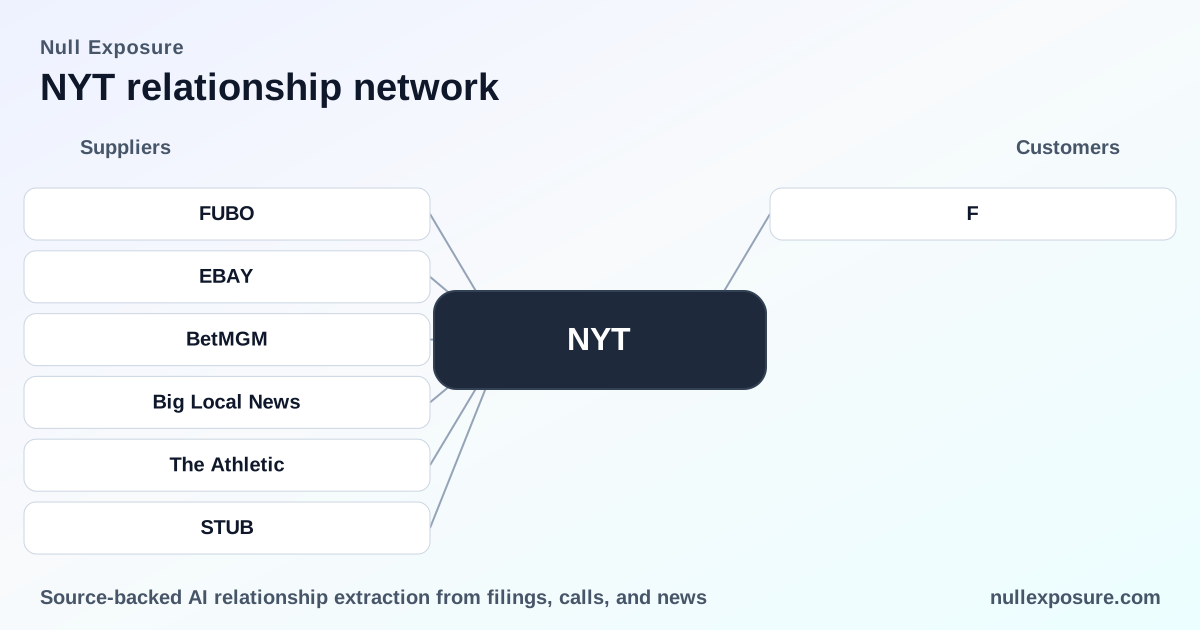
The New York Times Company: subscription economics anchored by scale, with selective commercial tie‑ups
The New York Times Company monetizes a high-margin, subscription-first news franchise: it sells digital and print subscriptions, drives advertising revenue against that engaged audience, and licenses content to third parties. Recurring subscription receipts are the core cash engine—accounting for the majority of revenue—while licensing and ad sales provide complementary upside and commercial flexibility. Investors should value NYT as a scaled consumer‑subscription platform with predictable recurring revenue, measured advertising cyclicality, and occasional corporate sponsorships and licenses that are peripheral but strategically visible.
For a concise, machine‑checked portrait of NYT’s customer relationships, visit https://nullexposure.com/.
How NYT’s customer economics work in practice
The company reports subscription revenue as the dominant revenue stream, and subscription economics are both large and highly material to overall financials. According to the company’s public filings through December 31, 2024, subscription revenue was reported at $1,788,207 (in thousands) and represented 69.2% of total revenue for the period, underlining the primacy of individual and group subscribers. NYT ended 2024 with approximately 11.43 million subscribers, including about 10.82 million digital‑only subscribers, which gives the business scale and recurring cash flow visibility.
Operational metrics show healthy margins relative to traditional publishing: trailing operating margin is reported near 20.8% with positive EBITDA and steady revenue growth (quarterly revenue growth YOY of 10.5% in the latest reported quarter). These economics support a premium valuation multiple (forward P/E ~29) that embeds growth expectations from subscriber expansion, product bundles (The Athletic, Cooking, Games, Wirecutter), and increased monetization per user.
What the public record lists as customer relationships
Below I cover every relationship surfaced in the results. Each item is summarized in plain English with a direct source reference.
F — sponsorship with Lincoln (Ford)
NYT’s archived Media Decoder blog notes a sponsorship agreement with Ford Motor Company’s Lincoln brand that provided an additional 100,000 users free access to the website under the terms of the promotion. This is framed as a corporate sponsorship that delivered incremental audience access rather than a long‑term subscription commitment. Source: archived NYT Media Decoder post, December 15, 2011 (https://archive.nytimes.com/mediadecoder.blogs.nytimes.com/2011/12/15/janet-robinson-chief-executive-of-times-co-to-step-down/).
Ford Motor Company — sponsorship with Lincoln (same event)
The same archived NYT Media Decoder entry is also recorded under the fuller name Ford Motor Company, describing the Lincoln sponsorship that granted 100,000 complimentary accesses to the Times site. This duplicate record confirms the event was widely reported within NYT’s own coverage of company leadership and commercial activity. Source: archived NYT Media Decoder post, December 15, 2011 (https://archive.nytimes.com/mediadecoder.blogs.nytimes.com/2011/12/15/janet-robinson-chief-executive-of-times-co-to-step-down/).
Takeaway: both relationship records reference the same 2011 sponsorship arrangement where Ford’s Lincoln brand subsidized access for a defined user cohort; the arrangement is historical and promotional in nature rather than an indicator of a structural B2B revenue stream.
Operating and contracting posture — what the constraints reveal
The collection of constraints extracted from NYT’s public filings provides a clear view of how the company contracts, whom it serves, and where counterparty risk resides.
- Contracting posture: NYT is fundamentally subscription‑driven; the company explicitly generates revenues principally from the sale of subscriptions and advertising. Subscription revenue is the primary contractual mechanism, signaling recurring purchase relationships with consumers and institutional groups rather than one‑off transactions.
- Counterparty profile: The dominant counterparty type is individual consumers, with a smaller but notable share of group corporate and group education subscriptions (collectively ~6% of digital‑only subscribers at end‑2024). This implies a broad, dispersed revenue base with low counterparty concentration at the corporate customer level.
- Geography and scale: NYT is a global media organization with subscribers in 229 countries and territories, which diversifies geographic risk but exposes the company to macro and regulatory variability across markets.
- Materiality and criticality: Subscriptions are critical to NYT’s business, representing the majority of revenue and underpinning margins; advertising and licensing are material but secondary.
- Contract maturity and obligations: The company reports operating leases with a weighted‑average remaining lease term around 5.6 years, indicating medium‑term fixed obligations for real estate and equipment; the company also recognizes building rental revenue from subleases of headquarters space.
- Relationship roles and stages: NYT acts primarily as a seller of subscriptions and content, while also acting as a licensee/licensor in content arrangements with digital aggregators and third‑party platforms. The subscriber base is active and recurring.
- Business segment orientation: The company’s relationships are concentrated in services (subscription and content delivery), supported by marketing investments (media expense in the hundreds of millions annually) and product bundling (The Athletic, Cooking, Games, Wirecutter).
Collectively, these signals describe a mature, subscription‑led publisher with predictable recurring revenue, moderate fixed costs from leases, and diversified distribution via licensing and third‑party platforms.
Relationship risk profile investors should monitor
Investors evaluating NYT’s customer franchise should focus on a small set of high‑leverage risks:
- Churn and ARPU pressure: Subscription economics depend on maintaining subscriber retention and extracting growth in average revenue per user; marketing spend and product bundling are critical levers to manage churn.
- Concentration of revenue type: Subscriptions are the dominant revenue source, so any secular decline in willingness to pay for news content would materially affect cash flow.
- Commercial sponsorships are peripheral: Corporate promotions and sponsorships (for example, the historical Lincoln promotion) generate episodic audience lifts but do not substitute for durable subscription growth.
- Lease and fixed‑cost exposure: Multi‑year lease obligations create fixed cost floors that reduce operating leverage in a downturn, while rental income from subleases mitigates some cost.
- Regulatory and international risk: Global distribution offers scale but brings regulatory and currency considerations that can impact monetization outside the U.S.
How to monitor these customer relationships going forward
- Track subscriber counts and composition in quarterly filings (digital vs print, individual vs group).
- Watch marketing spend (media expense) as an indicator of pace to acquire and retain subscribers.
- Monitor licensing announcements and corporate sponsorships for incremental audience or revenue impact.
For a deeper, structured look at counterparties and customer relationships across public companies, see the Null Exposure portal: https://nullexposure.com/.
Final investor takeaway
NYT is a subscription‑first media business with demonstrable scale and durable margins; subscriptions are both the revenue engine and the primary risk vector. Corporate sponsorships and licensing complement the franchise but remain secondary to the subscription base. Investors should underwrite NYT’s valuation to subscriber growth, retention trends, and the company’s ability to extract higher per‑user revenue while managing fixed costs and international complexity.