Realty Income (O): customer relationships that underwrite a predictable cash yield
Realty Income operates as a scale landlord of free‑standing, single‑tenant commercial properties and monetizes through long‑term net leases that pass property-level operating costs to tenants while generating stable rental cash flow and dividend distributions to shareholders. The firm's business model is built on long lease durations, diversified tenant exposure across defensive retail and service operators, and selective partnerships to enter new geographies, making tenant relationships the primary determinant of revenue stability and portfolio risk.
For a concise overview of our coverage and tools for counterparty analysis, visit https://nullexposure.com/.
Why tenant relationships matter for Realty Income's investment profile
Realty Income is a REIT that sells occupancy risk rather than retail operations risk: its returns depend on lease structures, tenant credit, and portfolio concentration rather than on consumer demand per se. Long‑dated, triple‑net leases concentrate revenue visibility and transfer property operating obligations to tenants, which reduces landlord capex variability but raises sensitivity to tenant credit events and sectoral secular change. The company's scale—over 15,600 properties with large institutional clients—creates diversification benefits, but the top 20 tenants still represent material share of contractual rent, so portfolio concentration is a genuine portfolio governance focus.
Counterparty-by-counterparty: what investors need to know
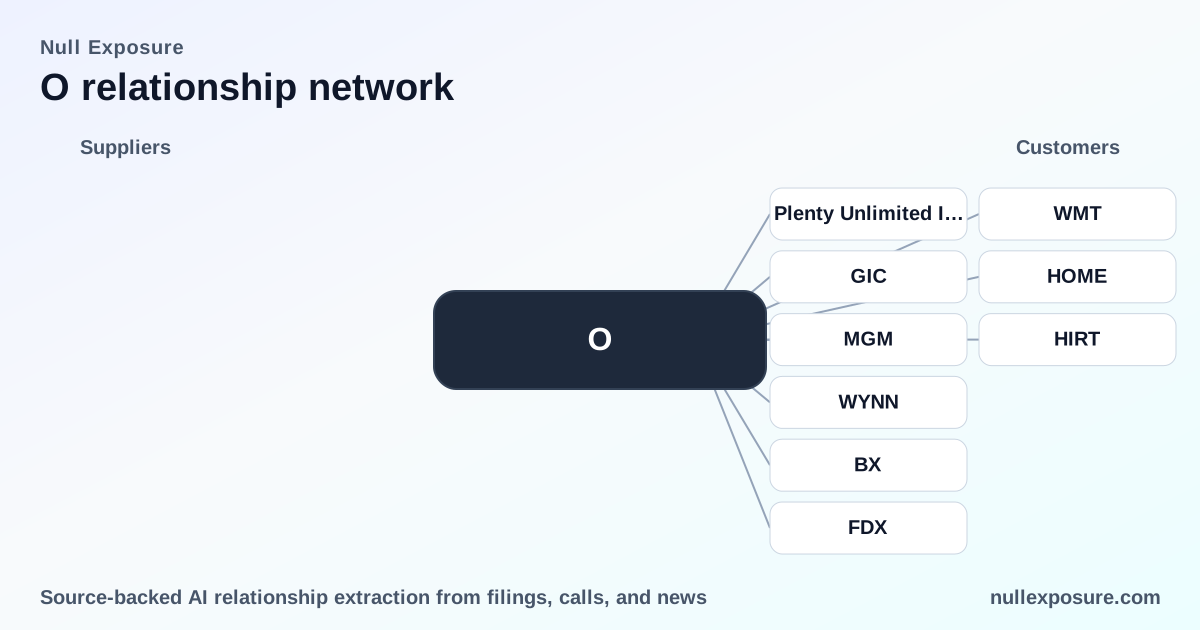
Below I summarize every counterparty relationship flagged in the recent source set, with concise plain‑English context and the documentary source.
GIC
Realty Income is partnering with sovereign wealth investor GIC to support disciplined international expansion, including entry into Mexico via partnership‑led investments. Source: Realty Income earnings call (2025 Q4, referenced March 2026).
Plenty Unlimited Inc.
Realty Income and Plenty announced a strategic alliance to develop up to $1 billion of vertical farm assets that will be leased to Plenty under long‑term net leases, signaling the REIT's extension into specialized agritech real estate. Source: PR Newswire release (March 2026).
Dollar General
Dollar General is identified among major tenants in Realty Income's diversified lease mix, representing a stable, low‑price‑point retail counterparty that contributes to the company's defensive rental profile. Source: Intellectia.ai coverage summarizing Realty Income's FY2026 positioning (May 2026).
7‑Eleven
7‑Eleven is named alongside convenience and grocery tenants that supply recurring, non‑discretionary rent flows, reinforcing Realty Income’s exposure to stable convenience retail cash flows. Source: Intellectia.ai summary of FY2026 commentary (May 2026).
Wynn Resorts
Wynn Resorts is listed as one of the corporate tenants to which Realty Income leases property, reflecting selective exposure to leisure and hospitality operators within a broadly retail‑oriented portfolio. Source: The Globe and Mail coverage (March 2026).
Blackstone (BX)
Realty Income expanded a strategic relationship with Blackstone through an $800 million perpetual preferred equity interest in Las Vegas CityCenter, showing the company’s willingness to structure capital partnerships alongside leasing activity. Source: Realty Income earnings call (2025 Q4, March 2026).
MGM
Realty Income structured an investment tied to assets that are strategically important to MGM, with structures designed to provide downside protection and attractive risk‑adjusted returns, highlighting hybrid capital and property financing roles beyond pure landlord activity. Source: Realty Income earnings call (2025 Q4, March 2026).
FedEx
FedEx is cited among large corporate lessees that contribute to Realty Income’s stable client base, supporting logistics and last‑mile industrial exposure within the portfolio. Source: The Globe and Mail coverage (March 2026).
Walmart
Walmart is named as another major corporate tenant, offering scale and investment‑grade stability in the retail bucket of Realty Income’s rent roll. Source: The Globe and Mail coverage (March 2026).
HOME / At Home
Realty Income used early visibility into At Home store‑level trends to divest select assets ahead of the tenant’s Chapter 11 filing, demonstrating active asset management and selective disposition to mitigate tenant distress. Source: Realty Income earnings call (2025 Q4, March 2026).
HIRT / Hines
Realty Income is entering Mexico in a partnership‑led manner alongside GIC and Hines, indicating the use of established global real estate operators to de‑risk international expansion. Source: Realty Income earnings call (2025 Q4, March 2026).
What the relationship set tells you about operating posture and risk
- Contracting posture — long term and landlord‑centric. The company emphasizes long‑term net leases (weighted average remaining lease term ~9.3 years) where tenants carry taxes, insurance, and maintenance, generating predictable landlord cash flows and low variability in property operating costs.
- Concentration — diversified but with material top accounts. No single tenant contributes over 10% of revenue historically, but the top 20 tenants account for roughly 36.4% of annualized rent, so portfolio concentration is meaningful at the top‑tier level and requires active tenant credit monitoring.
- Counterparty profile — large enterprises and investment‑grade exposure. A notable portion of rent derives from investment‑grade clients or affiliates; this institutional quality underpins the company’s dividend model but does not eliminate exposure to retail secular shifts.
- Geographic footprint — principally North America with growing international exposure. The portfolio is U.S.‑centric but includes the U.K. and other European countries, and Realty Income is pursuing disciplined international entry (e.g., Mexico) via partnerships, which outsources local execution risk to experienced partners.
- Criticality and maturity — established, transactional relationships. Realty Income operates an asset‑ownership model that is mature (56 years of activity) and transactional in nature: the company is primarily a seller/lessor rather than an operator of retail chains.
- Materiality signals — portfolio‑level importance rather than single‑tenant dependency. Company filings state that no individual client represented more than 10% of revenue in recent years, supporting the notion of diversification even as the top 20 concentration is material.
Investment implications—what drives upside and where to watch downside
- Upside drivers: steady rent escalators embedded in long leases, a large base of defensive retail and service tenants, and strategic structured investments with institutional partners that enhance yield without taking operating risk.
- Key risks: tenant credit deterioration in concentrated top accounts, secular retail shocks that could compress re‑let spreads for freestanding sites, and execution risk on international expansion despite partner selection.
- Active management evidence: the At Home dispositions and the Las Vegas CityCenter preferred stake demonstrate a toolkit that includes asset sales and structured capital placements to manage downside and enhance returns.
For a deeper look at counterparty exposures and how they affect portfolio cash flow, see additional analysis at https://nullexposure.com/.
Bottom line
Realty Income’s tenant relationships form the core of its valuation case: long, net leases with broadly diversified tenants provide predictable cash flow, while the top‑20 tenant concentration and selective exposure to non‑retail operators create identifiable areas to monitor. The company’s partnership strategy for international growth and occasional structured investments broaden the return profile beyond pure leasing but require active governance. Investors should price Realty Income as a cash‑flow landlord with concentrated top‑account risk and clear levers for downside mitigation.