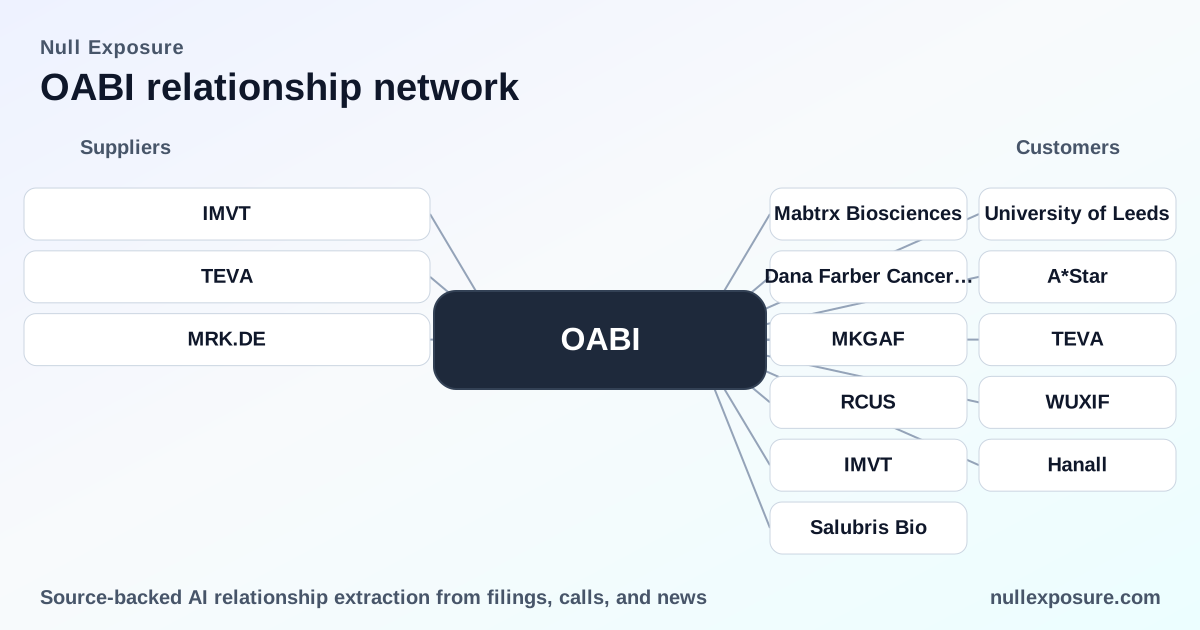
OmniAb (OABI): A partner-first antibody engine that monetizes with licenses, milestones and royalties
OmniAb operates a platform licensing and services model: the company licenses its OmniAb discovery technologies to biopharma partners, delivers discovery services, and captures value through upfront fees, development milestones and downstream royalties on approved products. Revenue is partner-driven and milestone-weighted, with OmniAb citing 32 clinical or approved partner programs and more than $350 million in remaining milestones as the core monetizeable runway. For investors, the thesis is straightforward: platform scale and partner success drive non-dilutive revenue, while clinical readouts at partners translate into asymmetric re-rating events for OABI. Learn more about the methodology and source coverage at https://nullexposure.com/.
Why the partner map matters for valuation
OmniAb is a pure-play discovery platform: its operating leverage is tied to partner activity rather than internal late-stage development. That structure creates three investment characteristics to weigh:
- Concentration of payout timing: revenue recognition is uneven and milestone-driven; a small number of partner catalysts can materially change near-term cash flow.
- Counterparty risk and optionality: partners range from big pharma to incubated start-ups, giving a mix of balance-sheet stability and upside from small-cap licensees that can scale rapidly.
- De-risk through diversity: OmniAb reports dozens of programs across indications and partners, which reduces binary single-program exposure but leaves earnings volatility tied to partner clinical timelines.
Key financial context: OmniAb’s trailing revenue was modest (roughly $18.7 million TTM) against a market cap near $204 million, underscoring that future value is dominated by milestone and royalty capture rather than product revenue today.
Relationship map: every partner mentioned in OmniAb materials (source-by-source)
Below are the partner relationships cited in OmniAb’s public materials and press coverage, each in plain English with the source noted.
Dana Farber Cancer Institute
OmniAb executed a new license agreement with Dana-Farber in Q4 2025 as part of a series of licensing deals announced in the quarter. This was disclosed on OmniAb’s Q4 2025 earnings call and reiterated in the company press release (FY2026). Source: OmniAb Q4 2025 earnings call and company press release (Biospace / FY2026).
Mabtrx Biosciences
OmniAb signed a license and services agreement with Mabtrx, an incubated JV tied to ArrowMark Partners and Viking Global, for OmniAb-derived antibody discovery programs announced in late 2025. Source: Corporate press release via BusinessWire/FinancialContent (Nov 2025) and OmniAb Q4 2025 call.
MabTherix Biosciences
Press coverage uses the name “MabTherix” (variant spelling) to describe the same newly formed incubated company that entered a license with OmniAb in Q4 2025; the arrangement highlights OmniAb’s role in incubator-driven discovery partnerships. Source: The Globe and Mail / OmniAb earnings materials (FY2026).
Merck KGaA (ticker references MKGAF / MKKAY / MRK.DE)
Multiple sources report that Merck KGaA is advancing an OmniAb-derived program—M9140—directly to Phase III based on Phase I data, underscoring a late-stage partner catalyst. Coverage listed Merck under several ticker variants in public transcripts and news items. Source: OmniAb partner update in FY2026 earnings call coverage (InsiderMonkey and The Globe and Mail, FY2026).
Arcus Biosciences (RCUS)
Arcus reported notable survival data from a Phase 2 gastric trial that used an OmniAb-derived antibody (zimberelimab) in combination therapy, illustrating clinical validation of OmniAb-derived assets. Source: OmniAb Q3 2025 partner slide and earnings call transcript (InsiderMonkey, FY2025).
Immunovant (IMVT)
Immunovant’s batoclimab, an OmniAb-enabled program, reported positive durability and clinical momentum; analysts identify IMVT-1402 as a material partner asset for OmniAb with meaningful milestone potential. Source: OmniAb partner update slides and analyst commentary in FY2025–FY2026 coverage (InsiderMonkey; investing.com / Leerink notes, FY2026).
Teva (TEVA)
Teva is listed among high-profile partners pushing an OmniAb-enabled asset (TEV-408) forward; Teva disclosed a funding arrangement with Royalty Pharma to accelerate development, providing a financing-backed pathway to value capture for OmniAb. Source: OmniAb Q4 2025 partner highlights and investing.com coverage of JPM and FY2026 commentary.
A*Star
OmniAb completed a license agreement with A*Star during Q3 2025, reflecting the company’s engagement with government or research institutes for non-corporate collaborations. Source: OmniAb Q3 2025 earnings call transcript (InsiderMonkey, FY2025).
University of Leeds
OmniAb completed a license deal with the University of Leeds in Q3 2025, showing the platform’s reach into academic translational partnerships. Source: OmniAb Q3 2025 earnings call transcript (InsiderMonkey, FY2025).
Salubris Bio
OmniAb disclosed that a Salubris program (SAL003, an anti-PCSK9 antibody that originated from an OmniAb platform) moved to registration in China following NMPA acceptance, signaling a near-term regulatory milestone in a major market. Source: OmniAb Q3 2025 partner updates (InsiderMonkey, FY2025).
WuXi / WUXIF
OmniAb’s early partnership with WuXi generated at least one commercial product that carries a 3% global royalty, an example of the steady, recurring royalty income path available to the company. Source: OmniAb Q3 2025 transcript and partner disclosure (InsiderMonkey, FY2025).
Hanall
HanAll reported preparation for an NDA submission in Japan for batoclimab, another OmniAb-enabled program moving toward regulatory filing in a major geography. Source: OmniAb partner update in Q4 2025 earnings coverage (InsiderMonkey, FY2026).
FATN (FatPipe)
An outlier in the results list, FatPipe’s appearance comes from unrelated procurement news; OmniAb has no operational linkage to this press item in the company materials. Source: Third-party press feed (AccessNewswire, FY2026).
What the relationship set tells investors about OmniAb’s operating model
- Contracting posture: OmniAb consistently uses license-and-services deals plus milestone and royalty structures; the presence of incubated JV agreements (Mabtrx/MabTherix) shows active participation in sponsor-led venture models. This is a deliberate monetization design rather than ad hoc spot deals.
- Commercial concentration and criticality: The company points to 32 clinical/approved programs and >$350 million in remaining milestones, indicating meaningful future cash flow concentrated in partner clinical outcomes (OmniAb FY2026 disclosures). Big-pharma partners (Teva, Merck KGaA) provide balance-sheet stability, while smaller or incubated partners provide upside.
- Maturity spectrum: Partners span early discovery to registration and Phase III (Merck KGaA, Salubris, HanAll), giving both short-term regulatory events and longer-term royalty tails.
- No explicit customer-level constraints recorded: the available relationship data does not include contractual caveats or constraints tied to specific partners; treat this as a company-level signal that public materials emphasize license breadth and milestone upside without disclosing restrictive clauses in the source set.
Risk / opportunity lens and investor action items
- Opportunity: Clinical readouts and regulatory filings at partner organizations (notably Merck KGaA, Immunovant, Salubris, Teva) are direct re-rating catalysts for OABI because of the milestone and royalty structure. Analysts have called IMVT-1402 the most significant partner asset with >$100M in milestone potential in published coverage. Source: investing.com / Leerink commentary (FY2026).
- Risk: Milestone timing and partner clinical risk create earnings volatility; a failed partner trial or delayed regulatory filing compresses milestone receipts and short-term valuation.
- Next actions for research: track partner clinical timelines, milestone schedules disclosed by OmniAb, and quarterly partner updates for milestone recognition triggers.
For a consolidated view of OmniAb’s partner disclosures and to monitor updates across these relationships, see the company partner coverage at https://nullexposure.com/.
Conclusion: OmniAb is a license-and-royalty platform whose valuation hinges on partner execution. Investors should treat OmniAb as a leveraged play on partner clinical success and milestone realization, not a traditional biopharma with internal late-stage assets.