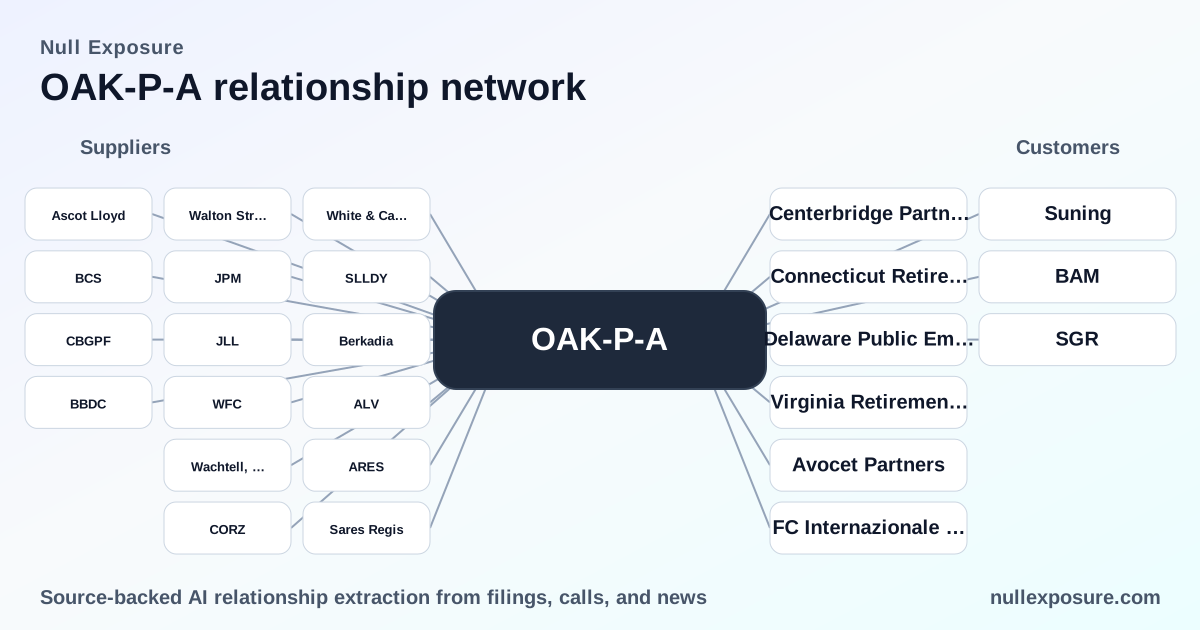
OAK-P-A: How Oaktree’s customer network underpins a preferred-income play
Thesis: OAK-P-A represents a fixed-income, semi-annual preferred distribution tied to Oaktree Capital Group’s balance-sheet and fee-generating alternative-investment business; investors buy the security for stable coupon exposure while relying on Oaktree’s ability to monetize through management fees, performance fees and direct capital deployments. For a consolidated view of customer relationships and how they inform credit and liquidity risk, visit https://nullexposure.com/ for primary signal coverage.
What the security actually pays for — the business model in plain English
Oaktree operates as an alternative asset manager and active credit investor that monetizes through fee income from managed funds and through principal returns on balance-sheet investments. The OAK-P-A preferred units deliver a fixed 6.625% coupon (semi-annual), so the preferred’s stability depends on two operating realities: (1) the ongoing durability of fee-bearing assets under management and (2) Oaktree’s willingness and capacity to deploy balance-sheet capital into stressed credits, corporate financings and insurance capital solutions. Investors in the preferred hold a claim tied to income stability rather than direct equity upside.
How customer relationships reveal strategy and risk
Below I walk through every customer (or counterparty) relationship extracted from the coverage set and explain what each means for Oaktree’s commercial posture.
Centerbridge Partners, L.P.
White & Case reported in March 2026 that funds managed by Centerbridge were buyers in a transaction involving Oaktree-managed assets, signaling third‑party investor activity around dispositions of Oaktree positions, and highlighting Oaktree’s use of strategic sales to recycle capital. (White & Case press release, Mar 2026)
Virginia Retirement System
Alternatives Watch noted in February 2025 that the Virginia Retirement System committed capital ($150 million) to an Oaktree opportunistic credit fund, showing large public-pension demand for Oaktree’s credit strategies and the manager’s ability to attract institutional LPs. (Alternatives Watch, Feb 11, 2025)
Connecticut Retirement Plans and Trust Funds
The same Alternatives Watch report lists Connecticut Retirement Plans and Trust Funds as a $300 million investor in Oaktree’s fund, underscoring concentrated, large-scale institutional commitments into flagship credit vehicles. (Alternatives Watch, Feb 11, 2025)
Delaware Public Employees’ Retirement System
Alternatives Watch also recorded Delaware Public Employees’ Retirement System as a capital contributor to the fund, linked to investments in essential infrastructure-related companies — a nod to Oaktree’s strategy of targeting defensive, utility-like assets within credit portfolios. (Alternatives Watch, Feb 11, 2025)
TPI Composites Inc. (TPIC)
A Chapter11Cases report (May 2026) documents a 2023 Oaktree credit agreement with TPI that converted outstanding preferred equity and accrued dividends into a $393 million senior secured loan plus equity, illustrating Oaktree’s willingness to use its balance sheet to restructure stressed issuers and to convert equity exposures into secured credit positions. (Chapter11Cases, May 2026)
FC Internazionale Milano (Inter Milan)
The New York Times reported on May 22, 2024 that Oaktree-managed funds assumed ownership of Inter Milan after a loan to Suning was not repaid, demonstrating Oaktree’s capacity to exercise creditor rights and take controlling positions when borrowers default. (New York Times, May 22, 2024)
Suning
The NYT coverage further documents that the loan was originally extended to Suning in 2021, showing Oaktree’s long-dated credit exposures to corporate owners of strategically valuable assets (in this case, a football club) and the operational outcomes when sponsors fail to refinance. (New York Times, May 22, 2024)
Avocet Partners
CityBiz reported that Avocet launched an insurance-focused platform backed by $500 million of committed equity from funds managed by Oaktree and Lane42, signaling direct strategic capital commitments into operating platforms that expand Oaktree’s product footprint in insurance and specialty finance. (CityBiz, Mar 2026)
Sentinel Security Life Insurance Company
Alternative Credit Investor (Mar 16, 2026) noted that Oaktree will provide capital support to Sentinel, including funding a surplus note into a newly created captive — evidence of Oaktree’s increasing role as an on‑balance-sheet insurer capital provider and partner to insurance enterprises. (Alternative Credit Investor, Mar 16, 2026)
Allianz
Alternative Credit Investor also highlighted Oaktree’s arrangement to manage a share of Allianz’s reinsurance assets under a partnership, indicating institutional-level reinsurance and asset-management mandates that expand fee revenue and embed Oaktree into insurance balance-sheet economics. (Alternative Credit Investor, Mar 2026)
Arzan Investment Management (AIM)
Latham & Watkins reported that AIM secured a debt-financing commitment for its GCC hospitality platform from funds managed by Oaktree, illustrating Oaktree’s deployment of credit to sponsor-led, regionally focused hospitality and real-estate platforms. (Latham & Watkins news release, May 2026)
Brookfield (BAM / parent activity)
Pensions & Investments covered Brookfield’s $3 billion acquisition of the remaining Oaktree stake, confirming Brookfield’s consolidation of control and the broader corporate ownership context for Oaktree’s capital strategy and resource access. (Pensions & Investments, FY2025)
Star Entertainment (SGR)
The Australian Financial Review’s Street Talk (Oct 16, 2025) reported Oaktree’s renewal of debt-focused approaches toward the Star Entertainment capital structure, highlighting targeting of stressed corporate capital stacks in operationally compromised sectors. (Australian Financial Review, Oct 16, 2025)
Operating-model signals investors should read into (company-level)
Because no separate constraint excerpts were extracted, these are company-level operational signals derived from the relationship map rather than from a discrete constraint feed:
- Contracting posture: Oaktree behaves both as a fund manager (fee contracts with institutional LPs) and as a principal lender/operator when market dislocation creates opportunities; expect hybrid contracting terms and bespoke capital solutions.
- Concentration profile: The manager secures large, concentrated commitments from public pensions and strategic partners, which enhances fee predictability but also concentrates counterparty exposure to a limited set of large institutional LPs.
- Criticality of relationships: Ties to insurers (reinsurance mandates, direct capital to Sentinel) and to large pensions make Oaktree’s services strategically important to those clients and raise the cost of losing or disrupting those relationships.
- Maturity and control: Brookfield’s consolidation of ownership changes the control dynamic and should reduce strategic uncertainty while increasing access to parent capital for both liquidity support and strategic deployments.
Investment implications and final takeaways
- Credit profile for OAK-P-A is backed by predictable fee streams plus active balance-sheet deployment; investors get coupon stability but must accept residual exposure to Oaktree’s principal investment decisions.
- Positive signals: Large pension commitments, insurer mandates and strategic capital launches (e.g., Avocet) support fee durability and cross-selling, reducing preferred‑coupon risk.
- Key risks: Principal deployments into distressed credits and ownership positions (Inter Milan, TPI restructuring) concentrate downside in volatile credits; Brookfield ownership materially changes governance and optionality.
For a consolidated feed of customer-level signals and to track changes to these counterparty relationships in real time, consult https://nullexposure.com/.
Bold takeaway: OAK-P-A offers yield anchored to a mature, fee-generating alternative manager that also uses balance-sheet capital opportunistically — investors should price both the income stability and the principal-risk vector embedded in Oaktree’s active creditor and operator role.