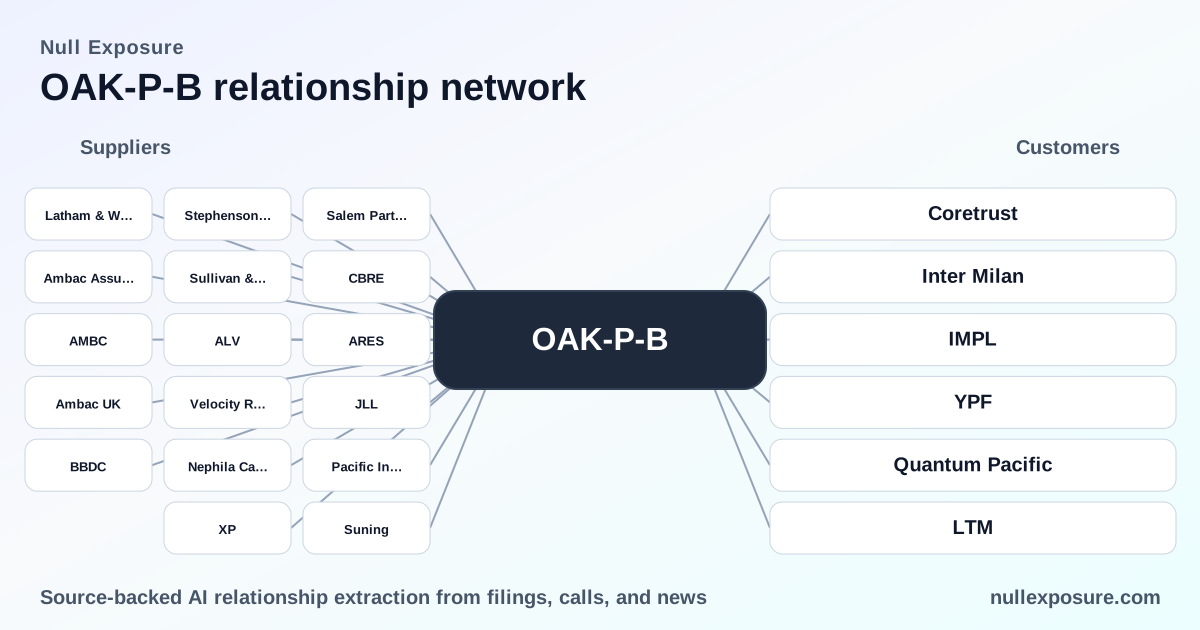
OAK-P-B: How Oaktree’s preferred units reflect a credit-first commercial footprint
OAK-P-B represents a fixed-dividend preferred claim on Oaktree Capital Group’s cash flows, marketed to institutional investors seeking stable income inside the alternative-asset complex. Oaktree monetizes through credit-oriented capital deployment and fee-bearing asset management, using structured financings, royalty deals, and distressed-credit financing to generate predictable coupon-like returns that support preferred dividends. For an investor assessing customer exposure and counterparty risk, the public record shows Oaktree operating as an active lender and strategic financier across industries from insurance captives to airlines and pharma royalty deals. (Explore more at https://nullexposure.com/.)
What the preferred unit buys you — a compact operating thesis
OAK-P-B gives holders a priority income stream backed by Oaktree’s enterprise-level cash generation. Oaktree’s core revenue drivers are credit origination and management, capital provision to stressed borrowers, and structured revenue streams such as royalties and mezzanine financing. That commercial posture produces steady distributable cash when markets price credit appropriately, but it also ties OAK-P-B’s risk profile to Oaktree’s success in sourcing and servicing large, often concentrated financings.
Public customer relationships that define Oaktree’s commercial posture
Below I list each relationship captured in the public record and the investor-relevant takeaway. Each entry is a one- to two-sentence plain-English summary with source.
Sentinel Security Life Insurance Company
Oaktree provided capital support to Sentinel by funding a surplus note investment into a newly created captive insurance company, demonstrating Oaktree’s role as a private capital backer for insurance-related balance-sheet engineering. According to Captive Insurance Times (May 3, 2026), Oaktree funded that surplus note as part of a multifaceted transaction.
Coretrust
Coretrust refinanced a downtown L.A. building with a $64.7 million mezzanine loan from Oaktree alongside a $209.6 million senior loan from AIG, illustrating Oaktree’s active participation in commercial real estate mezzanine financing. The Los Angeles Business Journal reported on this refinancing and subsequent foreclosure events (first reported March 10, 2026).
Inter Milan
Oaktree made a strategic investment to strengthen Inter Milan’s finances, showing Oaktree’s use of equity-like capital injections into sports franchises as part of its credit and opportunistic investment playbook. SportsMintMedia confirmed the investment and its role in shoring up club finances (reported March 10, 2026).
Quantum Pacific
Funds managed by Oaktree were involved in the sale of financing transactions by Fleetscape to Quantum Pacific, signaling Oaktree’s willingness to originate and then monetize debt financing via secondary transactions. Stephenson Harwood noted the advisory role in that deal (reported March 10, 2026).
Impel NeuroPharma (IMPL) — royalty and debt financing
Oaktree provided $50 million upfront to Impel in exchange for tiered royalty payments on Trudhesa U.S. sales and other payments, reflecting Oaktree’s deployment of structured royalty financing in biopharma. The GlobeNewswire press release dated March 17, 2022, described the royalty and debt financing arrangement.
IMPL (duplicate record)
The same GlobeNewswire release documents the same $50 million royalty/debt package for Impel, reinforcing that Oaktree uses tiered royalty streams to secure downside protection and participate in upside drug commercialization (GlobeNewswire, March 2022).
YPF / YPF SA
Oaktree participated as a creditor in a debt restructuring of Argentine oil producer YPF SA, showing Oaktree’s involvement in sovereign- or quasi-sovereign country restructurings and large energy credits in Latin America. Livemint reported Oaktree’s creditor role in that restructuring (reported March 10, 2026).
LTM / Latam Airlines Group — debtor-in-possession financing
Oaktree offered $1.3 billion of debtor-in-possession financing to Latam Airlines Group during its Chapter 11 process, demonstrating Oaktree’s capacity to underwrite large restructuring financings that are functionally rescue capital. Livemint (March 10, 2026) referenced the financing; Aerotime (March 10, 2026) recorded that the $1.3 billion tranche was Oaktree-committed capital pending court approval.
LTM (duplicate Aerotime entry)
Aerotime’s coverage reiterates that Latam received multiple tranches totaling $2.2 billion, including an Oaktree-committed $1.3 billion tranche that required court approval—underscoring Oaktree’s role as a major restructuring lender in aviation distress (Aerotime, March 10, 2026).
How these relationships translate into operating characteristics
These customer interactions collectively define Oaktree’s commercial model: a contracting posture heavily weighted toward bespoke financings and structured credit, often in stressed or transitional situations. That posture produces several company-level characteristics:
- Concentration: Oaktree takes meaningful, often large-ticket exposures (e.g., $1.3 billion for Latam; mezzanine loans in real estate), which concentrates counterparty risk by size even as sector diversity spreads exposure across industries.
- Criticality: Many relationships are economically critical to counterparties—debtor-in-possession financings and surplus notes directly affect borrowers’ liquidity—so Oaktree functions as a consequential provider of lifecycle capital.
- Maturity and capability: The dealset (royalty financing, mezzanine real estate debt, restructuring DIP loans) demonstrates a mature platform with underwriting depth across complex credit structures.
- Contracting posture: Oaktree structures bespoke, enforceable claims (royalties, mezzanine liens, DIP financing terms) that prioritize downside protection and cash yield.
Note: No company-level constraints were captured in the inspection set; there are no explicit constraint excerpts to attribute to these relationships.
Investment takeaways and risk considerations
- Revenue stability for OAK-P-B is supported by Oaktree’s fee and financing income from structured credit and royalty deals; this underpins preferred dividend distributions.
- Concentration risk is material. Large single-name financings can drive earnings volatility if restructuring outcomes or collateral recoveries disappoint.
- Sector- and jurisdictional complexity increases credit execution risk. Latin American restructurings and cross-border sports and real-estate deals introduce legal and operational execution friction.
- Structure mitigates downside. Oaktree typically takes secured or contractually prioritized interests (mezzanine liens, royalty claims, DIP commitments), which reduces, but does not eliminate, downside exposure.
Final verdict for investors and operators
Oaktree leverages private-credit and structured-finance expertise to create yield that underlies OAK-P-B’s preferred distributions. The company’s business model is deliberately active and concentrated: it generates income by writing large, structured credits that are critical to borrowers and are contractually protective for Oaktree. That combination produces attractive yield potential for preferred-holders, counterbalanced by borrower- and execution-specific credit risk.
For practitioners requiring a deeper view of Oaktree’s counterparty exposures and how they impact preferred coverage, visit https://nullexposure.com/ for portfolio-level intelligence and relationship analytics.