Bond (OBAI) — Mastercard Partnership and Customer Relationships: What Investors Need to Know
Bond (trading as TG-17, Inc., ticker OBAI) builds AI/ML data‑processing software and monetizes through enterprise licensing, cloud-based deployments and B2B2C partnerships that embed its security and personal‑safety capabilities into larger platforms. The firm’s go‑to‑market is partnership‑led — cloud infrastructure on AWS and ecosystem integrations, including a B2B2C relationship with Mastercard, are core distribution channels — and those partnerships materially shape both upside and customer concentration risk. For a deeper look at customer exposures and partnership implications, visit https://nullexposure.com/.
A concise business snapshot for investors
Bond is a small, early commercial software company positioned in security and personal‑safety applications. Revenue TTM is about $9.97M with gross profit of $566k and negative EBITDA, highlighting an early‑stage margin profile and ongoing investment in product and commercialization. Market capitalization is roughly $10.6M, insiders control nearly 49% of the stock while institutional ownership is low (≈7%), which is a governance and liquidity signal for holders. The corporate profile and most recent quarter are reported through 2025-12-31 in public company disclosures.
Key structural facts that drive commercial dynamics:
- Partnership distribution (B2B2C integration) rather than pure direct enterprise sales.
- Cloud dependency (publicly stated use of AWS) for core deployments and scale.
- High insider ownership and low institutional float, which affects liquidity and takeover dynamics.
- Early revenue with negative operating margins, implying execution sensitivity to partner rollouts and customer concentration.
How Bond describes its customer model and monetization
Bond sells software and services that are embedded in platforms and devices rather than purely sold as stand‑alone on‑premise packages. That model yields a mixture of recurring software revenue and commercial arrangements tied to partners’ user bases — meaning growth is levered to partner distribution and ecosystem adoption rather than a classic direct‑sales enterprise ramp. Public filings and market summaries show the company emphasizes telecom and app ecosystem integrations alongside payments and infrastructure partners.
Customer relationships disclosed in public reporting
Bond’s recent public filing and market write‑ups list a set of strategic integrations and deployments. The dataset returned two relationship entries that reference the same partnership in different forms; both are drawn from a March 2026 market write‑up of Bond’s Nasdaq filing.
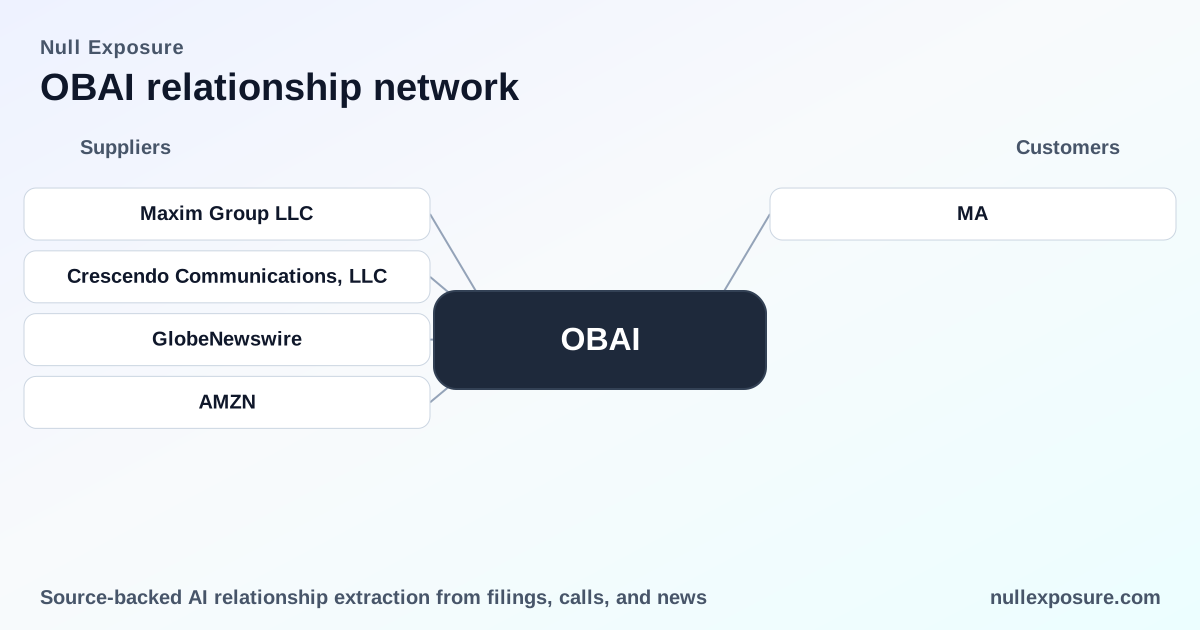
MA
Bond reports a B2B2C relationship with Mastercard as part of its partnership set, positioning Mastercard as a distribution and integration partner for delivering Bond’s personal‑security services through payment and app ecosystems. This relationship was noted in a TradingView summary of Bond’s IPO filing in March 2026 (TradingView, March 10, 2026).
Mastercard
The public filing and media coverage explicitly name Mastercard as a partner for ecosystem integrations and B2B2C distribution, complementing Bond’s cloud and telecom integrations and a pilot drone first‑responder deployment in Coral Gables, FL. The TradingView IPO coverage (March 10, 2026) contains these partnership details and the same set of partnership descriptions.
What these relationships actually imply for operations and risk
The Mastercard tie is more than a logo; for a company of Bond’s size a B2B2C relationship with a global payments platform is a distribution multiplier and a concentration risk at once. Operational implications include:
- Contracting posture: Bond’s commercial stance is partnership‑centric, relying on integration and platform embedding vs. large direct enterprise contracts.
- Concentration: With limited revenue and a distribution strategy that leverages a few major partners, customer concentration risk is elevated — a delayed or limited rollout via a single platform partner would meaningfully impact growth.
- Criticality: Integrations with Mastercard and telecom/app ecosystems are commercially critical because they drive user reach and recurring usage; dependence on AWS for cloud operations adds an infrastructure criticality vector.
- Maturity: Financials (small market cap, negative EBITDA, small gross margin) indicate early maturity, where partner execution determines commercial scaling rather than internal sales force expansion alone.
No contractual constraint excerpts are provided in the public data feed; that absence is itself a company‑level signal that detailed commercial terms, revenue share mechanics, and exclusivity arrangements are not widely disclosed, increasing the need for investor diligence on deal economics and renewal terms.
Investor implications — upside and principal risks
Bond’s partnership model delivers asymmetric outcomes:
- Upside: Large‑scale distribution via Mastercard and telecom/app partners can rapidly expand addressable users without proportionate sales spend, improving gross economics if integration leads to strong activation and monetization.
- Risks: Execution dependency on partner rollouts, cloud dependency on AWS, and concentrated revenues are primary near‑term risks. Financials show limited profitability headroom; any partner slowdowns will pressure margins and require additional capital.
- Liquidity and governance: High insider ownership (~49%) and low institutional ownership (~7%) limit free float and amplify idiosyncratic share moves, which investors should price into entry and exit strategies.
- Valuation context: At a Price‑to‑Sales near 1.06 and tiny market cap, the stock reflects early commercial traction but also the market’s pricing for execution risk and poor profitability.
A pragmatic investor checklist: validate the nature of the Mastercard agreement (revenue share, exclusivity, contract length), confirm the AWS dependency terms and costs, and quantify concentration by partner for the most recent quarter.
Closing: a partnership story to watch
Bond’s commercial profile is partnership‑driven and turnout‑dependent: the Mastercard relationship is the most visible customer tie and functions as a double‑edged sword — it is the fastest path to scale and the largest single source of execution risk. The company’s early financials and ownership structure underscore the importance of confirming deal economics and measuring how partner integrations convert into recurring revenue and margin expansion.
For a structured investor briefing and ongoing monitoring of customer risks and partnership disclosures, see more at https://nullexposure.com/.