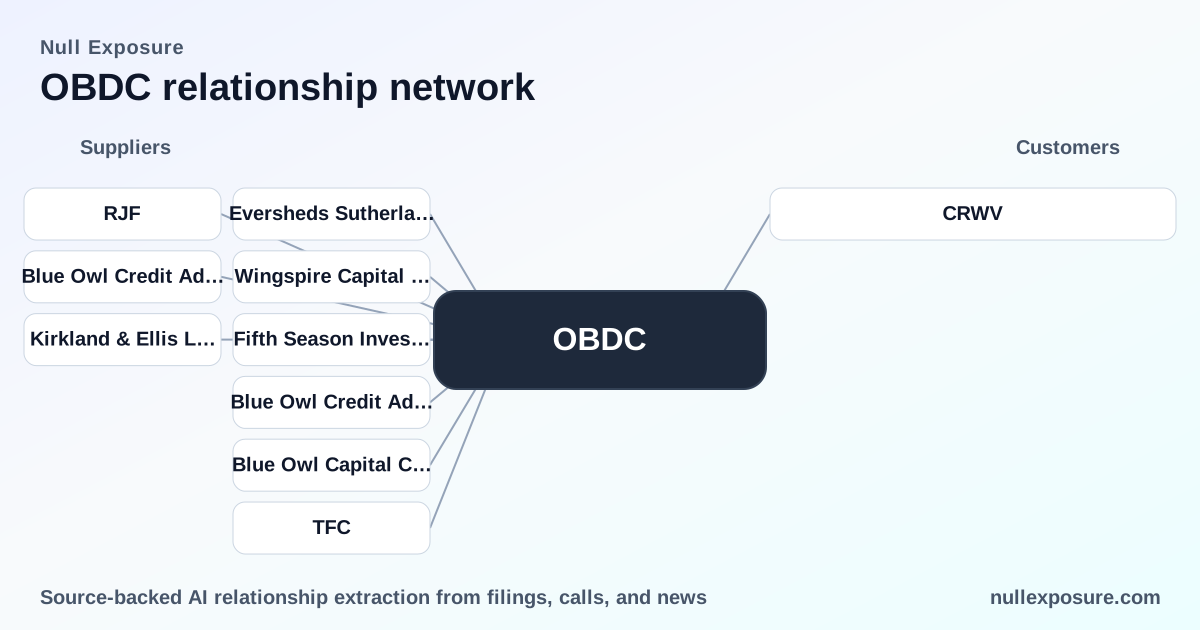
Blue Owl Capital (OBDC): Customer Relationships That Define Credit Exposure and Fee Risk
Blue Owl Capital Corporation operates as a specialist private credit and direct lending manager that originates, holds, and sells middle‑market loans and structured credit; it monetizes through interest spread, loan origination and servicing fees, collateral management fees on CLOs, and realized gains on secondary loan dispositions. For investors evaluating OBDC’s customer footprint, the practical picture is a U.S.-focused, mid‑market lending platform with material first‑lien credit exposure and active distribution channels. For a systematic read of these relationships and what they signal about credit, concentration, and litigation risk, visit https://nullexposure.com/.
How Blue Owl’s customer relationships translate to returns and risk
Blue Owl structures its business around longer-dated credit investments (typical maturities three-to-ten years) and recurring arrangements with CLO vehicles and other capital conduits. That operating posture creates three predictable dynamics: credit underwriting drives earnings, CLO and bond sales create distribution-dependent liquidity, and collateral management roles create fee streams but also operational conflicts when Blue Owl holds CLO tranches itself. The firm’s portfolio is materially weighted to first‑lien debt and average stakes are meaningful — roughly $58.1 million per portfolio company as of December 31, 2024 — which implies high single‑counterparty economic significance for many credits.
Customer relationships: counterparties investors should track
Hitting every reported relationship in the public record, below are concise, source‑anchored summaries investors need to factor into credit and litigation scenarios.
Barracuda
Blue Owl’s loans to Barracuda are cited in a stockholder lawsuit alleging fee and valuation gaps in OBDC’s adviser activities, flagging potential legal and reputational exposure tied to specific credits (InvestmentNews, May 3, 2026). Source: https://www.investmentnews.com/regulation-legal-compliance/stockholder-sues-blue-owl-adviser-alleges-414m-in-excessive-fees/266379
Peraton Corp.
Peraton Corp. is listed among borrowers where the same litigation alleges valuation or documentation gaps in Blue Owl’s loan book, underscoring that the suit references multiple mid‑market credits (InvestmentNews, May 3, 2026). Source: https://www.investmentnews.com/regulation-legal-compliance/stockholder-sues-blue-owl-adviser-alleges-414m-in-excessive-fees/266379
Conair Holdings
Conair Holdings appears in the litigation excerpts as a named borrower in the same cluster of challenged loans, signaling the complaint spans diverse sectors within Blue Owl’s portfolio (InvestmentNews, May 3, 2026). Source: https://www.investmentnews.com/regulation-legal-compliance/stockholder-sues-blue-owl-adviser-alleges-414m-in-excessive-fees/266379
Cornerstone OnDemand, Inc.
Analysts flagged a marking discrepancy where Blue Owl reportedly valued junior preferred and second‑lien claims in Cornerstone at roughly $0.90, while the most senior debt traded near $0.78 at year‑end 2025 — a signal that internal valuations and market prices diverged materially (InvestmentNews, May 3, 2026). Source: https://www.investmentnews.com/regulation-legal-compliance/stockholder-sues-blue-owl-adviser-alleges-414m-in-excessive-fees/266379
SOFI
SoFi’s expansion into a small business lending marketplace lists Blue Owl as a capital partner, indicating Blue Owl’s role as a capital provider into fintech distribution channels and a potential originator of small business credit exposures (Markets FinancialContent, Mar 10, 2026). Source: https://markets.financialcontent.com/stocks/article/finterra-2026-1-28-sofis-maturation-rally-deep-diving-the-12-gain-and-the-future-of-the-fintech-super-app
XOMA
XOMA received a non‑dilutive financing arrangement with Blue Owl (up to $140 million, closed Dec 19, 2023), showing the firm’s use of structured financing to back royalty and milestone acquisitions in life‑science counterparties (Markets FinancialContent, Mar 10, 2026). Source: https://markets.financialcontent.com/wral/article/predictstreet-2025-12-13-xoma-royalty-corporation-a-deep-dive-into-a-biotech-royalty-aggregator-12132025
CAI (Caris Life Sciences)
Caris Life Sciences entered a credit agreement that named Blue Owl as a lender alongside Blackstone, confirming Blue Owl’s participation in strategic healthcare credit facilities for growth and buy‑and‑build strategies (MarketScreener, Apr 02, 2025 filing noted). Source: https://www.marketscreener.com/news/earnings-flash-cai-caris-life-sciences-inc-reports-q3-revenue-216-8m-vs-factset-est-of-174-1-ce7d5cdddb80f325
CRWV (CoreWeave) — listing 1
Reporting links Blue Owl to a data‑center venture in Lancaster, Pennsylvania where CoreWeave is the tenant, illustrating Blue Owl’s exposure to infrastructure assets leased to hyperscale/AI compute tenants (ts2.tech, Mar 10, 2026). Source: https://ts2.tech/en/blue-owl-capital-stock-price-owl-in-focus-before-the-open-as-ratings-firms-try-to-calm-fund-fears/
CoreWeave — listing 2
The same report reiterates the Lancaster data‑center tie to CoreWeave, serving as a confirmatory reference that Blue Owl’s infrastructure investments extend into cloud‑compute real estate strategies (ts2.tech, Mar 10, 2026). Source: https://ts2.tech/en/blue-owl-capital-stock-price-owl-in-focus-before-the-open-as-ratings-firms-try-to-calm-fund-fears/
ADCT (ADC Therapeutics) — Quantisnow source
ADC Therapeutics disclosed indebtedness that includes facilities provided by Blue Owl and noted covenants and restrictions imposed by that indebtedness, indicating contractual leverage and covenant sensitivity for royalty/biotech financings (QuantiSnow, May 2, 2026). Source: https://www.quantisnow.com/insight/adc-therapeutics-reports-fourth-quarter-and-full-year-2025-financial-6438620
ADCT (ADC Therapeutics) — Barchart source
Barchart’s coverage of ADC Therapeutics’ amended healthcare royalty financing agreement similarly lists Blue Owl among financing counterparties, reinforcing the company’s exposure in life‑science royalty and structured finance deals (Barchart, May 2, 2026). Source: https://www.barchart.com/story/news/360487/adc-therapeutics-announces-amended-healthcare-royalty-financing-agreement
Pimco (bond purchaser)
Pimco purchased the entirety of a $400 million bond issuance tied to Blue Owl’s private credit fund, demonstrating institutional demand and the ability to syndicate or distribute large credit lines to global fixed‑income managers (Alternative Credit Investor, Apr 13–15, 2026 reporting). Source: https://alternativecreditinvestor.com/2026/04/15/pimco-purchases-blue-owl-bdcs-400m-bond-offering/
Business model constraints that matter to investors
Blue Owl’s public materials and filings indicate a set of operating constraints that drive both upside and vulnerability:
- Long‑term, mid‑market credit posture. The firm targets three‑to‑ten year maturities and defines the investment universe as U.S. middle‑market companies with EBITDA generally $10M–$250M, creating credit cycles that play out over multiple years and require active monitoring.
- Framework sales and CLO plumbing. Blue Owl uses recurring loan sale agreements with CLO issuers, acting both as seller of loans and collateral manager, which produces fee capture but embeds potential conflicts when the firm holds CLO equity or notes.
- Material portfolio concentration in first‑lien debt. As of Dec 31, 2024, first‑lien debt represented 75.6% (fair value) of the portfolio — a structural tilt that magnifies exposure to cyclical credit losses but preserves recovery priority.
- Geographic and segment concentration. Investment activity is primarily U.S.‑focused with portfolio segments spanning distribution, infrastructure, manufacturing, services, and software — a diversified sector mix but concentrated geographically.
- Deal size and capital intensity. Average investment sizes (~$58.1M) and frequent transactions in the $10–$100M band, with some $100M+ contributions to CLO sales, show significant per‑counterparty economic weight.
These are company‑level signals that shape how lenders, borrowers, and investors interact with OBDC’s originated credit.
Investment implications and watchlist
- Valuation and marking disputes are not theoretical. The Cornerstone valuation divergence and the stockholder lawsuit alleging fee/valuation gaps across multiple credits create near‑term legal and reputational risk that can pressure NAVs and investor confidence (InvestmentNews, May 3, 2026).
- Institutional distribution is robust. Pimco’s purchase of a $400M bond offering validates external demand for packaged Blue Owl credit, supporting liquidity and funding flexibility (Alternative Credit Investor, Apr 2026).
- Sectoral monitoring required. Exposure to healthcare royalties, fintech partnerships, and infrastructure leases (ADC Therapeutics, SoFi, CoreWeave) requires active surveillance of covenant compliance, tranche pricing, and tenant credit quality.
- CLO and fee conflicts deserve scrutiny. As both seller and collateral manager, Blue Owl’s governance around valuation, fee waivers, and related‑party holdings is an active risk vector.
For investors or allocators conducting diligence on OBDC’s customer book, prioritize covenant language, valuation governance for subordinated instruments, and the firm’s disclosures on collateral manager fee arrangements. For a deeper empirical feed on counterparties and valuation incidents, see https://nullexposure.com/.
Bold takeaways: Blue Owl’s model scales returns through concentrated, mid‑market loan stakes and CLO distribution, but that exact structure raises concentrated credit and governance risks that show up in litigation and valuation disputes.