Orchestra BioMed (OBIO): Partner-driven commercialization, milestone-heavy monetization
Orchestra BioMed operates as a biomedical incubator and device developer that monetizes through structured partnerships: licensing intellectual property, milestone and upfront payments, tiered revenue interests and royalties on commercialized products, and the sale or strategic exit of portfolio assets. The company funds clinical development by sharing R&D and regulatory risk with large medtech partners and converts programs to cash via licenses, milestone receipts and occasional asset sales.
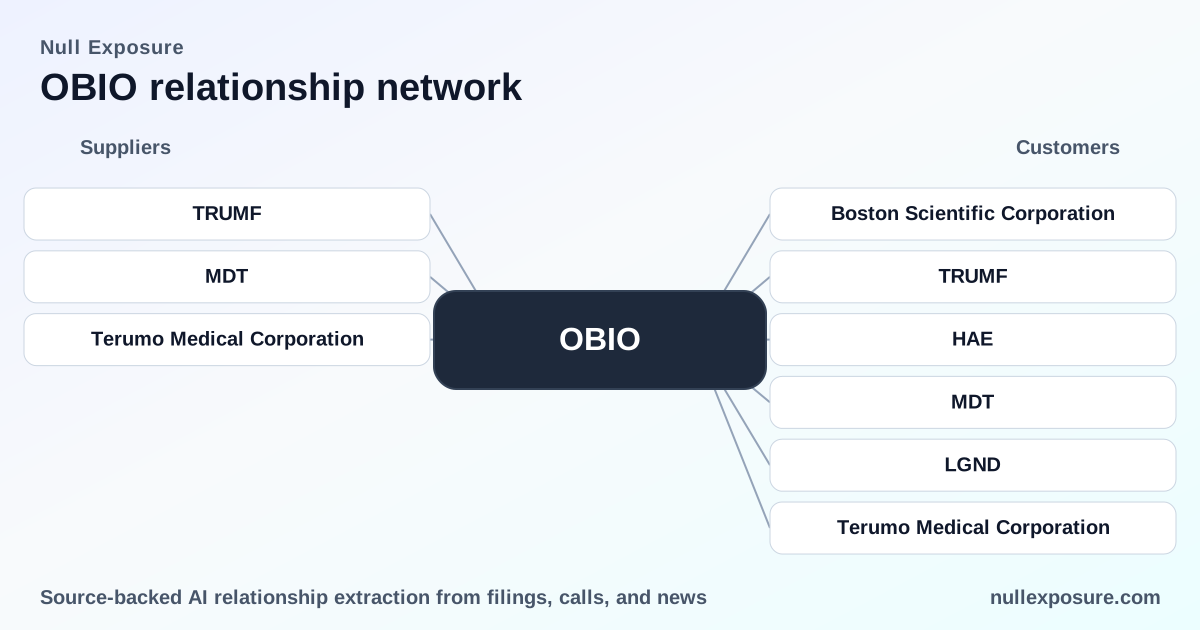
For a compact map of Orchestra’s counterparty footprint and implications for investors, see the partner summaries below or visit https://nullexposure.com/ for broader exposure analytics.
How Orchestra’s operating model translates into cash flow
Orchestra’s commercial strategy is not vendor-style product sales; it is partner-led, milestone-driven and IP-centric. Revenue lines come from:
- Licensing and collaboration economics — upfront fees, milestone receipts and shared commercialization royalties.
- Usage- or sales-linked royalties — royalty recognition deferred under ASC 606 until underlying sales occur, producing lumpy downstream cash.
- Point-in-time product sales from select portfolio companies — occasional spot sales where Orchestra sells products directly, recognized on shipment.
These contract types create a cashflow profile that is lumpy but high-leverage to regulatory and commercial inflection points. Geography and customer mix matter: Orchestra shows a United States operating focus for some product revenues and active pilot programs in VA hospitals, signaling concentration in North America and exposure to public-health buyers.
Partner list and what each relationship delivers
Below are plain‑English summaries of every counterparty referenced in the public corpus, with source context for each claim.
Medtronic (MDT)
Orchestra has a strategic collaboration with Medtronic for development and commercialization of AVIM Therapy, including sponsorship of a multinational pivotal study and revenue-sharing or license expansion pathways for wider commercialization. According to Globenewswire and multiple investor releases in 2025–2026, Medtronic holds negotiation rights to expand global commercialization and has previously taken exclusive licenses for other Orchestra programs. (Sources: GlobeNewswire press releases, InvestingNews and FierceBiotech, FY2025–FY2026 reporting.)
- Constraint tie: Orchestra treats the Medtronic Agreement as a collaboration under ASC 808 but accounts for Medtronic as a customer under ASC 606, which establishes Medtronic’s role as a paying partner and commercialization counterparty. (Company filings cited in constraints.)
Terumo (Terumo Corporation / Terumo Medical / TRUMF / TRUMY)
Orchestra licensed IP to Terumo and executed a structured commercial arrangement around the Virtue® Sirolimus AngioInfusion Balloon (Virtue SAB) that included a fee and convertible-preferred equity investment; Orchestra retained development responsibilities in the U.S. and revenue recognition was tied to combined R&D services and the license. Globenewswire and regional reporting in 2026 describe a ROFR agreement and a $10.0 million fee plus a prior $20 million preferred-stock investment. (Sources: GlobeNewswire March 2026; regional reporting, FY2025–FY2026.)
- Constraint tie: Orchestra’s Terumo Agreement explicitly reflects a license plus ongoing development posture—Terumo is a licensee while Orchestra completes U.S. regulatory work (per company disclosures).
Haemonetics (HAE)
Haemonetics acquired Vivasure Medical, a company in which Orchestra previously held a strategic position, and Orchestra expects up to $21 million in aggregate proceeds related to that transaction (including upfront and milestone payments). Orchestra’s March 2026 releases and third-party reporting lay out the expected cash inflows tied to the Vivasure sale that closed January 9, 2026. (Sources: SahmCapital release and GlobeNewswire investor update, FY2026.)
Ligand (LGND / Ligand Pharmaceuticals)
Ligand committed financing tied to Orchestra’s programs — specifically a $35 million commitment in return for a tiered revenue interest in future royalties tied to BackBeat and Virtue programs. FierceBiotech and InvestingNews reported on the financing structure that ties Ligand to upstream program economics and downstream royalty streams. (Sources: FierceBiotech and InvestingNews, FY2025–FY2026.)
Boston Scientific Corporation
Orchestra’s public filings reference Boston Scientific in the context of competitive or market developments — for example, Boston Scientific’s FDA approval of a competing paclitaxel-coated balloon product was noted in Orchestra’s FY2024 10‑K. The mention situates Orchestra’s portfolio in a competitive medtech landscape rather than indicating a direct partnership. (Source: OBIO FY2024 10‑K.)
Company-level constraints that shape risk and upside
Several operating and accounting signals surfaced across Orchestra’s disclosures; these are company-level characteristics unless explicitly tied to a named partner above.
- Contracting posture: Orchestra leverages licenses and collaborations as its principal commercial instrument, using milestone and royalty economics to reduce upfront cash burn. Contracts include mixed obligations (licenses bundled with R&D services) that push revenue recognition over development periods.
- Revenue recognition profile: Orchestra records usage- or sales-based royalties under the ASC 606 exemption, meaning royalty cash is realized only after commercial sales occur, producing lagged and concentrated upside.
- Geographic concentration: Multiple disclosures indicate North American focus, with product sales and pilot programs primarily in the United States and a specific emphasis on VA hospitals for some systems, implying program outcomes are sensitive to U.S. regulatory and provider adoption cycles.
- Customer mix and criticality: Orchestra’s counterparties are large medtech incumbents that receive commercialization rights, which places Orchestra in the role of risk-sharing developer rather than global commercial lead; this amplifies upside if programs scale and reduces operational burden but concentrates counterparty risk.
- Relationship maturity: Several partnerships are in active pivotal development stages (notably AVIM with Medtronic), and portfolio exits (Vivasure sale to Haemonetics) show Orchestra converts IP into near-term cash through strategic sales.
Investment implications — concise read for investors
- Upside is milestone-driven. Major near-term cash inflection points come from Medtronic/Ligand proceeds and the Vivasure/Haemonetics transaction. (See Orchestra FY2025–FY2026 investor releases.)
- Downside is counterparty and execution risk. Reliance on a small set of large partners concentrates realization risk and ties revenue timing to regulatory and partner commercialization success.
- Accounting constructs mute headline revenue but protect downside. Use- and sales-based royalty recognition and bundled license+R&D obligations mean book revenue trails commercial adoption but preserves upside capture from royalties and exits.
- Geographic concentration matters. Heavy U.S. exposure and VA-focused pilot programs concentrate adoption risk in a single payer/provider ecosystem.
For a deeper partner-risk analysis and to benchmark Orchestra’s counterparty economics against other medtech incubators, explore our coverage at https://nullexposure.com/.
Bold strategic relationships (Medtronic, Terumo, Ligand, Haemonetics) and the Vivasure exit will determine Orchestra’s cash trajectory over the next 12–24 months; investors should track milestone receipts, pivotal‑trial readouts and commercialization rights exercises as primary catalysts.