Origin Bancorp (OBK): Customer Relationships, Credit Events, and Operational Signals for Investors
Origin Bancorp operates as a regional community bank that monetizes through net interest margin on a long-duration commercial and mortgage loan book, fee income from deposit and treasury services, and wealth/ancillary services delivered across more than 60 branch and loan production locations in the Southern U.S. The firm’s business model is relationship banking: deposit gathering from individuals, small and mid-sized businesses, and municipalities funds an asset book concentrated in long-term commercial real estate and commercial loans. For a concise investor summary and deeper relationship analytics, visit NullExposure.
Why recent credit items matter to shareholders
Origin’s FY2026 public disclosures and third‑party commentary record isolated but material credit events tied to a small set of counterparties. The bank recognized a $1.1 million off‑balance‑sheet commitment related to borrower fraud and subsequently charged it off, and net charge‑offs remained elevated through recent quarters before moderating. These are specific loss events, not a systemic reversal of underwriting, but they expose the sensitivity of a relationship‑driven portfolio to individual borrower fraud and litigation outcomes. Origin’s reserving behavior and the bank’s stated expectation of recoveries are central to how these events will flow through earnings and capital metrics. (Origin earnings release, GlobeNewswire, Jan 28, 2026; KBRA publication, March 2026.)
Key borrower relationships and what investors should know
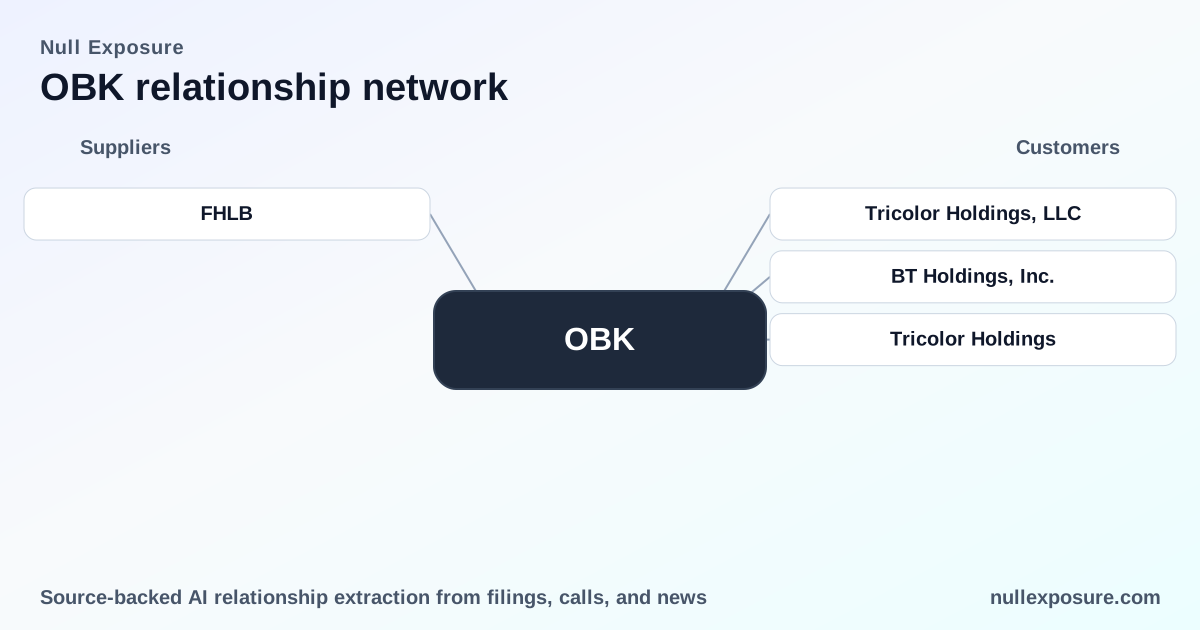
Tricolor Holdings, LLC — charged-off commitment
Origin reported a $1.1 million off‑balance‑sheet commitment tied to borrower fraud at Tricolor Holdings, LLC that was drawn during the quarter and charged off, reducing the carrying exposure but leaving open the potential for recovery. This position is disclosed in Origin’s FY2026 earnings release and the company has characterized ultimate recovery as likely but not booked. (Origin earnings release, GlobeNewswire, Jan 28, 2026.)
Tricolor Holdings — elevated prior-quarter losses now recognized
Prior quarters showed elevated losses tied to Tricolor Holdings that pushed net charge‑offs higher; those elevated losses have now been recognized and net charge‑offs fell to $3.17 million in the subsequent quarter as reported by market commentary. The disposal of that exposure reduced immediate credit drag on the margin profile. (Market commentary, SimplyWallStreet, March 2026.)
BT Holdings, Inc. — losses largely reserved
KBRA’s review notes modest adverse credit developments tied to BT Holdings, Inc., with most lending and legal losses already reserved for, indicating that the bank has front‑loaded provision coverage for much of the expected loss exposure related to BT Holdings. This reserving posture limits near‑term earnings volatility from that counterparty. (KBRA rating action, March 2026.)
Operating model characteristics drawn from public constraints
Origin’s public filings and disclosures convey a clear, relationship‑centric community bank operating model with several structural characteristics that matter for investors:
-
Contracting posture: long‑term assets. The commercial mortgage book is generally amortized over 20–30 years with typical five‑year balloons, signaling a loan portfolio with long contractual duration and periodic refinancing risk at balloon maturities rather than short‑term repricing. (Company filing excerpts, FY2024–FY2025.)
-
Counterparty mix: retail, small business, municipalities, and mid‑market. Deposits and credits are sourced from individuals, small and mid‑sized businesses, and municipalities, underlining the bank’s reliance on localized relationship banking rather than wholesale or institutional funding. This underpins stable deposit gathering but concentrates economic exposure in regional commercial and municipal cycles.
-
Geographic concentration: regional U.S. footprint. Operations are concentrated across Texas, Louisiana, Mississippi, South Alabama, and the Florida Panhandle, linking credit performance to regional real‑estate and oil & gas/cyclicality in those markets. Geographic concentration amplifies local economic cycles for a bank of this scale.
-
Materiality and central credit focus. The loan portfolio totaled $7.57 billion with an allowance for credit losses of $91.1 million; Origin identified valuation of qualitative factors in the ACL as a critical audit matter, highlighting that credit identification and valuation is central to financial statement integrity. This is a company‑level signal that credit loss estimation drives both earnings and audit focus.
-
Relationship role and maturity. Origin functions as both seller of banking services and a service provider—issuing letters of credit, lending, and deposit services—across mature, relationship‑driven customer relationships that tend to persist over time, which supports cross‑sell but also raises concentrated exposure to individual counterparty shocks.
-
Contingent exposure and internal limits. Commitments to extend credit aggregate to meaningful contingency dollars (~$1.67 billion in commitments across maturities), and internal single‑borrower in‑house lending limits range between $30–35 million, indicating both a capacity for sizeable credits and structured concentration controls.
-
Segment focus: community banking services. Management reports a single aggregated operating segment—community banking—making the firm’s fortunes closely tied to the health of local commercial real estate and small/mid‑market lending trends.
Before proceeding with transaction or portfolio decisions, review the bank’s latest financials and the KBRA commentary for the most recent reserve and capital posture. For a structured breakdown and ongoing monitoring, explore NullExposure.
Investment implications and risk summary
-
Earnings sensitivity: Charge‑offs tied to fraud and borrower litigation create episodic earnings hits; however, the bank’s reserving for the BT Holdings exposure and the charge‑off of the Tricolor item suggest management is containing near‑term earnings volatility. Investors should watch ACL coverage relative to nonperforming loans and loan growth.
-
Concentration risk: Regional geographic concentration and a heavy tilt to long‑term commercial mortgages create duration and regional cycle exposure. Balloon maturities introduce refinancing risk at five‑year horizons for a significant chunk of the book.
-
Counterparty diversity vs. local correlation: The mix of individuals, small business, municipalities, and mid‑market clients supports deposit stability and fee margins, yet these same counterparties are correlated to regional economic performance, amplifying downside in localized downturns.
-
Capital and governance signals: The explicit identification of ACL qualitative valuation as a critical audit matter directs investor attention to governance and credit discipline—an area where conservative provisioning and transparent disclosures reduce execution risk.
Bottom line for investors
Origin Bancorp’s model is classic community banking: relationship‑driven deposit gather, long‑dated lending, and localized underwriting. The recent Tricolor charge‑off and reserved BT Holdings exposure are discrete credit events already reflected in the company’s disclosures and third‑party credit commentary, not evidence of a broad underwriting collapse. Investors should monitor reserve adequacy, regional commercial real estate performance, and the cadence of charge‑offs against the bank’s stated in‑house limits and contingent commitments. For ongoing relationship and counterparty monitoring tailored to financial stakeholders, see the Origin profile and relationships at NullExposure.