Owens Corning (OC): Portfolio pruning accelerates cash conversion and simplifies go‑to‑market
Owens Corning sells fiberglass, roofing, insulation and doors worldwide and monetizes through manufacturing and channel sales to distributors, contractors, and retailers; the company is accelerating portfolio exits of capital‑intensive businesses in favor of higher cash conversion and simpler distribution economics. Recent transactions — notably the amended sale of its glass reinforcements business and the divestiture of several door distribution units — materially reshape OC’s customer and channel profile and reduce capital intensity. Learn more about how these strategic moves change customer risk and supplier dynamics at https://nullexposure.com/.
Big moves this quarter: what investors should know
Owens Corning’s recent disposals are not one‑off asset sales but part of a clear strategic tilt: shrink the capital footprint of Composites and Doors, redeploy proceeds to the core Roofing and Insulation franchises, and shorten the chain between manufacturing and final sales channels. These actions increase free cash flow potential and lower operating leverage, while shifting customer relationships toward distributors and resellers with more transactional, scale‑based economics.
Transactional relationships in the public record
Praana Group — sale of glass reinforcements business
Owens Corning amended and completed the sale of its glass reinforcements business to the Praana Group, converting negotiated seller‑financing into increased up‑front cash and removing seller notes to accelerate proceeds and risk transfer. According to JEC Composites (May 2026), the revised agreement reflects OC’s intention to exit more capital‑intensive composites operations and improve near‑term liquidity.
Metrie — acquisition of door distribution businesses
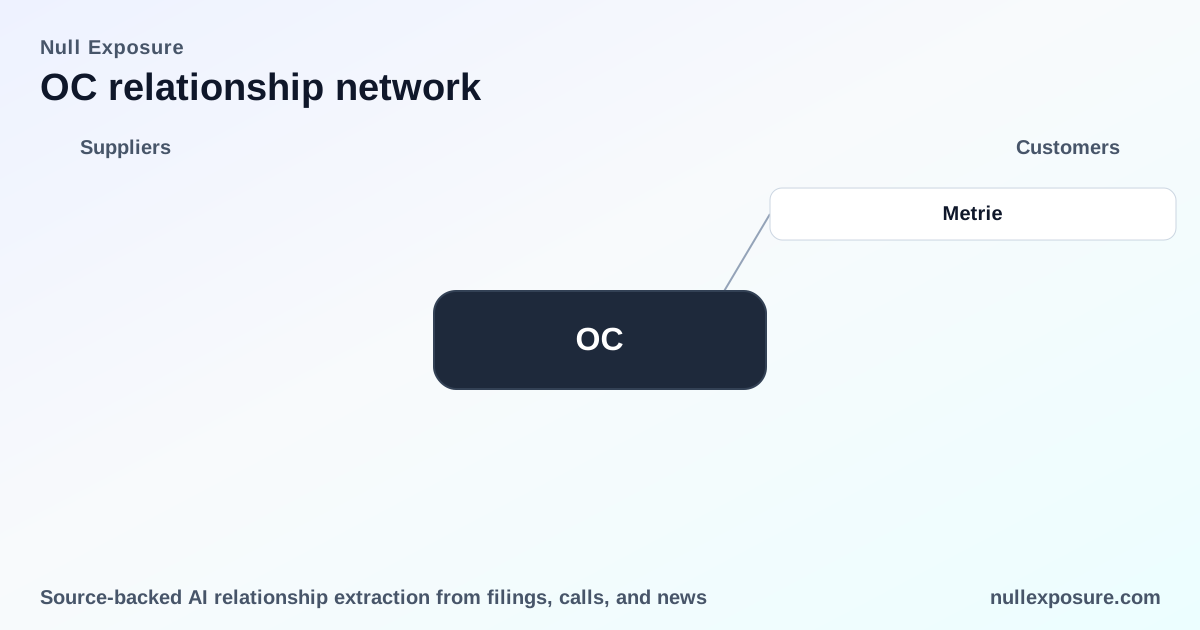
OC sold BWI Distribution, Louisiana Millwork, and Florida Made Door businesses to Metrie, North America’s largest millwork manufacturer and distributor, transferring regional distribution and reseller relationships to a specialist operator. Building‑Products (March 2026) reported the transaction as a consolidation of OC’s door distribution footprint into a dedicated millwork distributor, simplifying OC’s channel structure for Doors.
How these relationships change OC’s operating model
Owens Corning’s disclosures and the transactional evidence produce consistent company‑level signals about its operating posture:
- Geographic breadth is global but managed by segment. The firm sells across North America, EMEA, APAC and LATAM; operations and channel strategies are tailored by region and product line, which supports scale but requires localized distribution partnerships.
- Channel concentration towards distributors and resellers. OC sells shingles and roofing components primarily through distributors, home centers and lumberyards, and doors through wholesale and retail distribution — a channel mix that benefits from scale and long‑standing logistics relationships.
- Customer roles skew to transactional buyers rather than captive partners. Evidence shows OC sells to parts molders and fabricators and provides processed asphalt to other manufacturers and contractors, indicating customer relationships are largely B2B transactional with commercial pricing dynamics.
- Manufacturing orientation with targeted divestitures to reduce capital intensity. The company operates Roofing, Insulation, Doors and Composites segments; the recent Praana sale underlines a deliberate shift away from capital‑heavy composite manufacturing towards higher cash‑flow segments.
These signals imply a contracting posture that leans on standard commercial terms with distributors and resellers, lower single‑customer concentration risk following divestitures, and moderate criticality for remaining customers who rely on OC’s branded roofing and insulation inputs. The maturity of relationships is mixed: core Roofing and Insulation channels are long‑standing and stable, while recently divested assets were less aligned with OC’s long‑term capital priorities.
Why these transactions matter for investors
- Improved cash profile and lower capital intensity. The Praana deal increases up‑front cash proceeds and removes seller notes, directly improving liquidity and deleveraging prospects. The sale to Metrie removes regional distribution assets that historically required working capital and operational oversight.
- Channel simplification reduces execution risk. Shifting to distributors and specialist resellers concentrates execution through partners with scale, simplifying logistics and sales management, and providing a clearer lens on margins by segment.
- Earnings mix shifts toward predictable segments. Roofing and Insulation generate recurring demand tied to renovation and construction cycles; reducing exposure to bespoke composites manufacturing eliminates some cyclicality and large capex swings.
Risks and what to watch next
- Execution risk on redeployment of proceeds. The benefit to investors depends on how OC deploys cash — repurchases, debt reduction, or reinvestment into Roofing/Insulation each have different ROI and signaling implications.
- Market cyclicality remains. Roofing and Insulation are tied to housing and commercial construction cycles; geographic exposure across NA, EMEA, APAC and LATAM means macro divergence can still materially affect revenue profiles.
- Partner concentration dynamics. While divestitures reduce some concentration, the firm’s reliance on major distributors and home centers concentrates commercial exposure to a smaller set of channel partners, making distributor relationships strategically significant.
For a concise profile of the company’s strategic posture and customer relationships, see our overview at https://nullexposure.com/.
Bottom line for investors
Owens Corning is actively reshaping its customer universe by selling capital‑intensive assets and consolidating distribution into specialist partners. These steps increase cash conversion and reduce operational complexity while concentrating revenue into core, more predictable product segments. Investors should monitor capital allocation decisions and the evolution of distributor partnerships as the primary drivers of valuation re‑rating over the next 12–24 months.
Sources referenced in this commentary include JEC Composites (May 2026) and Building‑Products (March 2026), along with Owens Corning’s segment disclosures and public statements in FY2025–FY2026.