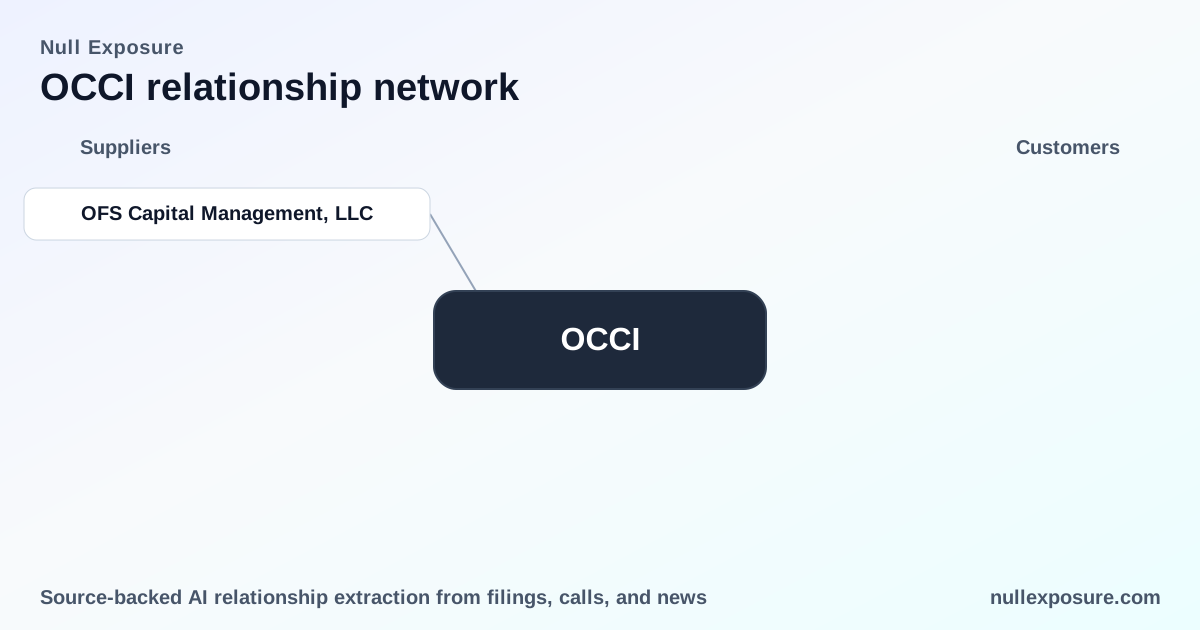
OFS Credit Company (OCCI): The customer relationships that shape a small BDC’s liquidity and counterparty profile
OFS Credit Company Inc (OCCI) operates as a business development company that monetizes by originating and buying middle‑market debt and selective equity positions, collecting yield and fees while seeking capital appreciation through portfolio valuation gains. The firm funds those positions through a blend of equity capital and structured financing — including repurchase funding against CLO securities — creating a business model that is sensitive to counterparty financing terms and short-term liquidity access. For operational and investment diligence, the single customer-style financing relationship disclosed in public coverage is a high‑signal item for evaluating OCCI’s funding reliability and counterparty concentration.
Explore complementary coverage at https://nullexposure.com/.
One concise relationship investors should know: Nomura repurchase agreement
- Nomura Securities International, Inc. — master repurchase agreement, $25 million (FY2025). According to a press release reported by Investing.com on May 3, 2026, OFS Credit entered into a Master Repurchase Agreement with Nomura Securities International for collateralized loan obligation (CLO) securities, establishing a $25 million repo facility against those assets (https://www.investing.com/news/company-news/ofs-credit-enters-25-million-repurchase-agreement-with-nomura-93CH-4332165).
This agreement provides secured short‑term financing against CLO holdings and directly links OCCI’s liquidity availability for those assets to a single large broker‑dealer counterparty.
Why that single relationship matters for investors
The disclosed Nomura repo is not a portfolio investment; it is a financing counterparty relationship that alters how investors should think about OCCI’s balance‑sheet flexibility and risk profile. Repurchase agreements against CLO securities are standard in leveraged credit management, but the practical implications are immediate:
- Contracting posture: The arrangement is a secured, collateralized borrowing line rather than an equity partnership — Nomura acts as a lender against specified CLO collateral under a Master Repurchase Agreement.
- Counterparty criticality: With the only publicly captured customer-style relationship involving a major broker‑dealer, Nomura’s credit terms, haircuts, and operational capacity materially influence OCCI’s ability to finance CLO positions.
- Maturity and roll risk: Repo facilities are typically short‑dated and rolled periodically; that structure makes OCCI exposed to funding‑market volatility and changes in dealer appetite for CLO collateral.
- Concentration signal: A single disclosed $25 million repo agreement is a notable funding link for a company with OCCI’s market capitalization and portfolio size — it signals a potential funding concentration that requires tracking across reporting periods.
How those characteristics sit within OCCI’s broader operating profile
OCCI is a small publicly listed BDC with a market cap around $93 million and a price‑to‑book ratio below 1 (book value $4.358; P/B ~0.589) as reported in the latest company data. The firm records negative trailing EPS and negative return on equity while reporting positive operating margins on a TTM basis, reflecting the typical BDC mix of interest income and mark‑to‑market portfolio results. These company‑level signals translate into operational constraints for investor analysis:
- Liquidity sensitivity: Small capitalization and negative EPS increase reliance on external financing and portfolio liquidity; secured repo lines are therefore functionally critical to meet funding and opportunity needs.
- Counterparty selection matters: With limited institutional ownership concentration and relatively low insider ownership, counterparty financing terms can be more determinative of short‑term NAV volatility than for larger, more diversified managers.
- Maturity profile is short and rolling: The repo instrument described is consistent with short‑term secured funding practices; investors must monitor rollover risk and potential margin calls against CLO collateral.
- No additional customer constraints were reported: The collected relationship data did not include other contractual limitations, exclusivity clauses, or named operational constraints; that absence is itself a signal to prioritize ongoing surveillance of financing relationships in subsequent filings.
Relationship-by-relationship drill (complete listing)
Nomura Securities International, Inc.
OFS Credit entered a Master Repurchase Agreement with Nomura for collateralized loan obligation securities, establishing a $25 million repo line that supplies secured financing against OCCI’s CLO positions; the transaction was disclosed via a press release reported May 3, 2026 (Investing.com: https://www.investing.com/news/company-news/ofs-credit-enters-25-million-repurchase-agreement-with-nomura-93CH-4332165).
Implication: This single counterparty financing arrangement is a direct lever on OCCI’s liquidity and margin exposure for CLO assets.
Investment checklist and risk map for equity and operations teams
- Counterparty risk: Track Nomura’s funding terms, haircuts, and margin call practices because they directly affect OCCI’s realized yields and potential forced sales of CLO instruments.
- Funding concentration: Monitor subsequent disclosures for additional repo counterparties or the expansion of the Nomura facility; diversification of funding reduces refinancing and roll risk.
- Asset liquidity and valuation: CLO securities are sensitive to credit cycles; repo counterparties will tighten haircuts in stress, amplifying volatility in NAV.
- Governance and transparency: Given OCCI’s small scale and the outsized effect of a single repo line, active disclosure of financing counterparties in periodic filings is a governance signal investors should prioritize.
- Valuation context: Price‑to‑book below 1 and negative ROE suggest market skepticism; confirm that financing arrangements are supportive of long‑term NAV recovery rather than short‑term leverage that increases downside risk.
For investors requiring systematic monitoring of OCCI’s counterparty network and financing commitments, see additional analysis at https://nullexposure.com/.
Bottom line
OCCI’s business model — yielding from middle‑market credit with tactical use of CLO financing — is fundamentally dependent on secured funding relationships. The public record captures a material $25 million repo with Nomura Securities International, which functions as both an enabler and a concentrated point of operational vulnerability. Investors and operators should treat disclosed repo counterparties as core elements of the firm’s risk profile, monitor roll and haircut dynamics, and insist on regular transparency about funding diversification and contingency liquidity plans.