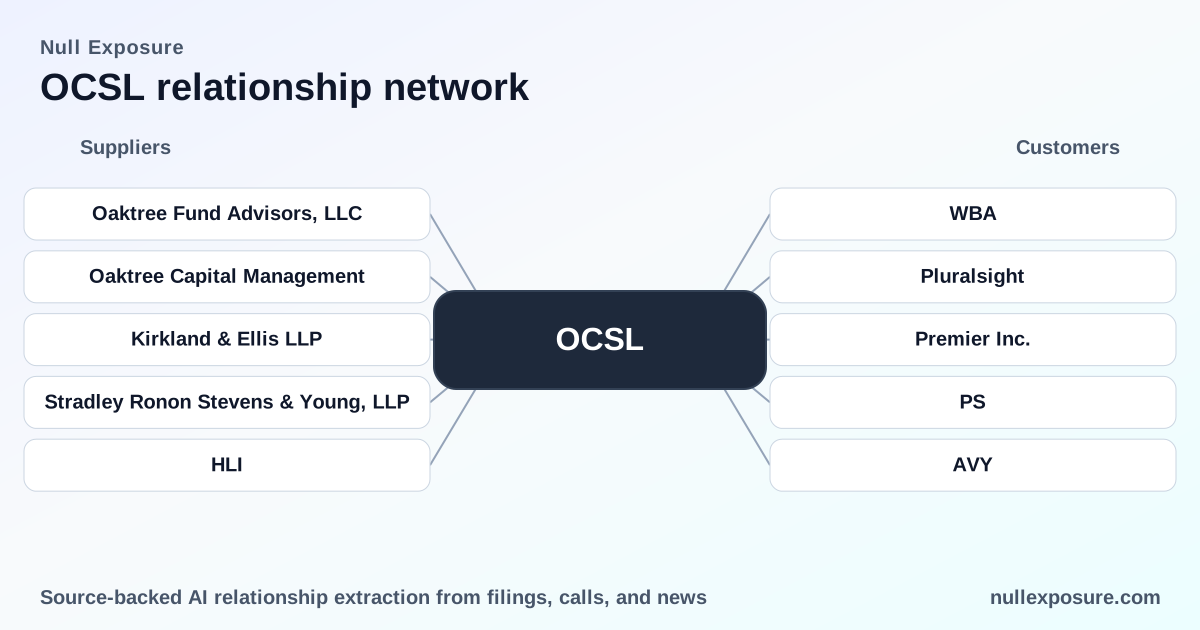
OCSL: A lender-first portfolio whose credit work-outs are driving near-term performance
Oaktree Specialty Lending Corp (OCSL) operates as a publicly traded business development company that originates and acquires secured, often first‑lien debt to middle‑market and specialty borrowers, monetizing through contractual interest, fees and realized gains on workouts under the Oaktree platform. Returns are driven by yield on performing loans, credit recovery on troubled credits and selective equity upside—a mix that makes active credit management and restructuring capability the company’s operational heartbeat. Explore full coverage at https://nullexposure.com/.
What recent quarters reveal about how OCSL runs the business
OCSL’s public commentary and filings show a deliberate long‑duration lending posture to U.S. middle‑market borrowers, combined with active restructuring when credits deteriorate. Corporate disclosures and earnings commentary consistently emphasize U.S. originations and concentrated off‑balance sheet commitments, signaling geographic concentration in North America and material exposure size across selected credits. The firm’s operating model is characterized by:
- Contracting posture: Evidence points to multi‑year, first‑lien term structures on many portfolio positions, consistent with a long‑term lending playbook (Acquia referenced as a first‑lien term loan).
- Counterparty concentration: OCSL’s business centers on middle‑market borrowers, and its joint‑venture activity with partners like Kemper underscores co‑investment in senior secured loans.
- Sector mix: Holdings span software, infrastructure, distribution, healthcare services and manufacturing, which imposes cross‑sector credit risk but allows diversification within a concentrated middle‑market strategy.
- Maturity and liquidity signals: Large unfunded commitments—reported at $286 million as of September 30, 2025—show ongoing capital deployment and potential near‑term funding needs tied to portfolio growth.
These operating characteristics establish credit selection and workout execution as the single most important driver of NAV and dividend sustainability for OCSL.
Portfolio relationships to watch (each result from the record)
Pluralsight — transcript note (InsiderMonkey, March 10, 2026)
OCSL disclosed that Pluralsight was the largest detractor in the portfolio, with the equity position marked to zero and a follow‑on term loan written down to reflect impairment. According to the InsiderMonkey earnings transcript (FY2026), the company assigned no residual equity value to that investment.
Pluralsight — Globe and Mail recap (March 10, 2026)
The Globe and Mail also highlighted Pluralsight as the single‑largest detractor in the quarter, reinforcing that the Pluralsight exposure materially dragged returns during the period and required write‑downs.
Pluralsight — Investing.com earnings transcript excerpt (May 3, 2026)
Investing.com’s transcript reiterates OCSL’s commentary that Pluralsight materially pressured results in FY2026, confirming the company’s public acknowledgment across multiple outlets.
Walgreens Boots Alliance / WBA — Q4 2025 earnings call (March 7, 2026)
OCSL identified Walgreens Boots Alliance as a notable investment during the quarter, positioning WBA as a large, integrated healthcare/pharmacy borrower within the portfolio, according to the Q4 2025 earnings call (March 7, 2026).
Premier Inc. — InsiderMonkey earnings recap (March 10, 2026)
Management highlighted an investment in Premier Inc., a healthcare services group purchasing organization, as a transaction to note during FY2026, signaling exposure to institutional healthcare procurement dynamics (InsiderMonkey transcript).
Premier, Inc. — Investing.com transcript (May 3, 2026)
The Investing.com earnings transcript also references the Premier Inc. investment, underlining that OCSL has exposure to healthcare services through this position and flagged it in quarterly remarks.
Avery / AVY — restructuring disclosure (InsiderMonkey, March 10, 2026)
OCSL described restructuring activity on its Avery position and placing a portion of the loan back on accrual, reflecting successful workout mechanics that converted non‑earning pieces into income‑producing assets (InsiderMonkey FY2026 call excerpt).
Avery / AVY — Globe and Mail recap (March 10, 2026)
The Globe and Mail noted management’s active workout and restructuring efforts including Avery, corroborating the company’s focus on returning impaired positions to accrual status through negotiated solutions.
AVY — Investing.com transcript (May 3, 2026)
Investing.com’s transcript repeats the Avery restructuring language, confirming that Avery’s partial return to accrual status is a deliberate portfolio remediation outcome for FY2026.
Why these relationships matter for investors
OCSL’s quarterly narrative has two consistent themes: (1) single credits can materially move NAV and EPS when the company carries concentrated exposures, and (2) Oaktree’s restructuring capabilities actively recover value when credits deteriorate. Pluralsight’s full write‑down demonstrates downside concentration risk; Avery’s partial return to accrual demonstrates the upside of active work‑outs. Walgreens and Premier show that OCSL maintains sizable, investment‑grade style exposures to large corporate counterparts as well.
Key investment implications:
- Credit performance drives dividend sustainability. Interest and fee income lift yields when loans are accruing; write‑downs compress distributable earnings.
- Concentration risk is real. A single large detractor like Pluralsight can reduce near‑term earnings and NAV materially.
- Active restructuring is a value lever. Avery’s conversion back to accrual shows that recovery outcomes can offset losses elsewhere, provided senior secured positions and remedial bandwidth.
If you track OCSL as a capital allocator or potential partner, focus on quarterly portfolio detail, non‑performing loan roll rates, and the pipeline for converting unfunded commitments into performing assets. For deeper signal coverage and ongoing relationship tracking, visit https://nullexposure.com/.
Bottom line: risk‑adjusted return hinges on credit execution
OCSL is a credit‑first BDC where underwriting and workout execution determine value. Investors should price in higher yield potential against episodic NAV volatility from concentrated credits. Short‑term headwinds from impaired names have appeared in FY2026 results, while active recoveries have offset parts of that pressure. Monitor subsequent disclosures for movements in the large off‑balance commitments and any further reclassifications between non‑accrual and accrual status—these will be the clearest indicators of earnings normalization and dividend coverage going forward.