How Oil‑Dri’s customer footprint shapes risk and growth (ODC)
Oil‑Dri Corporation of America manufactures and sells absorbent products and animal‑health feed additives, monetizing through direct sales to retailers and wholesalers, long‑term manufacturing supply agreements, and international distribution partnerships that commercialize Amlan animal‑health products. The business combines high gross margins in specialty absorbents with channel exposure to a small set of material retail accounts and a distributed international partner model, creating a clear tradeoff between predictable domestic revenue and partner‑led growth overseas. For a consolidated look at partner activity and implications, see Null Exposure’s coverage: https://nullexposure.com/.
The investor case in one line
Oil‑Dri generates stable, cash‑generative product sales from a primarily North American commercial base while using distributor partnerships to accelerate Amlan’s international expansion—a low‑capex growth approach that concentrates counterparty risk at large retail customers.
What the customer map tells you as an investor
Oil‑Dri’s disclosures and recent press coverage collectively describe a company that combines short sales cycles and receivable recognition with a few durable commercial arrangements and geographically diverse channel partners.
- Contracting posture: Most customer obligations are short‑duration sales of finished goods (original duration one year or less), but the company also holds at least one explicit long‑term supply agreement for branded non‑clumping litters with A&M Products Manufacturing (a Clorox subsidiary). This mix means operating cash flows are largely transactional, with pockets of contractual stability supporting manufacturing scale.
- Concentration and criticality: Walmart accounts for a material share of revenue (approximately 19–20% of net sales in FY2025–2024), establishing a high‑impact buyer that defines short‑term revenue visibility.
- Channel maturity and role mix: Domestic retail and wholesale supply remains the core revenue engine; industrial and automotive sorbents travel through established distributor networks, while Amlan’s animal‑health growth follows distributor and commercial partner routes internationally.
- Geographic posture: Revenue is predominantly North American by dollar magnitude (domestic sales vastly exceed foreign subsidiaries in the most recent disclosure), but all cat litter products are marketed both domestically and internationally—creating exposure to global market opportunity with limited direct sales infrastructure.
- Ticket sizes: The company demonstrates a broad spend profile: some customer relationships are minor (example governance‑related customer sales of ~$0.4M in FY2025), while others (Walmart) are materially large.
Why those characteristics matter
The short‑term sales model yields rapid cash conversion but exposes the business to retail shelf dynamics and promotional activity; the long‑term manufacturing agreement with A&M provides stability for specific product lines and reduces volatility for that segment. Investors should value predictability from long contracts and scale advantages from large retail relationships against concentration risk and execution dependence on third‑party distributors.
Customer relationships in the headlines — concise takeaways
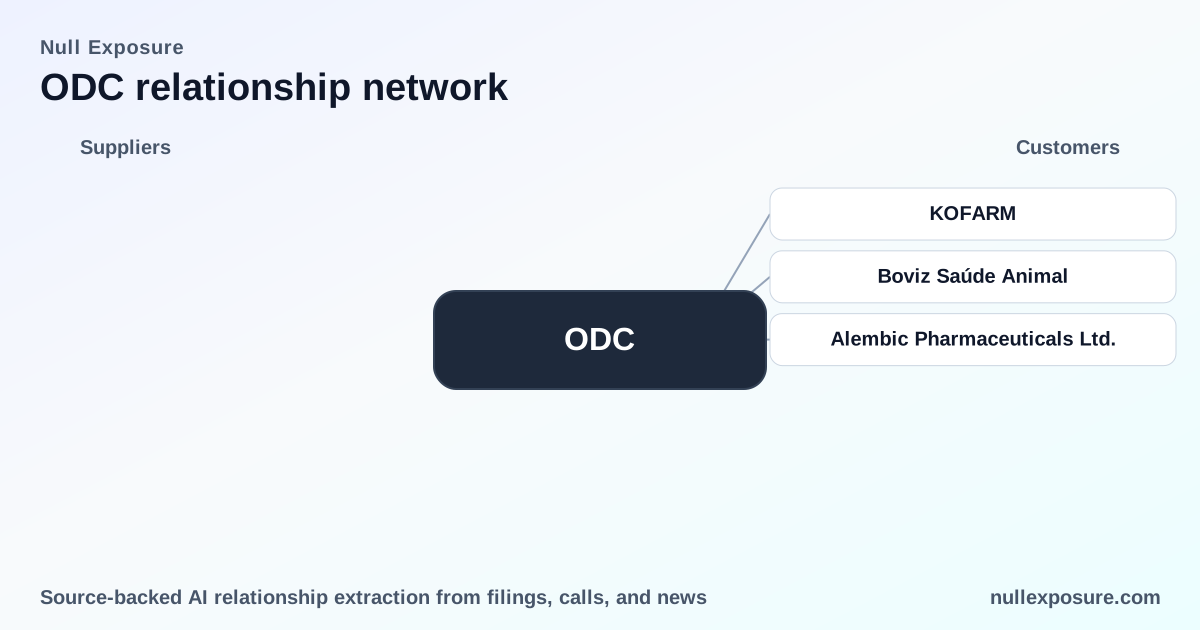
Below are the relationships surfaced in recent reporting with one‑ to two‑sentence summaries and source references.
-
KOFARM
Oil‑Dri’s animal‑health unit, Amlan, is deepening distribution ties in Mexico through KOFARM, which serves as a co‑sponsor and distribution partner at regional trade events and is presented as a key local distributor to support swine gut‑health commercialization. (GlobeNewswire press release, Feb 2, 2026 — https://www.globenewswire.com/news-release/2026/02/02/3230587/0/en/amlan-international-to-showcase-swine-gut-health-innovations-at-amvecaj-2026-in-partnership-with-kofarm.html; Ad-Hoc-News coverage, Mar 2026 — https://www.ad-hoc-news.de/boerse/news/ueberblick/oil-dri-shares-surge-on-strategic-expansion-in-animal-health/68558728) -
Boviz Saúde Animal
Amlan appointed Boviz as its distributor for feed‑additive technologies in Brazil’s cattle segment, positioning a local partner to penetrate Brazil’s large beef market through natural solutions for livestock producers. (TheCattleSite coverage, FY2025 — https://www.thecattlesite.com/news/amlan-expands-cattle-market-presence-in-brazil-through-partnership-with-boviz) -
Alembic Pharmaceuticals Ltd.
Amlan entered a commercial agreement with Alembic Pharmaceuticals to introduce poultry‑health solutions into India, leveraging Alembic’s market footprint to accelerate Amlan product adoption in South Asia. (Indian Pharma Post report, FY2025 — https://www.indianpharmapost.com/news/alembic-pharma-and-amlan-international-partner-to-advance-poultry-health-in-india-16938)
Operational constraints and what they signal about the business model
The company disclosures provide specific constraint signals that clarify how Oil‑Dri operates:
- Predominantly short sales cycles: Performance obligations generally arise from selling finished products to wholesalers, distributors and retailers with original durations of one year or less, reinforcing a transactional revenue base and near‑term cash conversion profile.
- At least one strategic long‑term manufacturing supply: Oil‑Dri maintains a long‑term supply agreement with A&M Products Manufacturing Company (Clorox) to manufacture branded non‑clumping litters, indicating selective contractually enforced stability for key product lines and production capacity utilization.
- Concentration in retail: Walmart represented about 19% of total net sales in FY2025, an explicit material customer that controls shelf placement and promotional economics—this is a revenue concentration risk and a lever for negotiating terms.
- Distributor dependence for industrial and animal channels: Industrial and automotive sorbents route through distribution networks, and Amlan’s international expansion relies on local distribution partners, which reduces direct selling cost but increases execution risk tied to partner performance.
- Domestic revenue scale with global reach: Domestic operations materially dominate sales dollars, while product lines are sold internationally—this structure supports steady domestic cash flows while leaving growth upside to partner‑led foreign expansion.
- Small‑account presence: Individual customers in the low‑hundreds of thousands of dollars exist alongside major accounts, indicating a mixed customer base with varied bargaining dynamics.
Investment implications and near‑term monitoring
Oil‑Dri’s profile is that of a specialty‑chemicals manufacturer with stable margins (gross profit ≈ $135.7M on $478.9M revenue TTM) and strong return on equity (≈20.7%), balanced against customer concentration and distributor execution risk. Key items for investors:
- Monitor Walmart revenue trajectory and contract terms given its outsized revenue share and impact on margins through promotional activity.
- Track Amlan distribution rollouts in Mexico, Brazil and India for incremental international revenue without heavy capex; distribution success will determine Amlan’s growth lift.
- Watch sourcing and input cost trends that drive gross margin given the transactional sales model and inventory dynamics.
- Verify renewal terms and duration for the A&M/Clorox supply agreement as that contract materially stabilizes a branded product line.
For a consolidated view of customer signaling and relationship flow, consult Null Exposure’s portal: https://nullexposure.com/.
Bottom line
Oil‑Dri offers a compelling combination of steady domestic cash generation and low‑capex international growth via distributor partnerships. Investors should value the company for its margin profile and contract anchors (notably the A&M supply agreement) while actively discounting concentration risk from large retail accounts and execution risk in partner markets. Continuous monitoring of distributor performance and large‑account sales is essential to assess upside from Amlan’s international expansion.