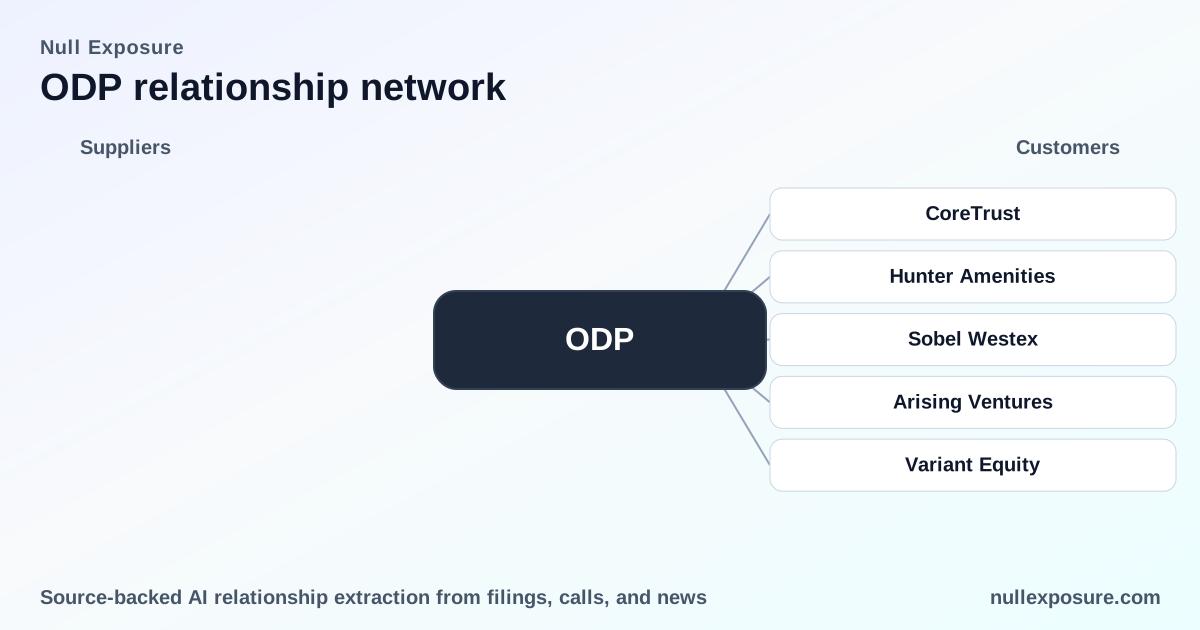
ODP Corp: Customer relationships that define a refocused B2B supplier
ODP Corporation operates a hybrid retail and business-services model, monetizing through office-supply sales, procurement services, and digital workplace solutions to small, medium and enterprise customers, supplemented by third‑party service partnerships and selective divestitures. Management has reoriented the company toward higher‑margin B2B channels, supply partnerships, and platform stakes rather than asset‑heavy retail expansion, creating a revenue mix that is service plus recurring procurement. For more context on ODP’s positioning and signals from its partner ecosystem, visit https://nullexposure.com/.
The strategic frame: why partner relationships matter to investors
ODP’s operating leverage now depends on two relationship vectors: supply/access partnerships that preserve product breadth and contractual terms, and services/technology alliances or divestitures that define where recurring margin lives. Recent filings and calls show management pursuing group purchasing relationships, hospitality and specialty suppliers, and monetizing non-core units. These moves signal a pivot to predictable contracting and platform-style revenue mix without abandoning retail distribution.
Quick takeaways for investors
- Diversified supplier network but concentrated strategic engagements: ODP leverages both large group purchasing organizations and specialty suppliers to maintain assortments for business customers.
- Active portfolio pruning: Sales of IT services and strategic stakes indicate capital redeployment to core procurement and workplace services.
- Distribution utility preserved: Third‑party services use Office Depot locations as channel reach (e.g., third‑party enrollment partners), preserving retail real estate value for B2B activation.
How each named relationship contributes to the picture
Below are the relationships identified in the record, each with a concise description and source reference.
CoreTrust
ODP publicly highlighted a new relationship with CoreTrust, a group purchasing collective with over 3,500 enterprise members, positioning ODP to win scale-driven procurement contracts and cross‑sell workplace services to that member base. This was announced on ODP’s 2025 Q2 earnings call.
Hunter Amenities
ODP disclosed supply agreements with Hunter Amenities to secure premium hospitality products, signaling deliberate sourcing for hospitality and facility customers who demand branded amenity items. Management noted this arrangement on the 2025 Q2 earnings call.
Sobel Westex
Sobel Westex is listed among newly established supplier agreements for premium hospitality and textile products, reinforcing ODP’s strategy to supply vertical markets (hospitality and facilities) via curated supplier relationships. This was referenced on ODP’s 2025 Q2 earnings call.
Telos Corporation (TLS) — Yahoo Finance / TSA PreCheck listing
Telos’ public release and coverage identified Office Depot locations as enrollment sites for TSA PreCheck, indicating that third‑party service providers leverage ODP retail footprint to deliver consumer and identity services. A Yahoo Finance report (FY2024) listed OfficeMax addresses among Telos enrollment locations.
Staples (competitive / M&A interest) — RetailDive (FY2022)
Multiple RetailDive articles from FY2022 documented interest from Staples and its owner Sycamore Partners in acquiring parts or all of ODP, showing how ODP’s retail and consumer assets attracted strategic buyers and shaped management’s divestiture discussions. RetailDive covered these interactions and the evolving sale/spinoff deliberations.
Arising Ventures — Varis sale (FY2025)
Industry reporting notes ODP sold Varis, its procurement technology and services platform, to Arising Ventures in October 2024 while retaining a 19.9% stake, signaling a partial exit that preserves strategic upside and shows a move to monetize non-core tech assets. This sale was reported by MDM in FY2025.
Sycamore Partners — reported engagement (FY2022)
Sycamore Partners — the private equity owner associated with Staples — featured in FY2022 reporting as a party in ongoing conversations about ODP’s strategic alternatives, underlining the regulatory and value calculus management faced while considering sales or splits. RetailDive documented ODP’s comment on remaining in conversation with Sycamore.
Variant Equity — CompuCom divestiture (FY2021 / FY2022 reporting)
Press coverage shows ODP divested CompuCom, its managed‑services unit, to private equity buyers such as Variant Equity (and affiliates), reflecting a corporate choice to exit lower‑return, capital‑intensive IT services and redeploy proceeds elsewhere. ChannelE2E and HomePageNews reported on the Variant Equity transaction (FY2021/FY2022).
Variac Equity Advisors — CompuCom sale reporting (FY2022)
CRN’s FY2022 reporting covered ODP’s sale of CompuCom to an affiliate of Variac Equity Advisors for up to $305 million, documenting the mechanics and the valuation gap versus the company’s 2017 acquisition price and underscoring portfolio rationalization.
Telos Corporation (TLS) — GlobeNewswire FY2025
A GlobeNewswire release in FY2025 noted Telos expanded TSA PreCheck enrollment to Office Depot and OfficeMax stores nationwide, confirming an ongoing commercial arrangement that leverages ODP’s bricks‑and‑mortar footprint for partner service distribution.
Telos Corporation (TLS) — GlobeNewswire FY2026
A separate GlobeNewswire announcement in FY2026 reiterated Telos’ use of roughly 500 Office Depot/OfficeMax stores for enrollment services, reinforcing the recurring nature of third‑party channel relationships for consumer and small‑business foot traffic.
Staples — additional RetailDive coverage (FY2022)
RetailDive’s subsequent FY2022 articles revisited Staples’ interest in ODP’s consumer business and the possibility of a $1 billion acquisition, repeating the theme that ODP’s retail assets attracted strategic buyer interest and influenced management’s capital allocation path.
What the relationship set implies about ODP’s operating posture
- Contracting posture: ODP is executing short‑ to medium‑term supply agreements and channel partnerships rather than long, asset‑heavy commitments; contracts skew to supplier agreements and channel licensing that preserve flexibility.
- Concentration: The relationship panorama shows diversified supplier and partner counterparts across hospitality suppliers, group purchasing networks and service providers, reducing single‑counterparty concentration risk while creating several strategic dependencies.
- Criticality: For partners like Telos, Office Depot’s physical footprint is functionally critical as a distribution node; for suppliers, ODP is a major channel but not exclusively critical given supplier portfolios.
- Maturity: The mix includes legacy supplier ties and more recent platform divestitures, indicating a mix of established and evolving relationships—mature retail channel partnerships plus active portfolio reconfiguration.
Investment implications and risk checklist
- Upside drivers: Higher margins from B2B procurement and platform monetization; recurring service revenue via partner channels; proceeds from non‑core divestitures.
- Key risks: Competitive pressure from Staples and private equity interest could compress strategic optionality; reliance on third‑party partners to monetize physical stores introduces operational dependency; supply agreements must hold cost and availability advantages to sustain margin.
- Watch points: Renewal terms for group purchasing arrangements, pace of platform stake monetization, and execution on channel partnerships that drive recurring service income.
For a concise investor briefing and additional signal aggregation on ODP and comparable corporate partner exposure, visit the research hub at https://nullexposure.com/.
Bold conclusion: ODP is trading its legacy retail narrative for a services‑and‑procurement identity — partner relationships are the lever that will determine margin recovery and valuation rerating.