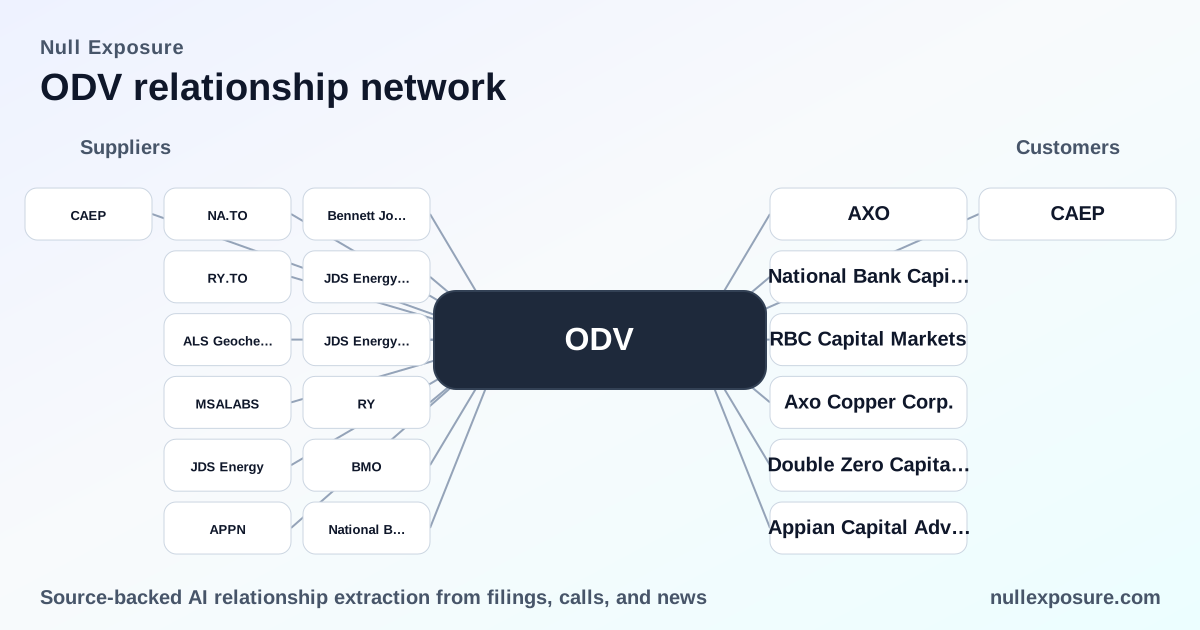
Osisko Development (ODV): Capital partners, buyers and the financing arc that matters for reserve conversion
Osisko Development operates as a gold-focused developer that monetizes assets through staged project advancement and selective disposals while funding reserve-conversion and mine planning via equity markets. The company advances its flagship Cariboo project through reserve-drilling funded by capital raises and strategic asset sales, and it retains structural insider and institutional backing that shapes near-term financing flexibility. For investors, the mix of bought-deal underwriters, a strategic asset sale, insider participation and ETF inclusion sets the framework for valuation re-rating and execution risk over the next 12–24 months.
Explore a deeper look at the counterparties and what they reveal about Osisko’s funding and commercialization path at https://nullexposure.com/.
Capital markets partners: bought-deal underwriters and their role in the plan
Osisko executed a bought-deal equity financing to accelerate reserve conversion at Cariboo; the underwriting syndicate is the immediate counterparty that determines access to capital and execution certainty.
-
National Bank Capital Markets
Osisko contracted National Bank Capital Markets as a co-lead underwriter on a US$125.0 million bought-deal offering that placed 35,311,000 shares at US$3.54 to fund Cariboo reserve conversion and mine-plan integration. (IRW-Press announcement, March 10, 2026). -
RBC Capital Markets
RBC acted as a co-lead underwriter alongside National Bank and Cantor in the same bought-deal, providing institutional distribution capacity that underpinned the financing’s scale and syndication. (IRW-Press announcement, March 10, 2026). -
Cantor (CAEP)
Cantor (listed in filings as CAEP in some reports) served as co-lead underwriter and co-bookrunner in the bought-deal, completing the three-way co-lead structure that delivered the company’s US$125.0 million base offering. (IRW-Press announcement, March 10, 2026).
Asset monetization: the San Antonio disposal and strategic equity received
Osisko monetized a non-core Mexican asset and received equity in the buyer, a transaction that both reduces project exposure and creates a new counterparty stake.
-
Axo Copper Corp. / AXO / Axo
Osisko completed the sale of its 100% interest in the San Antonio Gold Project to Axo Copper, receiving Axo common shares as consideration and taking a near-10% stake, thereby converting an illiquid project holding into liquid securities and a strategic equity position tied to the buyer’s success. (Osisko press release / GlobeNewswire, January 28, 2026; multiple market reports in March–May 2026).According to filings and coverage in FY2026, the transaction closed via the sale of Sapuchi Minera S. de R.L. de C.V., legally transferring the San Antonio project to Axo and establishing a cross-shareholding that aligns incentives between seller and buyer. (GlobeNewswire, January 28, 2026).
Insider and institutional financing behavior: pre-emptive buys and warrant exercises
Insider and affiliated funds increased committed capital during the financing window, signaling support for the company’s reserve-first pathway.
-
Double Zero Capital LP
Double Zero, identified as an insider under the investor rights agreement, exercised pre-emptive rights in the bought-deal and purchased 8,080,000 common shares at US$3.54 for gross proceeds of roughly US$28.6 million, demonstrating concentrated insider follow-on participation. (GlobeNewswire bought-deal close, February 3, 2026). -
Appian Capital Advisory Limited (funds advised by Appian)
Funds advised by Appian exercised 5,625,031 warrants, generating approximately C$24.9 million of proceeds to Osisko and converting a warrant exposure into direct equity ownership. (GlobeNewswire announcement on warrant exercise, March 9, 2026).
Passive-holder dynamics: index flows and ETF inclusion
Inclusion in passive indices triggers mechanical flows that can be material to liquidity and short-term demand.
- VanEck Junior Gold Miners ETF (GDXJ)
Osisko Development was confirmed for addition to the VanEck Junior Gold Miners ETF, which creates automated buying from passive funds tracking the benchmark and adds a sustained liquidity channel for the stock. (Ad-hoc-news coverage, May 3, 2026).
What the counterparty map tells investors about Osisko’s business model and operating posture
Taken together, these relationships outline a clear company operating model: proactive capital markets reliance, active non-core asset monetization, insider-aligned financing, and nascent passive-fund demand. Several business-model characteristics follow directly from the observed counterparties and transactions:
-
Contracting posture — Osisko demonstrates an offensive financing posture: it raised US$125 million through a bought-deal and simultaneously monetized a peripheral asset, indicating preference for equity capital over incremental debt at its current stage. The bought-deal structure and insider pre-emptive participation emphasize execution certainty over pricing alone.
-
Concentration and counterparty mix — The underwriter syndicate is diversified across major Canadian and U.S. brokers, reducing distribution concentration risk; however, insider concentration is meaningful (Double Zero’s participation and the company’s ~27.6% insider ownership) and will influence future equity actions. (Company ownership metrics, latest quarter FY2025).
-
Criticality of relationships — The Axo transaction converts a project liability into an equity stake in a single acquirer, creating cross-holding exposure that is potentially critical if Axo’s shares become material to Osisko’s balance sheet or liquidity profile. Simultaneously, ETF inclusion establishes a non-discretionary buyer that supports liquidity and price stability.
-
Maturity and execution stage — The counterparties and the nature of the transactions signal a company in advanced development rather than early exploration: reserve-conversion drilling is active, the firm is integrating mine planning, and it is funding that activity through equity markets rather than project finance. This maturity reduces certain technical execution unknowns but increases capital intensity and dependence on market windows.
No explicit operational constraints were flagged in the available relationship data set; as a company-level signal, that absence aligns with Osisko’s demonstrated ability to execute financings and disposals in FY2026 without disclosed contractual bottlenecks.
Key takeaways for investors
- Equity-financed reserve conversion: The US$125 million bought-deal plus insider participation funds the next development phase and materially lowers short-term funding risk relative to an unfunded program.
- Non-core asset monetization: The San Antonio sale both funds development and creates an equity exposure to Axo that could be monetized or retained strategically.
- Passive and institutional demand: GDXJ inclusion and institutional exercises (Appian) create durable buyer channels and improve secondary-market liquidity.
- Insider influence remains high: With roughly 27.6% insider ownership and active insider purchases during the financing, strategic decisions will reflect significant insider alignment.
For investors and operators evaluating ODV customer and counterparty exposure, the current map shows balanced market access with concentrated insider alignment and a deliberate shift from asset-holding to capital-efficient project advancement.
Learn more about comparable relationship analytics and market implications at https://nullexposure.com/.