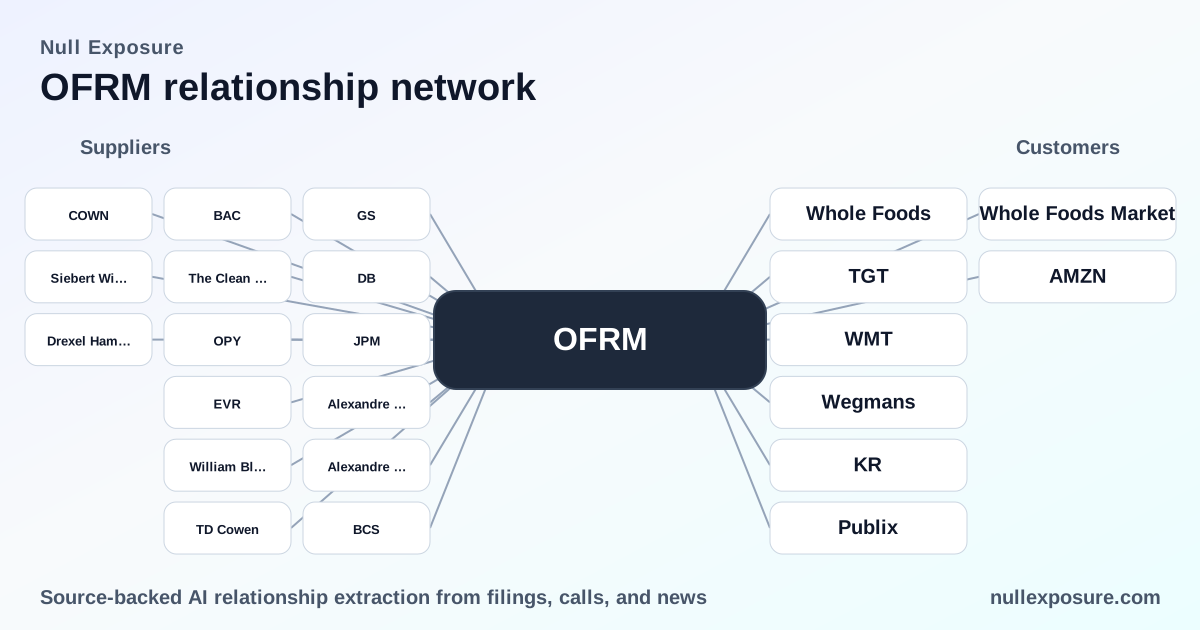
Once Upon a Farm (OFRM) — Retail relationships that define the go‑to‑market
Once Upon a Farm sells organic baby food pouches, meals, snacks and a growing set of chilled dairy SKUs through a retail-first distribution model and a smaller direct channel; the company monetizes by selling branded CPG goods into national and regional grocery chains and by capturing higher-margin direct‑to‑consumer sales for brand control. About 90% of revenue flows through retail partners and roughly 10% is DTC, positioning OFRM as a branded supplier whose growth and margin trajectory are driven by retail shelf placements and merchandising terms. (See Fortune coverage on FY2024 sales mix.)
If you want a single place to revisit these relationship signals, visit https://nullexposure.com/ for context and archival access.
The commercial model in plain language
Once Upon a Farm operates like a typical emerging branded food company that leverages distribution partnerships with major grocers to scale sales quickly. Revenue concentration in retail channels increases the commercial importance of national grocery relationships while a modest DTC business gives the company product and pricing control for innovation and higher margins. The company’s public metrics—positive gross profit and negative net income in recent trailing figures—reflect a rollout phase where sales growth and national shelf expansion take priority over profitability.
No explicit contracting constraints were extracted in the data payload, so the following operating characteristics are company-level signals drawn from the customer relationship set and cited reporting:
- Contracting posture: Supplier to large retailers with standard vendor agreements and trade terms; negotiating leverage is governed by shelf economics and branded growth potential rather than proprietary distribution advantages.
- Concentration: Retailers account for the vast majority of sales, indicating revenue is concentrated across a set of large national and regional partners rather than fragmented wholesale channels.
- Criticality to partners: OFRM products are differentiated within the organic baby-food category, making the brand strategically relevant to retailers targeting young families and health-conscious shoppers.
- Maturity of relationships: Presence in multiple national chains implies established commercial relationships rather than very early pilots; those relationships are still evolving as new SKUs (e.g., A2 milk shakes) are introduced.
Retail partner map — where OFRM products are sold
Below I list every customer relationship referenced in the collected results, with a concise commercial summary and the reporting source for each.
Whole Foods / Whole Foods Market
Once Upon a Farm lists Whole Foods as a retail customer and has placed new chilled products through Whole Foods Market, including A2/A2 Whole Milk Shakes available online and at stores. According to a DairyFoods report on the company’s dairy expansion and Fortune coverage of the FY2024 sales mix, Whole Foods is a visible national partner for OFRM’s refrigerated SKUs. (DairyFoods, FY2024; Fortune, Feb 2024.)
Target (TGT)
Target is repeatedly cited as a national retail partner carrying OFRM products, representing a material national channel for packaged goods distribution and consumer visibility. Multiple news captures referenced Target as a retailer for OFRM in FY2026 commentary and earlier reporting on the company’s IPO coverage. (QuiverQuant forecast page; NYPost coverage, FY2026.)
Kroger (KR)
Kroger is listed among the principal grocery partners for OFRM, and Fortune’s FY2024 reporting explicitly names Kroger as a key retail channel that generates the bulk of the company’s retail revenue. Kroger’s scale gives OFRM broad national reach in conventional grocery aisles. (QuiverQuant; Fortune, FY2024.)
Walmart (WMT)
Walmart is identified as a national retail customer for OFRM products, contributing to mass‑market distribution and scale. Multiple news summaries and IPO reporting list Walmart alongside other major retailers in FY2026 mentions. (QuiverQuant; NYPost, FY2026.)
Publix
Publix is included among OFRM’s retail partners in the gathered reporting, representing regional grocery penetration in the Southeast that complements the company’s national chains. (QuiverQuant; mexc summary, FY2026.)
Wegmans
Wegmans appears in the retailer list and signals OFRM’s placement in high-service regional grocers that serve family-focused demographics. Presence in Wegmans supports category credibility among premium grocery shoppers. (QuiverQuant; mexc summary, FY2026.)
Carter’s (CRI)
Carter’s has entered partnership activity that references Once Upon a Farm in capsule collaborations; coverage highlights co‑branding and cross‑promotional initiatives targeted at young families, indicating OFRM’s brand is used in strategic retail and licensing tie‑ins beyond grocery shelf placement. (Simply Wall St articles referencing Carter’s capsule with Once Upon a Farm, FY2026.)
Amazon (AMZN)
Amazon—cited in reporting as the operator of Whole Foods and as an e‑commerce partner—appears in the company’s channel mix by way of retail distribution and online visibility; Fortune’s FY2024 note on retail revenue identifies Amazon/Whole Foods in the list of retailers driving the majority of non‑DTC sales. (Fortune, Feb 2024; QuiverQuant extracts.)
What this partner set implies for investors
- Retail dependence is the defining commercial risk and opportunity. The company’s sales mix—~90% retail, ~10% DTC—means margin and growth are tightly coupled to successful negotiations with a small set of large retailers that control shelf placement and promotional funding (Fortune, FY2024).
- National scale is largely achieved, but trade economics matter. Distribution across Target, Kroger, Walmart and Whole Foods provides broad reach and brand validation, but those relationships also bring promotional cadence and slotting pressure that compress margins during aggressive growth.
- Brand partnerships broaden the playbook. Collaborations such as the Carter’s capsule signal OFRM is monetizing brand equity outside pure grocery channels, which de‑risks exclusive reliance on trade‑driven velocity (Simply Wall St, FY2026).
- No extracted constraints to counterbalance these signals. The available relationship data contains no explicit contractual limitations or caveats; investors should interpret that as a neutral data point and pursue diligence on any category‑specific trade terms, promotional liabilities and retailer concentration metrics.
Key takeaways for portfolio and operations teams
- Presence in major national retailers (Target, Kroger, Walmart, Whole Foods) is a primary growth engine and a structural lever for scale. (Fortune; QuiverQuant; NYPost)
- About 10% of sales are DTC, providing a higher‑margin complement to retail distribution and a laboratory for product innovation. (Fortune, FY2024)
- Regional partners like Publix and Wegmans strengthen category credibility; co‑branding with non‑grocery partners (Carter’s) expands marketing channels. (QuiverQuant; Simply Wall St, FY2026)
- Active diligence is required on trade terms and promotional liabilities since the data does not include explicit contracting constraints; expect vendor agreements typical of branded CPG suppliers to large grocers.
For a consolidated view of these relationship signals and to track future updates, see https://nullexposure.com/.