OFS Capital: customer relationships that matter for credit and portfolio risk
OFS Capital Corp is a publicly traded business development company that originates and manages private debt and selective equity investments for U.S. middle‑market companies and monetizes through interest income, fees and realized gains on portfolio exits. Its operating model is direct lending with ancillary servicing responsibilities and concentrated, active portfolio management designed to produce risk‑adjusted cash returns for shareholders.
For investors evaluating OFS customer relationships, the practical implications are clear: credit selection and workout capability are the primary drivers of short‑term earnings and long‑term NAV, while contract roles (servicer, collateral agent, administrative agent relationships) determine control and recovery economics in stressed credits. Visit https://nullexposure.com/ for a concise marketplace view of such counterparty dynamics.
Business model and operating posture — what to watch
- Contracting posture: OFS operates primarily as a lender and servicer. Public disclosures show OFS regularly sits in administrative or servicer roles under credit agreements, giving it active influence over collateral control and enforcement mechanics.
- Concentration and criticality: The portfolio is concentrated by design toward middle‑market exposures; single credits that turn non‑accrual can materially affect quarterly performance even when they represent small shares of fair value. Active servicing and workout capability are therefore operationally critical.
- Maturity and strategy: OFS’s focus on middle‑market private debt implies loan terms and structures that require ongoing underwriting diligence and covenant monitoring; this is a mature, repeatable strategy for BDCs but one that depends on market liquidity and credit cycles.
Customer relationships on record
Below I cover every customer relationship flagged in the available results and summarize the takeaway for investor due diligence.
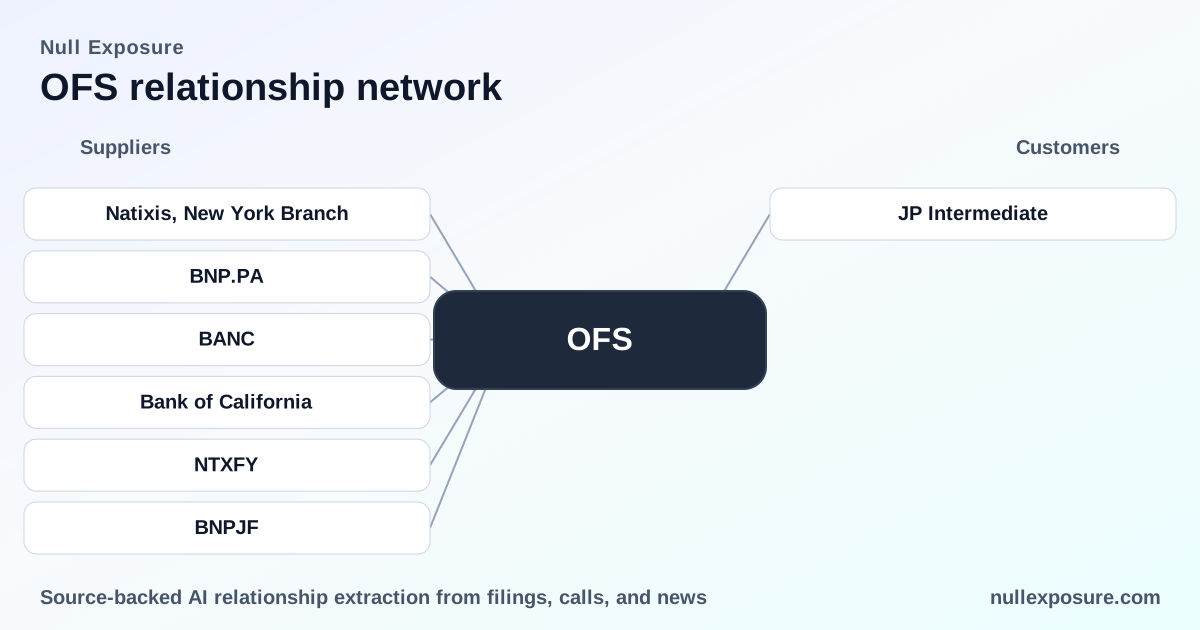
JP Intermediate JP Intermediate was disclosed as one new non‑accrual loan and was downgraded during the quarter, representing 0.6% of OFS’s total portfolio at fair value, indicating a small but real hit to accrual income and portfolio credit quality. According to an FY2024 earnings call transcript summarized by InsiderMonkey, OFS explicitly called out the JP Intermediate downgrade as a new non‑accrual position. Source: InsiderMonkey earnings call transcript coverage (reported March 2026) — https://www.insidermonkey.com/blog/ofs-capital-corporation-nasdaqofs-q3-2024-earnings-call-transcript-1384465/.
Company-level constraints and what they signal about counterparties The disclosures include three company‑level constraints that illuminate OFS’s counterparty mix and contractual posture:
- Middle‑market focus (counterparty_type = mid_market): OFS states that its investment strategy is concentrated on U.S. middle‑market companies, which confirms that counterparties are typically privately owned, lower‑liquidity borrowers where underwriting and active monitoring determine outcomes. This is a company‑level signal derived from OFS’s stated strategy.
- Geography = North America (geography_region = na): OFS’s investment mandate centers on U.S. borrowers, concentrating geographic credit risk domestically and tying portfolio performance to U.S. economic and monetary cycles.
- Relationship role = service_provider: Public documents include a Revolving Credit and Security Agreement that lists OFS Capital Corporation explicitly as servicer, alongside BNP Paribas as administrative agent and Citibank as collateral agent, dated June 20, 2019. That contractual posture gives OFS practical control over cash flow administration, borrower remediation and enforcement processes when a credit deteriorates — a material operational advantage for preserving recovery value.
What these constraints mean in practice
- Operational leverage: Acting as servicer increases OFS’s operational leverage in workouts and restructurings and reduces dependency on third‑party servicers for enforcement actions. That strengthens recoveries in stressed scenarios.
- Idiosyncratic credit risk: Middle‑market, U.S.-centric lending increases idiosyncratic risk exposure; individual problem credits like JP Intermediate can produce outsized earnings volatility relative to their portfolio weight.
- Concentration management is essential: The portfolio’s structure requires disciplined covenant enforcement and active monitoring to limit tail losses; the servicer role helps, but governance and underwriting quality remain primary controls.
Investment implications — risks and levers for upside
- Credit selection and monitoring determine NAV trajectory. Non‑accruals will depress distributable earnings and force markdowns; the JP Intermediate downgrade is a small but tangible example of this mechanism.
- Servicing rights are a tactical advantage in recoveries. Where OFS is servicer or has contractual control, it captures upside earlier in a workout and can limit loss severities compared with passive creditors.
- Concentration and shareholder structure matter. With meaningful insider ownership and modest institutional ownership, governance incentives and capital access during stress will influence OFS’s ability to hold or exit problem credits.
Key takeaway (bold for emphasis)
- OFS is a middle‑market direct lender that combines lending and servicing roles; credit performance of a limited number of borrowers drives near‑term earnings volatility, while its contractual servicer posture improves recovery economics on stressed credits.
Actionable next steps for analysts
- Review OFS’s most recent portfolio rollforward and non‑accrual disclosures in the quarterly filing to quantify trend momentum.
- Assess the scope of servicing and administrative rights across the top 20 credits to determine where OFS can influence recoveries.
- Monitor new non‑accrual additions (like JP Intermediate) for workout progression and any related collateral enforcement actions.
For a broader view of how counterparty contracting, concentration and control rights influence valuation and downside risk across BDCs, see the platform overview at https://nullexposure.com/.