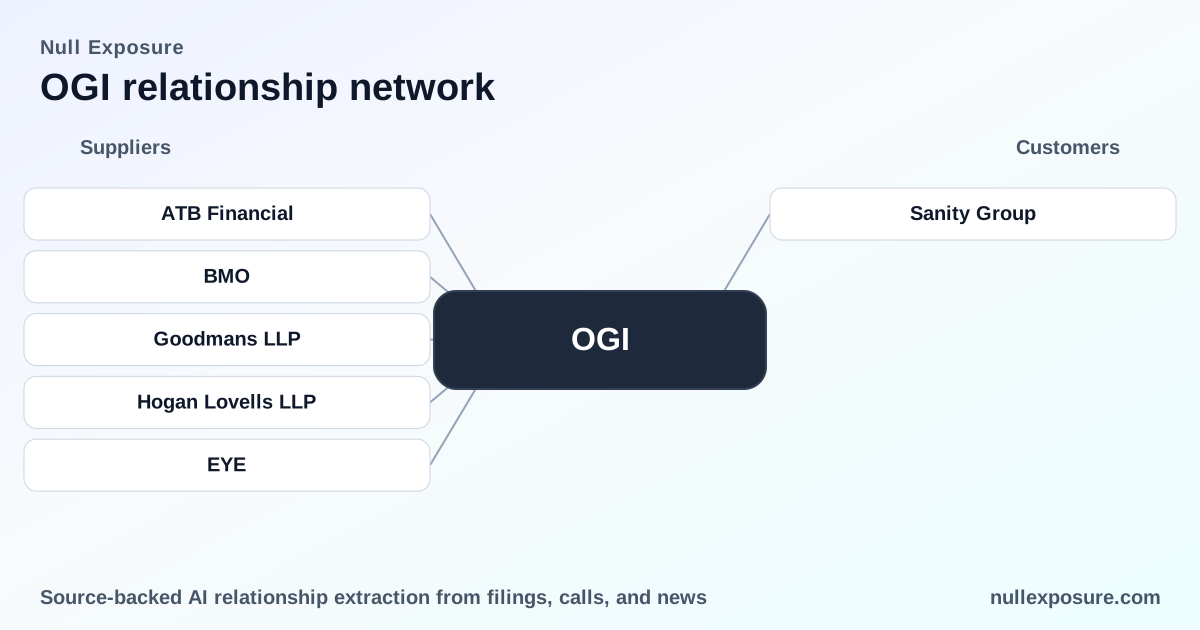
Organigram’s Customer Footprint: The Sanity Group Partnership and What It Means for Investors
Organigram Holdings Inc. operates as a Canadian cannabis producer that monetizes through branded product sales and wholesale supply agreements across domestic and international markets. The company converts cultivation and manufacturing capacity into revenue streams via direct sales to retailers, exports to regulated foreign markets, and strategic supply partnerships; Organigram’s reported trailing revenue of $279.99M and market capitalization around $195.5M reflect a small-cap operator with improving top-line momentum and a stated push into Europe. For a concise view of Organigram’s commercial relationships and how they translate to investor outcomes, visit https://nullexposure.com/.
One partnership stands out for European growth
Organigram’s customer disclosures and public commentary highlight a single recurring counterpart: Sanity Group, a Europe-focused cannabis operator. The relationship is both commercial and strategic: Organigram supplies product into Sanity’s German distribution network and has taken an equity position to deepen the alliance. This arrangement has been cited by management as a driver of growth in recent quarters, and by Sanity in its own corporate communications describing a supply agreement tied to their financing round.
Sanity Group — strategic European partner and investee
Organigram supplies cannabis product to Sanity Group and has an investment stake that formalizes a multi-year commercial supply arrangement; management cited this partnership as supporting growth in Germany and helping drive shipments into the U.K. and Australia. According to Organigram’s Q4 FY2025 earnings call transcript (March 2026), the company attributed recent growth to the Sanity partnership and flower shipments to the U.K. and Australia, and Sanity Group’s June 25, 2024 corporate release confirmed a new supply agreement tied to Sanity’s financing round. InsiderMonkey transcripts of Organigram’s Q4 2025 and Q1 2026 calls also note that Organigram sells product to Sanity and that Organigram holds an investment in the business.
Sources: Organigram Q4 FY2025 earnings call transcript (Mar 2026); Sanity Group press release (June 25, 2024); InsiderMonkey transcripts of OGI Q4 2025 and Q1 2026 earnings calls.
Why this single relationship matters to investors
- Geographic diversification: The Sanity Group link gives Organigram a commercial beachhead in Germany — a materially larger regulated market than Canada’s province-by-province retail base — and enables incremental shipments into the U.K. and Australia. Management has explicitly tied recent revenue growth to this channel, making it a visible driver of near-term sales.
- Commercial plus financial alignment: The dual role as supplier and minority investor converts a pure customer relationship into a strategic partnership. That alignment increases the incentive for long-term supply stability and product development geared to European market preferences.
- Concentration signal: While Organigram sells to multiple markets and customers, the prominence of Sanity in public commentary indicates a meaningful counterparty for European revenue. Investors should treat this as a concentration factor in geographic expansion scenarios; however, Organigram’s broader wholesale and retail channels continue to underpin its domestic revenue base.
Visit https://nullexposure.com/ for further relationship intelligence and institutional-grade summaries.
Operating model and business-model constraints (company-level signals)
With no formal constraint excerpts tagging specific counterparties, the following are company-level inferences about Organigram’s contracting posture, concentration, criticality, and maturity:
- Contracting posture — formal supply agreements govern international sales. Public statements and Sanity’s press release reference a negotiated supply agreement tied to financing, indicating Organigram operates under explicit contracts rather than ad hoc spot sales when moving product into regulated foreign markets.
- Concentration — moderate, geographically skewed. Organigram demonstrates reliance on a small set of commercial pathways for international growth; the Sanity relationship is a visible focal point for European expansion. Domestic retail channels remain diverse, but international revenue concentration could be higher while these partnerships scale.
- Criticality — strategic for market access. Partnerships that combine supply and equity create a higher level of criticality: losing such a partner would remove a consolidated route into Germany and hamper near-term EU expansion efforts.
- Maturity — partnership progressed from commercial supply to strategic investment. The relationship has evolved since 2023 and was reaffirmed with a supply agreement announced alongside Sanity’s financing in mid-2024, suggesting multi-year intent and increasing operational integration.
These signals affect underwriting of revenue durability, contract renewal risk, and the valuation multiple investors assign to Organigram’s international growth trajectory.
Risk profile and upside levers
- Key upside levers: Expansion of the Sanity channel across Germany, scaling of product assortments for EU regulatory requirements, and replication of the supplier-investor model in other jurisdictions. If Organigram converts the partnership into predictable recurring revenue, the company’s current EV/Revenue (~0.97) and EV/EBITDA (~35.5) multiples can decompress toward peer medians as scale improves.
- Primary risks: Regulatory complexity across Europe, counterparty concentration tied to a single strategic partner for EU access, and margin pressure as Organigram balances wholesale pricing with capital deployed into international logistics and marketing. Investors must monitor contract terms, pricing floors, and renewal mechanics.
- Financial posture context: Organigram shows a positive gross profit and a trailing profit margin of ~6.5%, but an operating margin that is negative on a trailing basis, underlining the importance of scaling revenue via high-utilization channels to achieve operating leverage.
Practical diligence checklist for research teams
- Obtain copies of the Sanity supply agreement and any related side letters to verify minimum volumes, pricing formulas, exclusivity, and termination rights.
- Track shipment flows and customs filings that corroborate management commentary on German, U.K., and Australian shipments.
- Monitor Sanity’s capital profile and commercial performance, since Organigram’s invested capital increases correlation between the two firms’ fortunes.
- Review Organigram’s regulatory filings and earnings transcripts for explicit guidance on expected renewal timelines, volume commitments, and price renegotiation windows.
Conclusion: a single commercial partnership with outsized strategic value
Organigram’s relationship with Sanity Group is both a revenue channel and a strategic lever for European market entry. Management has repeatedly credited the partnership with recent growth and Sanity’s own press materials confirm a supply agreement tied to a financing event. For investors, the key judgment is whether this partnership scales into predictable, margin-accretive revenue or remains a discrete channel with elevated counterparty concentration risk. For further coverage and deeper partner-level analysis, see https://nullexposure.com/.