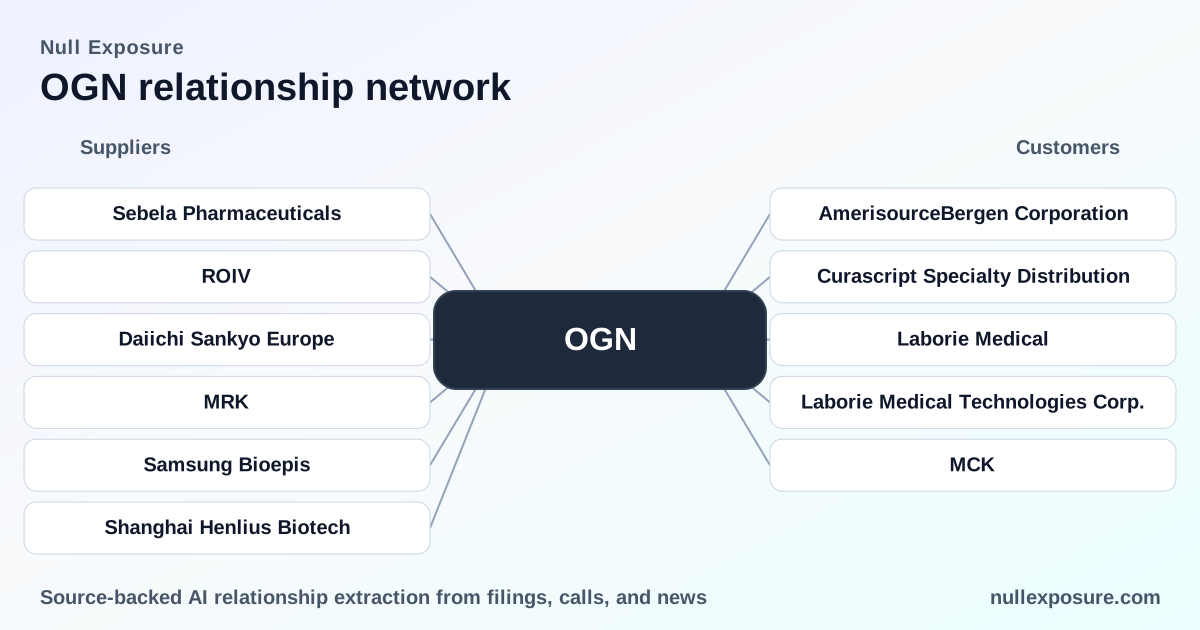
Organon & Co (OGN): Customer Map and Commercial Signals
Organon operates as a specialty pharmaceuticals manufacturer and seller focused on women's health, contraception, psychiatry, hormone replacement therapy and anesthesia, monetizing through product sales to wholesalers, hospitals, government agencies and managed care providers, plus contract manufacturing for third parties. Revenue flows are driven by broad distribution partnerships and a portfolio shift toward core biopharma assets, with non-core device divestitures used to sharpen capital allocation and reduce product complexity.
How Organon sells, and what that implies for investors
Organon runs a globally distributed, channel-dependent commercial model. The company reports that roughly 75% of 2024 revenues—about $4.8 billion—come from outside the U.S., demonstrating both international scale and exposure to cross-border reimbursement and supply chain dynamics (Organon 2024 filings). Organon sells primarily through drug wholesalers and retailers, hospitals, government agencies and managed-care intermediaries; it also performs third‑party contract manufacturing for firms such as Merck at six manufacturing sites.
- Contracting posture and concentration: The reliance on large wholesalers and distributors creates a negotiating dynamic where a small set of counterparties can influence payment terms and working capital. Organon discloses customer concentration risk in its 2024 10‑K, which investors should treat as a material commercial constraint on pricing flexibility.
- Criticality and maturity: Organon’s manufacturing relationships and long-term wholesaler channels reflect an established, mature operating model with recurring revenue characteristics, but also operational dependencies that make supply disruptions and contract renewals important risk vectors.
- Role diversity: Company filings categorize Organon simultaneously as seller, manufacturer and buyer within the healthcare value chain, which gives it multiple levers for margin management but also multiple points of counterparty exposure.
- Global footprint: A broad international footprint diversifies market risk but increases regulatory and payment complexity—both a growth vector and a margin pressure point.
If you want a single place to monitor counterparty-level intelligence on Organon’s commercial relationships, visit the NullExposure homepage for continuous updates: https://nullexposure.com/.
Customer relationships called out by filings and the press
Below are every relationship found in the provided results, presented as plain-English summaries with source references.
Curascript Specialty Distribution
Organon lists Curascript Specialty Distribution in its FY2024 10‑K as part of its customer concentration disclosures, signaling that specialty distribution channels are material to receivables and collections. According to Organon’s 2024 Form 10‑K, this relationship is recognized under customer concentration and accounts receivable reporting for FY2024.
AmerisourceBergen Corporation
AmerisourceBergen appears in Organon’s FY2024 10‑K within the company’s customer concentration notes, reflecting Organon’s reliance on large national wholesalers to distribute products and collect payment across channels. This is documented in Organon’s 2024 annual report disclosures.
Laborie Medical (TradingView / Moneycontrol report)
Media reports note Organon sold its postpartum haemorrhage device to Laborie Medical as part of a portfolio rationalization, consistent with Organon’s strategic refocus on core women's health biopharma and biosimilars. TradingView (citing Moneycontrol) reported this transaction activity in March 2026.
MCK (inferred symbol: MCK)
Organon’s FY2024 10‑K includes a reference to McKesson Corporation in the customer concentration and accounts receivable sections, indicating McKesson is a major distribution partner for Organon’s product flow and credit exposure for FY2024.
McKesson Corporation (duplicate 10‑K mention)
McKesson is again explicitly listed in the FY2024 filings, reinforcing the point that multiple large wholesalers—McKesson among them—feature as primary commercial conduits and material receivable counterparties for Organon in FY2024.
Laborie Medical Technologies Corp. (Zacks report)
Zacks and related press announced the completion of the divestiture of Organon’s JADA system to Laborie Medical Technologies Corp., confirming the company executed a sale of a non‑core device in early 2026 as part of strategic portfolio pruning (Zacks/press release, March 2026).
Laborie Medical (Whalesbook press)
Coverage in Whalesbook reiterated that Organon sold the JADA post‑partum haemorrhage system to Laborie for up to $465 million as part of its divestiture program, underscoring management’s use of asset sales to sharpen focus—reported March 2026.
Laborie (BioSpace press release)
Organon’s own quarterly release (BioSpace, May 2026) confirmed the January 2026 completion of the JADA system sale to Laborie, indicating the transaction closed and is reflected in Organon’s Q1 messaging and results.
Laborie Medical (Sahm Capital commentary)
Independent commentary noted the same JADA divestiture to Laborie and framed it as part of Organon’s repositioning within reproductive and postpartum health—reported February–March 2026 in market commentary.
Laborie Medical Technologies Corp. (Finviz item)
Finviz coverage summarized Organon’s finalization of the JADA sale to Laborie Medical Technologies Corp., corroborating multiple press sources that the divestiture took place in early 2026.
TFPM / Triple Flag Precious Metals Corp.
An outlier result references TFPM in the context of a transaction unrelated to Organon & Co (OGN) stock—this entry originates from a news item about Orogen Royalties (TSXV:OGN) and TFPM’s acquisition discussions (SimplyWall, May 2026). This is a cross‑ticker collision in news indexing and does not reflect a commercial relationship between Organon & Co. and Triple Flag.
Sun Pharmaceutical Industries
Market reports in April 2026 indicated Sun Pharmaceutical Industries was in advanced discussions to acquire Organon for approximately $10–12 billion, reflecting strategic interest from a large international buyer and potential forthcoming change of ownership (StocksToTrade/market reports, April 2026).
Grunenthal
Media coverage listed Grunenthal among parties reportedly expressing interest in Organon in that same April 2026 period, signaling competitive strategic interest from multiple pharmaceutical groups and private equity suitors (April 2026 news reports).
Commercial implications and investor takeaways
- Concentration and counterparty risk are real: Organon’s 2024 10‑K lists major wholesalers and distributors, making receivables and payment terms an active investor focus. Large distributor relationships compress pricing leverage and increase collections risk.
- Portfolio simplification in 2026 reduces product complexity: The JADA divestiture to Laborie crystallizes Organon’s pivot to core pharmaceutical assets and frees capital; multiple press sources confirm the sale closed in early 2026.
- M&A dynamics are active: Reported interest from Sun Pharma, Grunenthal and private equity groups transforms the strategic backdrop—potential change of control would alter distribution contracts, capital structure and long-term positioning.
- Watch global exposure and regulatory execution: With a majority of revenue generated outside the U.S., Organon’s earnings are sensitive to international reimbursement policies, FX and supply‑chain logistics.
For continuous tracking of Organon counterparty developments and to see how these relationships update over time, visit the NullExposure homepage: https://nullexposure.com/.
Bold, visible counterparties (McKesson, AmerisourceBergen, Laborie) and the corporate divestiture narrative are the primary commercial levers investors should monitor next quarter: collections, contract renewals, and any buyer-driven strategic changes will materially affect Organon’s cash flow profile and valuation.