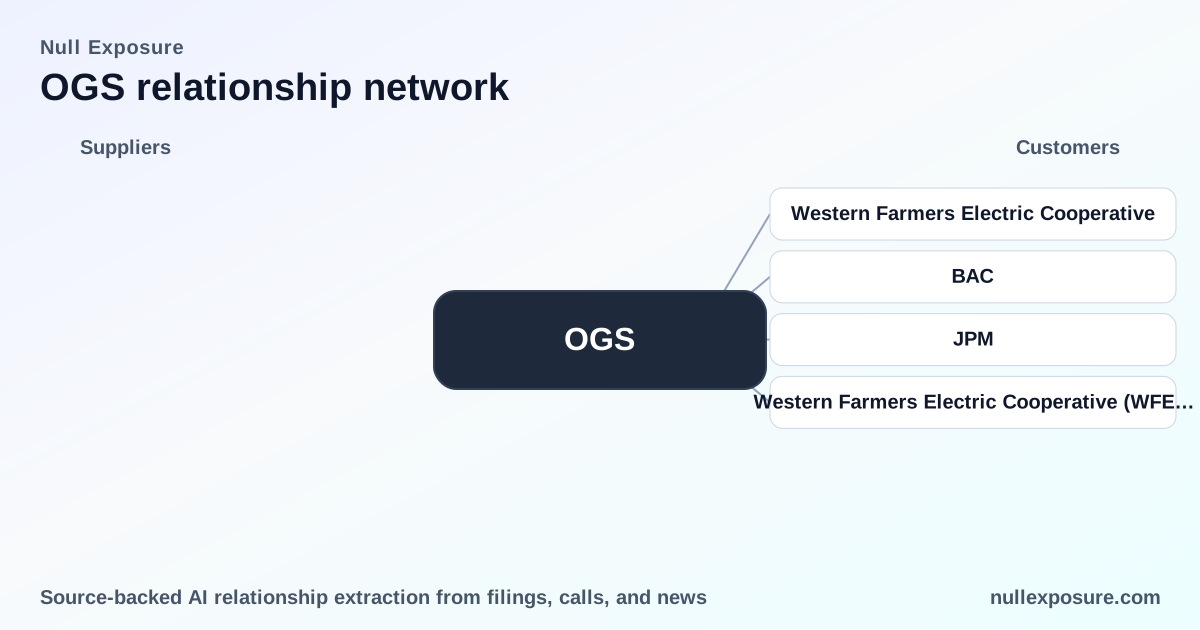
ONE Gas (OGS) customer relationships: where revenue, regulation and capital intersect
ONE Gas is a 100%-regulated natural gas distribution utility that monetizes through tariff-approved sales and transportation of gas to roughly 2.3 million customers across Oklahoma, Kansas and Texas. The company generates the bulk of its revenue from distribution services governed by regulatory frameworks, and recent disclosures show a mix of large strategic delivery agreements and capital-market settlements that directly affect near-term cash flow and share count. For a concise view of how customer deals and counterparty arrangements influence valuation, read on. For ongoing exposure and relationship intelligence, visit https://nullexposure.com/.
The operating model in plain English: regulated, recurring, capital intensive
ONE Gas operates as a regulated distribution utility: revenues arise from implied contracts created by tariffs and rates approved by regulators, not from freely negotiated commercial contracts. That contracting posture produces predictable billing mechanics and revenue recognition tied to delivery and regulatory mechanisms, which investors should value for stability.
Key company-level signals:
- Tariff-driven framework contracts: ONE Gas recognizes natural gas sales and transportation revenues under regulators’ tariffs, indicating long-duration, high-predictability cash flows rather than spot commercial sales.
- Regional concentration but diversified footprint: The company serves approximately 2.3 million customers across three states (Oklahoma, Kansas, Texas), which reduces credit concentration at the national level while preserving regional regulatory and weather exposure.
- Distribution is core and material: Natural gas distribution is the dominant segment; reported natural gas sales account for a large share of total revenues, confirming customer relationships are material to financials.
- Active service delivery: Revenues are recognized upon delivery; billing cycles and unbilled accruals are operational realities that affect working capital.
- Mature, regulated asset base: Long-lived pipeline and distribution assets are subject to regulatory lifecycle rules, including asset retirement obligations — this affirms capital intensity and multi-decade utility characteristics.
Together these characteristics define a business that is stable, capital-heavy, and dependent on regulated tariffs; customer relationships are simultaneously predictable and critical to capital planning.
The customer and counterparty relationships that matter
Below I cover each relationship cited in ONE Gas’ customer scope disclosures and press mentions. Each entry is a plain-English summary with the source noted.
Western Farmers Electric Cooperative (WFEC)
ONE Gas committed to build a major pipeline to serve WFEC’s Hugo Plant, with ONE Gas management stating during the Q4 2025 earnings call that the company will invest roughly $120 million to deliver more than 100 billion cubic feet annually to WFEC in southeastern Oklahoma. This project positions ONE Gas as a strategic service provider for regional power generation and increases contracted throughput on its new line (Q4 2025 earnings call, March 7, 2026). A local industry report also described the pipeline as a major Bennington–Hugo connector that will enable substantial annual deliveries (Pipeline Journal, March 2026), while a December 2025 press release cited a $160 million project cost in a regional dispatch; both figures highlight material capex associated with serving WFEC (OKEnergyToday, Dec 2025).
Bank of America (BAC)
ONE Gas agreed to issue 223,000 shares to Bank of America as part of settling forward-sale agreements by December 29, 2025, per a market notice reported on TradingView. This is a capital-markets settlement that reduces cash outflow but increases share count tied to prior equity hedging or share-forward arrangements (TradingView news, March 10, 2026).
JPMorgan Chase (JPM) / JPM
ONE Gas will issue 2,230,700 shares to JPMorgan Chase by December 29, 2025, in connection with settling forward-sale agreements, according to the same market report. This larger issuance is a near-term source of equity dilution related to prior financing/hedging structures and should be modeled into post-settlement share counts and EPS estimates (TradingView news, March 10, 2026).
Why these relationships change the investment calculus
The WFEC pipeline deal is an operational growth story: it converts capex into contracted throughput and incremental distribution revenue under regulated tariffs, strengthening ONE Gas’ position as a supplier to regional generation. The project is material in scale and directly ties customer demand (WFEC) to higher regulated asset base and future rate base recovery.
The Bank of America and JPMorgan Chase share issuances are capital-market events: settling forward-sale agreements through share delivery shifts capital structure and is effectively equity-financed settlement, which dilutes existing shareholders and reduces outstanding obligations without additional cash outflows. Investors should update share counts and consider short-term EPS pressure from these issuances.
Practical implications for valuation and risk
Treat these developments as a mix of operational upside and financing-driven dilution:
- Operational upside: The WFEC commitment supports higher throughput and potential rate-base growth; pipeline capex is recoverable under regulated frameworks and therefore supports long-term earnings stability. This is a revenue- and asset-base positive.
- Capital structure impact: The planned issuance of ~2.45 million shares combined (JPM + BAC) by year-end 2025 is dilutive and should be reflected in forward EPS and per-share metrics. The settlement structure suggests ONE Gas chose equity delivery over cash, preserving liquidity at the cost of dilution.
- Regulatory sensitivity: Because revenues depend on tariffs, any incremental assets or contracts require regulatory acknowledgment to fully convert capex into earnings — regulatory approval and timing are value drivers.
- Concentration and credit exposure: Serving 2.3 million customers across three states reduces single-counterparty credit concentration; however, large counterparties like WFEC are critical projects whose performance and off-take timing have outsized earnings impact.
A concise risk checklist investors should track:
- Regulatory decisions on rate-base recovery and tariff adjustments for the new pipeline.
- Timing of WFEC deliveries and any changes to projected capex (two press sources cite different cost figures).
- Precise accounting and timing of share issuances to JPM and BAC and their impact on diluted EPS.
- Weather and demand-seasonality that affect billed volumes and unbilled revenue accruals.
Bottom line for investors
ONE Gas is a classic regulated utility with predictable tariff-driven revenues, but near-term valuation depends on the execution of material capex projects and transparent capital-market settlements. The WFEC pipeline expands contracted throughput and supports a larger rate base, while the JPM and BAC share settlements are a financing decision with immediate dilution effects. Combine regulatory progress, capex-to-rate-base conversion, and post-settlement share counts into your model to arrive at a forward view of earnings and valuation. For a deeper look at counterparty exposures and how they feed into risk-adjusted cash flows, see https://nullexposure.com/.
Overall, these disclosures reinforce ONE Gas’ operational stability and capital intensity, and they create concrete near-term variables — project execution, regulatory outcomes, and share issuance — that will determine whether upside from infrastructure investment outweighs dilution from financing arrangements.