Omega Healthcare Investors (OHI): Customer relationships that drive cash flow — and the credit risks that can erode it
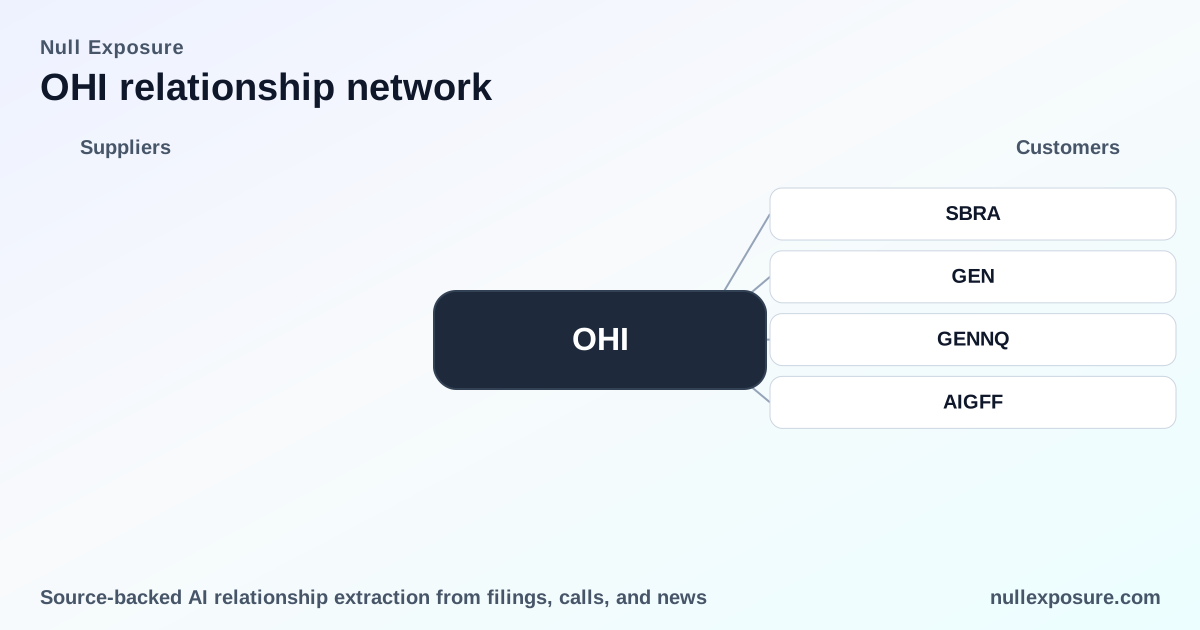
Omega Healthcare Investors is a specialized REIT that owns and finances long‑term healthcare real estate, monetizing primarily through long‑term triple‑net leases and real‑estate loans to operators of skilled nursing and assisted‑living facilities. Investors should value OHI as a finance and credit business as much as a landlord: rent and loan cash flows depend on operator solvency and reimbursement dynamics, and recent public commentary underscores both material exposure to operator distress and active asset‑level solutions. For a focused operator‑counterparty view, dive into the relationship map below — or visit https://nullexposure.com/ for the underlying evidence and monitoring tools.
How Omega’s customer model actually works — concise investor takeaways
Omega’s commercial posture is contractually durable: the company’s leases and loans are structured as long‑term, typically 5–15 year triple‑net agreements, which transfers operating cost and reimbursement risk to operators while securing predictable contractual rent. Geographic diversification spans North America and parts of EMEA (notably the U.K. and Canada), but the business is fundamentally a financing platform: ongoing returns depend on operator liquidity, Medicaid/Medicare funding stability, and asset‑level workout outcomes. Filings also show sizable remaining capital commitments and a core product focus on long‑term care real estate rather than short‑term services.
- Contracting posture: Long‑term, triple‑net leases (5–15 year terms).
- Geography: Primarily North America with select U.K./Jersey exposure.
- Critical risk: Operator credit and reimbursement policy are material to cash flows.
- Capital posture: Sizeable remaining commitments consistent with active portfolio management.
Where to look next
For investors tracking covenant events, lease‑assumption deals, or operator bankruptcy outcomes, having a live vantage point on counterparties pays off; learn more at https://nullexposure.com/.
Relationship inventory: every named counterparty called out in recent coverage
Below I list each counterparty referenced in the collected sources and the practical implication for OHI investors, with source attributions.
101 West State Street
Omega expects 101 West State Street to assume the Genesis master lease, and Omega indicated that the debtor consideration will extinguish its DIP and term loan obligations tied to that operator. This underscores OHI’s strategy to secure third‑party assumption to preserve contractual cash flow when an operator restructures (source: Omega Q1 2026 earnings transcript coverage, The Globe and Mail / InsiderMonkey, May 2026).
CommuniCare / Communicare
Omega disclosed that 18 CommuniCare facilities and related assets held for sale were expected to fetch $480 million, and Q1 rent from these facilities was reported at $9.2 million — a sign that divestiture and sale processes are being used to resolve operator exposure (source: Q1 2026 earnings transcript, The Globe and Mail, May 2026).
Sabra (SBRA)
Management stated that OHI significantly expanded its relationship with Sabra and committed capital in Canada while working to deleverage the balance sheet, indicating a strategic capital allocation to affiliated or peer operators when yield and risk profiles align (source: OHI Q4 2025 earnings call transcript, March 2026).
Maplewood
Multiple disclosures reference Maplewood in the context of write‑offs, deferred rent exposures, and cash contributions; management described treating certain assets as RIDEA structures where Omega captures cash flow with promoted fees tied to performance, reflecting a flexible, asset‑level operating model for stressed counterparties (sources: InsiderMonkey Q1 2026 transcript; TradingView summary; Globe coverage, May 2026).
Genesis (listed as GEN / GENNQ / AIGFF in different feeds)
Genesis is the central operator risk cited across commentary: Genesis filed Chapter 11 in 2025 and historically accounted for sizeable rent (~$52 million annually on 31 facilities); Omega’s public narrative has focused on lease assumptions, third‑party takeovers, and bankruptcy resolution to protect rent and loan recoveries (sources: OHI Q4 2025 earnings call, March 2026; SimplyWall investor commentary, March 2026; InsiderMonkey/TradingView coverage, May 2026).
GENNQ (Genesis OTC reference)
Company statements reiterate that Genesis’ Chapter 11 filing covers the leased portfolio and related liquidity actions, which reinforces that operator bankruptcy is an active cash‑flow event that OHI is resolving through courts and market transactions (source: OHI Q4 2025 earnings call transcript, March 2026).
AIGFF (market commentary reference)
Analyst pieces referenced AIGFF when discussing tenant credit risk scenarios alongside Genesis, using the ticker as an example in broader valuation and tenant‑credit sensitivity analyses; this is illustrative of how market commentary frames counterparty risk in OHI valuation discussions (source: SimplyWall coverage, March 2026).
SBRA (ticker repeat for Sabra)
Market and management commentary used the SBRA ticker interchangeably with the Sabra name to denote the expanded capital relationship; the repeat references confirm that capital commitments are a material, strategic lever for OHI (source: OHI Q4 2025 earnings call, March 2026).
ENSG (Ensign)
Ensign disclosed a joint project with Omega involving development of vacant land on a leased property, signaling collaborative development or densification plays as one pathway OHI uses to extract incremental value from existing leases (source: InsiderMonkey coverage of Ensign earnings, March 2026).
Preferred Care
Preferred Care — an operator that filed for bankruptcy protection — was discussed explicitly in Q&A as an operator whose contract abrogation risk is mitigated by Omega’s control of the underlying properties, highlighting that property control is a tactical advantage if operators restructure (source: StockInvestor recap of the Q1 2026 call, May 2026).
What this relationship map tells investors about OHI’s operating constraints
The collected evidence paints a clear operating model: Omega is a capital provider and landlord whose contract structure is long‑dated and heavily dependent on operator credit. The company’s management uses asset sales, lease assumptions by third parties, RIDEA structures, and capital commitments to address operator stress. These are not isolated tactics — they are central to Omega’s risk‑management playbook.
- Maturity and contracting: Long‑term lease tenor stabilizes revenue but transfers many operational risks to tenants.
- Concentration and criticality: Operator bankruptcies (Genesis, Preferred Care, Maplewood exposures) are critical events that can significantly alter near‑term cash flow.
- Capital flexibility: Documented commitments and active capital deployment (including Canada and Sabra relationships) demonstrate a strategy to redeploy capital into stabilized or restructuring outcomes.
Investment implications — bottom line
For investors, the key tradeoff is clear: OHI’s contractual income profile is attractive and predictable on paper, but realized cash flows hinge on successful operator workouts, sales, or lease assumptions. Monitor bankruptcy resolutions, asset‑sale proceeds, and third‑party lease assumptions closely; those discrete events will determine whether contractual revenues convert into distributable earnings.
If you want a structured, evidence‑first feed of operator events and contract changes tied to OHI, explore the research tools and ongoing monitoring offered at https://nullexposure.com/.