Okta’s customer footprint: partnerships, contracts and what they mean for investors
Okta is a pure-play identity SaaS company that monetizes by selling multi-year, subscription-based access to its cloud identity and access management platforms (Okta Platform and Auth0). The business model generates highly predictable recurring revenue, driven by enterprise and mid-market renewals, channel distribution and annual invoicing cadence; that predictability underpins valuation and sensitivity to retention and upsell. For a concise institutional view of Okta’s commercial dynamics, see Null Exposure’s coverage for practical signals and counterparty intelligence: https://nullexposure.com/.
How Okta sells value and why customers pay
Okta sells identity as a platform — single sign-on, multi-factor authentication, identity lifecycle and developer identity tools — to organizations that treat identity as a security and UX control point. Contracts are subscription-first and typically multi-year with annual advance billing, which creates cash visibility and a high-margin recurring revenue base (98% of revenue in fiscal 2025 came from subscription offerings). That contracting posture produces a sales motion that emphasizes renewal, platform expansion and channel partnerships rather than one-time professional services.
- Contracting posture: subscription, annual invoicing, multi-year arrangements that favor predictable revenue recognition.
- Customer mix: broad — from the largest enterprises to mid-market, small business, government and nonprofits — supporting scale but requiring diverse sales coverage.
- Geographic tilt: revenue is concentrated in North America but operations and customers are global; fiscal 2025 billing showed the United States as the dominant region by revenue.
- Business criticality & maturity: identity is mission-critical for customers, positioning Okta as a sticky platform with expansion potential, while the company’s go-to-market is a mature SaaS model reliant on renewal economics and channel partnerships.
The relationships we tracked — who Okta is working with now
Below are every customer relationship observed in the reporting window. Each entry is a plain-English summary tied to the underlying public mention.
-
AvePoint (AVPT) — AvePoint’s Confidence Platform expanded multi‑SaaS backup support to include Okta, signaling that AvePoint treats Okta as a protected SaaS source for governance and backup in its agentic AI and multi‑SaaS data protection roadmap. According to a GlobeNewswire release on Feb. 4, 2026, the update explicitly lists Okta among supported SaaS sources for the Confidence Platform, and industry news outlets echoed the same detail in March 2026.
Source: GlobeNewswire press release, Feb. 4, 2026; follow-up reporting (March 2026). -
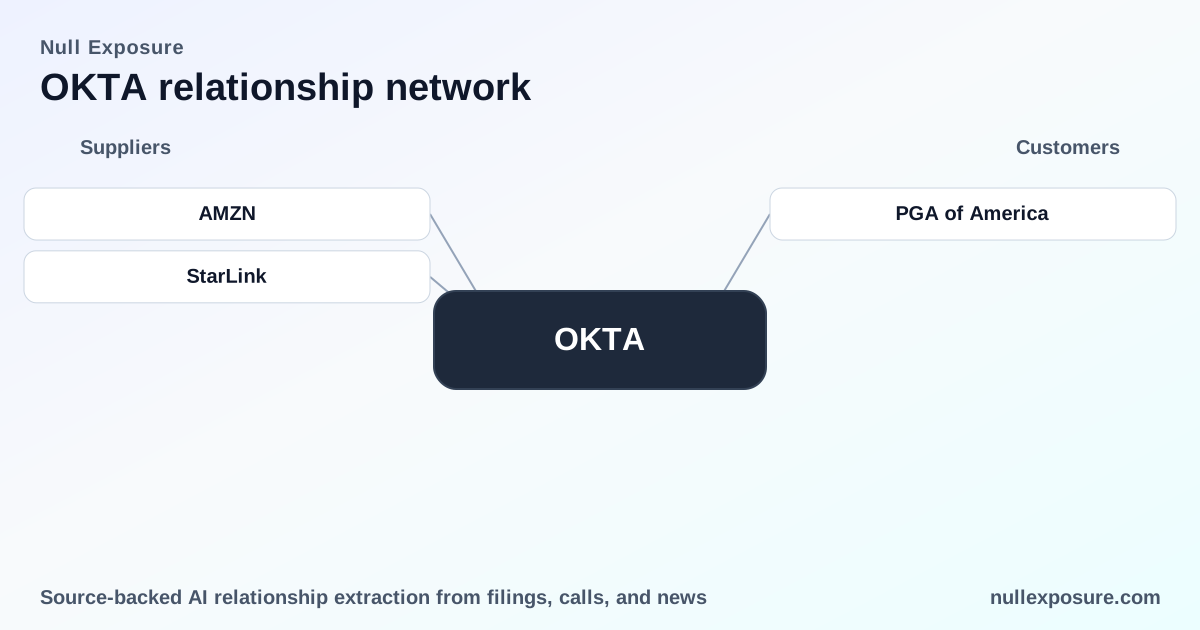
PGA of America — Okta expanded a partnership to secure identity for PGA’s professionals and fans and to support AI-enabled digital experiences across the PGA ecosystem, reflecting a branded sports-organization use case for Okta’s AI-focused identity solutions. Coverage from SahmCapital in March 2026 documents the extension and cites a Feb. 5 announcement highlighting the scale (more than 30,000 PGA professionals) and the strategic framing around AI identity.
Source: SahmCapital reporting and coverage of Okta–PGA developments, February–March 2026.
What these relationships mean for investors
Both relationships reflect two separate but important commercial vectors for Okta:
- The AvePoint mention is product ecosystem validation: third-party data governance and backup providers are incorporating Okta as a protected SaaS source, reinforcing Okta’s role as a core enterprise identity control point that other vendors must integrate with.
- The PGA of America expansion is vertical and go-to-market proof: branded partnerships in sports and entertainment extend Okta’s identity use cases into consumer-facing experiences and AI-enabled interactions, which supports upsell opportunities and marketing credibility.
These ties are supportive signals for Okta’s growth playbook: partner integrations increase stickiness and open distribution channels, while marquee partnerships demonstrate the platform’s capacity to secure both internal workforce identities and external consumer journeys.
Operating-model constraints and company-level signals investors should internalize
The public evidence yields several company-level operating characteristics that matter for valuation and risk assessment:
- Subscription-first revenue model. Okta operates SaaS subscription contracts with annual invoicing and multi-year terms, which creates predictable ARR and operating leverage but concentrates sensitivity on churn and renewal rates.
- Diverse counterparty scale. The customer base spans very large enterprises down to small businesses and nonprofits; this breadth reduces single-customer concentration risk while requiring differentiated sales motions for each segment.
- Geographic concentration with global reach. Reported billing shows a dominant U.S. revenue base alongside international customers, so macro or regulatory shifts in North America will disproportionately affect top-line performance while global expansion remains an upside vector.
- Materiality of subscriptions. Subscriptions constituted roughly 98% of revenue in fiscal 2025, meaning revenue volatility is tightly linked to subscription health and renewal economics.
- Seller role and go-to-market maturity. Okta sells both direct and through channel partners (resellers and system integrators), reflecting a mature SaaS GTM that balances field sales with partner-driven distribution.
These constraints imply that Okta’s financial outcome is highly dependent on renewal rates, platform adoption (expansion within accounts), channel execution and the company’s ability to monetize new identity use cases such as AI agent identity.
Financial context and investor signals to watch
Okta’s market position is reflected in its public financials: market capitalization around $13.7B, revenue TTM ~$2.92B, gross margin strong, and forward P/E materially lower than trailing P/E, reflecting positive earnings leverage expectations. Key investor signals:
- Monitor ARR growth and net retention as primary drivers of upside.
- Track churn and large-account concentration: sustained retention above historical baselines will support the forward multiple.
- Watch product-led initiatives (Auth0 for AI Agents, AI identity partnerships like PGA) for evidence they convert into measurable ARR.
For a practitioner-level view of counterparty relationships and to benchmark Okta against other identity vendors, Null Exposure provides a concise investor product set: https://nullexposure.com/.
Risks and concluding read
Okta’s strengths — subscription predictability, critical identity positioning and broad partner ecosystem — also create concentrated risk exposures: retention deterioration, slowing expansion in large enterprises, or geopolitical/regulatory changes that affect cross-border identity data flows would pressure the model. The investment thesis rests on continued high retention, successful monetization of AI identity use cases, and efficient expansion within the installed base.
Bottom line: Okta is a SaaS platform with durable recurring revenue and expanding ecosystem partnerships; investors should focus on renewal economics and measurable ARR contribution from new vertical and AI partnerships as the primary drivers of valuation re-rating.