Olema Pharmaceuticals (OLMA): How competitive relationships shape commercial prospects
Olema Pharmaceuticals is a clinical-stage biopharma focused on therapies for estrogen receptor–positive (ER+) women's cancers; it currently generates no product revenue and will monetize through drug approvals, licensing, and commercialization deals once lead candidates progress. Investors should treat Olema as a development-stage company whose valuation depends on clinical execution, competitive positioning against large-cap oncology players, and the timing and structure of potential partner arrangements. For additional company and relationship intelligence, visit https://nullexposure.com/.
How Olema operates and where value will come from
Olema advances small-molecule and oncology programs through clinical development, aiming to capture value at one or more inflection points — clinical readouts, regulatory filings, or licensing/commercial partnerships. The company’s financials show zero revenue through TTM and negative EBITDA, signaling a dependence on capital markets and potential partner funding until commercialization. Olema’s route to monetization is textbook for clinical-stage biotech: translate positive Phase data into higher valuation and either build a commercial organization or strike licensing deals with established pharma players.
Business-model signals investors must weigh
No constraint excerpts were provided in the source material; as a result, the following are company-level operating signals drawn from Olema’s public profile and FY2024 disclosures:
- Contracting posture: Pre-commercial. Olema is positioned to license or co-commercialize rather than act as a volume supplier; contracting will be deal-driven around specific programs and indications.
- Customer concentration: Not applicable today — Olema reports no product revenue and no commercial customers; relationships cited in its 10‑K are competitive peer references rather than buyers.
- Criticality of relationships: Competitive landscape references in its filings indicate the company is competing for market share in established ER+ oncology segments dominated by large pharma, increasing the strategic importance of partnering and differentiation.
- Maturity: Clinical-stage. Zero revenue and negative profitability establish a runway risk that depends on financing and successful trial outcomes rather than near-term cash flow.
These signals translate into an investment checklist: clinical timelines, cash runway, partner interest, and comparative differentiation against incumbent therapies.
The competitive and peer relationships Olema lists in its FY2024 10‑K
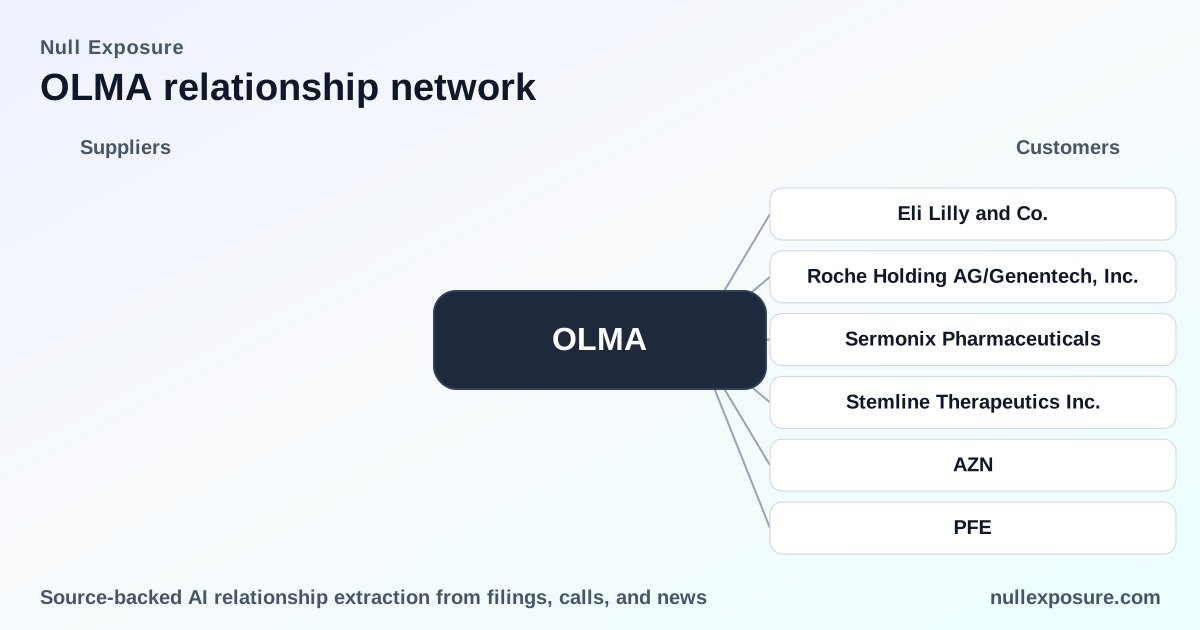
Olema’s FY2024 Form 10‑K enumerates multiple marketed drugs and late-stage candidates from other companies as part of its competitive landscape. Each named firm frames the therapeutic battleground around Olema’s programs.
Sermonix Pharmaceuticals
Olema’s 10‑K references lasofoxifene, which is being developed by Sermonix Pharmaceuticals, as part of the competitive set for ER+ breast cancer treatments. According to Olema’s FY2024 Form 10‑K, lasofoxifene is one of several external programs that define the market context for Olema’s candidates.
Roche Holding AG / Genentech, Inc.
Roche/Genentech is cited for giredestrant (GDC‑9545) in Olema’s FY2024 filing, identifying Roche’s selective estrogen receptor degrader as a direct comparator in the ER+ treatment landscape. Olema lists giredestrant in its 10‑K to map competitive risk around palazestrant and related molecules.
Eli Lilly and Co.
Olema’s filing names imlunestrant (LY3484356) from Eli Lilly as a development-stage competitor in the same therapeutic class. The FY2024 10‑K uses imlunestrant to demonstrate the breadth of late-stage and evolving alternatives Olema must position against.
Stemline Therapeutics Inc.
Stemline is listed for elacestrant, marketed as ORSERDU™, which is a marketed ER-targeting therapy referenced in Olema’s FY2024 10‑K as part of the current competitive baseline producers and products.
AstraZeneca PLC (AZN)
Olema identifies fulvestrant, marketed as Faslodex by AstraZeneca, as a marketed product and a potential competitive or generic-risk anchor for palazestrant. The FY2024 10‑K explicitly cites AstraZeneca/“AZN” to show incumbent treatment options that define prescribing patterns.
Pfizer (PFE)
In discussing KAT6 inhibitor competition for OP‑3136, Olema’s 10‑K names PF‑07248144 being developed by Pfizer, signaling that Pfizer is an active competitor in epigenetic/KAT6 inhibitor development and therefore a relevant peer in the company’s competitive assessment.
(Note: AstraZeneca and Pfizer were both listed in the 10‑K under their corporate names and ticker forms, reflected in Olema’s FY2024 disclosure.)
What these relationships mean for investors
- Competitive intensity is high. Olema’s own filings juxtapose its lead candidates against marketed drugs and late-stage assets from large-cap pharmas, which impacts pricing power and market entry dynamics.
- Partners and licensing will be decisive. Given Olema’s pre-commercial status and zero revenue, commercial partnerships or acquisitions by larger drugmakers are the most probable routes to monetization unless the company elects to build its own sales infrastructure.
- Regulatory and clinical differentiation are the primary value drivers. Beating or matching safety/efficacy profiles of referenced drugs such as ORSERDU™ or giredestrant will materially change Olema’s commercial optionality.
Risks and opportunity checklist for modelers
- Clinical execution risk: trial outcomes determine near-term valuation moves.
- Competitive displacement risk: marketed incumbents and late-stage rivals reduce addressable share unless Olema demonstrates superior outcomes.
- Financing and dilution risk: negative EBITDA and zero product revenue require ongoing capital access until a monetization event.
- Partnership upside: strategic collaboration with an established oncology commercializer would accelerate adoption and de‑risk launch execution.
For decision-makers conducting diligence, the FY2024 Form 10‑K is the authoritative document where Olema documents these market references; use that filing to trace timelines and the exact language Olema uses to position its programs.
For deeper, ongoing coverage of Olema and peer relationships, see the company’s 10‑K and related SEC filings and check portfolio monitoring at https://nullexposure.com/.
Conclusion: Olema’s value proposition is binary and execution-driven — successful clinical differentiation or a strategic partnership will reprice the company, while competitive pressures from incumbents and late-stage programs create meaningful downside if clinical readouts underperform.