Olin Corporation (OLN): Customer Relationships that Drive Near‑term Revenue and Long‑term Strategic Positioning
Olin is a vertically integrated chemicals and ammunition company that monetizes through three core channels: chlorine and vinyls (feedstocks and PVC value chain), specialty epoxy and precursors, and domestic ammunition manufacturing and services. The firm converts commodity and specialty chemical production into durable cash flows via long-term supply agreements, joint ventures that commercialize by‑product streams, and targeted asset acquisitions. Investors should read customer relationships as both demand anchors for commodity cycles and strategic levers that expand downstream capture and hydrogen co‑product monetization.
For deeper coverage of counterparty-level exposure and contract maturity across materials names, see https://nullexposure.com/.
How recent customer deals reveal strategy: securing feedstock, expanding downstream, and monetizing by‑products
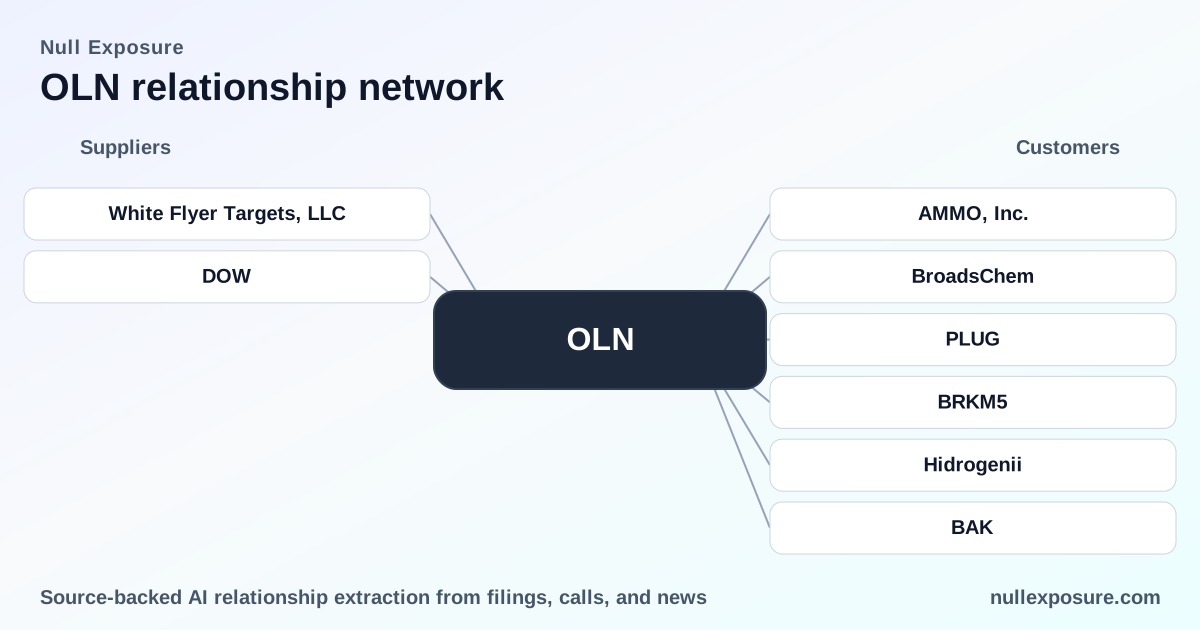
Olin’s disclosed customer relationships over FY2024–FY2025 reflect an explicit strategy: lock in long-duration supply flows for high‑value intermediates (EDC/VCM/PVC), partner to commercialize hydrogen by‑product, and add scale in small‑caliber ammunition. These actions reduce commodity margin volatility by embedding Olin in customers’ production chains (Braskem, BroadsChem), extract incremental value from chlorine production through hydrogen sales (Plug Power/Hidrogenii), and expand manufacturing capability through M&A (AMMO, Inc.). Collectively, these ties increase revenue visibility while shifting the firm toward fee‑like, contractually anchored outcomes.
Explore OLN coverage and data at https://nullexposure.com/.
Customer relationships, one by one
AMMO, Inc. — acquisition of small caliber ammunition assets
Olin agreed on January 21, 2025 to acquire AMMO, Inc.’s small caliber ammunition manufacturing assets for $75 million, an acquisition that strengthens Olin’s Winchester footprint and expands its domestic ammunition capacity. This was disclosed in Olin’s FY2024 10‑K/related filing describing the definitive agreement. (OLN 10‑K / announcement Jan 21, 2025)
BroadsChem — long‑term EDC supply agreement in Brazil
Olin announced a long‑term supply agreement to provide EDC to BroadsChem, integrating a lower‑cost EDC producer with a leading PVC operator in Brazil and creating mutual value by securing feedstock for downstream vinyl production. The arrangement was mentioned on Olin’s Q4 2025 earnings call as part of its Brazil expansion strategy. (OLN Q4 2025 earnings call)
PLUG / Plug Power Inc. — hydrogen liquefaction & offtake via Hidrogenii JV
Olin supplies by‑product hydrogen from chlorine operations to a liquefaction and distribution facility operated by Hidrogenii, a 50/50 joint venture with Plug Power, enabling trailer shipments of liquefied hydrogen to Plug’s material‑handling customers and supporting a novel spot pricing market. This relationship is described in Plug Power press materials and industry reporting from 2025 on the Louisiana plant commissioning. (Plug Power press release, 2025; GasCompressionMagazine, Apr 2025)
Hidrogenii — joint venture operator leveraging Olin hydrogen
Hidrogenii is a 50/50 JV between Plug Power and Olin that operates a Louisiana hydrogen liquefaction plant using Olin’s by‑product hydrogen from chlorine production; the JV commercializes what would otherwise be a co‑product and gives Olin direct access to hydrogen markets. The arrangement is documented in Plug Power’s press release and coverage around the JV’s first‑quarter operations in 2025. (Plug Power press release, 2025)
Braskem (BRKM5 / BAK identifiers in coverage) — long‑term EDC and PVC supply alignment in South America
Olin entered into a long‑term commercial arrangement to supply EDC and expand infrastructure in Brazil with Braskem, supporting Braskem’s transformation of its chlor‑alkali and vinyl footprint and increasing Olin’s downstream reach in the South American PVC market. This was reported across industry press in 2025 and referenced in investors’ coverage following Olin’s Q4 disclosure. (PlasticsNews, 2025; trading reports referencing OLN filings, 2026)
Notes on source consolidation: multiple news outlets reported the Plug Power/Hidrogenii JV and the Braskem agreement across 2025–2026; the summaries above consolidate those reporting threads into a single description for each commercial relationship. Sources include Olin filings and contemporaneous press releases and trade coverage cited in the company’s investor communications.
What the constraints tell investors about OLN’s operating posture
-
Contracting posture: long‑term orientation. Evidence in Olin’s filings demonstrates multi‑year government and commercial contracts in manufacturing and government ammunition services, and explicit long‑term supply agreements with industrial customers. This converts volatile commodity sales into predictable supply revenues when paired with take‑or‑pay or multi‑year off‑take terms.
-
Counterparty mix: meaningful government exposure. Sales to U.S. government agencies and government contracting activities accounted for roughly 11% of sales in 2024, signaling a stable, policy‑driven revenue component that is both cyclical and discrete from commodity cycles.
-
Geographic footprint: North America core, EMEA and global presence for chemicals. Segment sales break down with substantial U.S. concentration plus material European exposure; Olin is a vertically integrated global manufacturer with operations and customers across NA, EMEA, and other foreign markets.
-
Materiality and criticality: Chlor Alkali and Vinyls are mission‑critical. The Chlor Alkali Products and Vinyls segment represented about 55% of 2024 sales, defining core cash generation and making EDC/PVC supply relationships strategically critical. Winchester ammunition and Epoxy businesses are also material (roughly 25% and 20% shares noted respectively), creating multi‑segment dependency.
-
Business model characteristics: manufacturing + distribution with expansion phases. Olin operates both manufacturing and distribution functions; recent M&A (AMMO assets), long‑term commercial deals (Braskem, BroadsChem), and a JV (Hidrogenii) indicate management is pushing from commodity producer toward integrated supply contracts and by‑product monetization.
-
Maturity and concentration risk: mixed. The company’s revenues are anchored by mature, industrial segments (chlor‑alkali and vinyls) but the push into hydrogen logistics and expansions in Brazil increase project‑level complexity and counterparty concentration risk on major partners.
Investment implications and risks
-
Upside drivers: locked‑in EDC/PVC flows with Braskem and BroadsChem improve downstream pricing capture; the Hidrogenii JV converts a co‑product into an adjacent revenue stream; AMMO asset acquisition increases Winchester scale and government contract leverage.
-
Near‑term risks: commodity cycle sensitivity persists in core chemicals; government contract dependence and geographic concentration in the U.S. leave a non‑trivial portion of revenue tied to procurement budgets and regional demand.
-
Key monitoring items: contractual terms on EDC supplies, operational ramp at the Hidrogenii liquefaction site, and integration/production outcomes at the acquired AMMO assets.
For a structured counterparty and contract view that complements this narrative, visit https://nullexposure.com/ for our investor‑oriented relationship dashboards and filing‑level signals.