Olenox Industries (OLOX): Customer Relationship Intelligence and Commercial Constraints
Olenox Industries builds and sells prefabricated modular structures and provides construction services, monetizing through module hardware sales and project-based construction contracts. The company recognizes revenue over time on many contracts (percentage-of-completion style) and also contracts distributors and manufacturing partners to fulfill orders. Investors evaluating OLOX should view the business as service-led with a hardware component, where project fees, contract terms, and customer concentration drive near-term cash flows and execution risk.
Learn more about our customer intelligence at https://nullexposure.com/.
A single extract: what the company disclosed about SG DevCorp (and related SG entities)
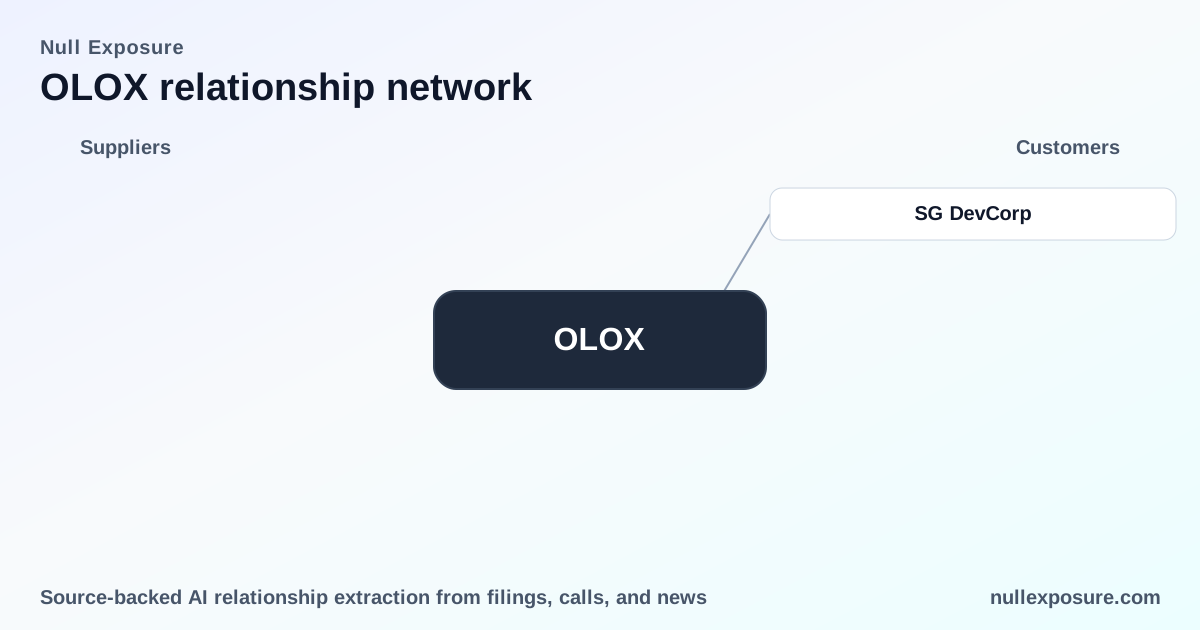
The public filing that underlies our relationship extraction shows a Master Purchase Agreement that allocates project fees to an SG-affiliated counterparty. The filing states SG Echo will be paid a fee equal to 12% of the agreed cost of each project, which the company records in connection with its project delivery arrangements. This relationship is captured in Olenox’s 2024 Form 10‑K (fiscal year 2024). According to the 10‑K filing, the Master Purchase Agreement provides for a 12% fee to the SG counterparty for each project (Form 10‑K, year ended December 31, 2024).
- SG DevCorp — The extraction labels the counterparty as SG DevCorp, while the 10‑K text explicitly references SG Echo as the fee recipient under the Master Purchase Agreement; the filing documents a 12% project fee paid to that SG entity (Olenox 2024 Form 10‑K).
Source: Olenox Industries, Form 10‑K for the fiscal year ended December 31, 2024 (disclosure of Master Purchase Agreement and SG payment terms).
How these disclosed relationships fit into Olenox’s commercial model
Olenox’s disclosed relationships and contract language reveal several company‑level operating characteristics that matter to investors:
- Contracting posture — long‑term and project‑based. The company applies revenue recognition over time on many contracts, consistent with percentage‑of‑completion accounting, and the public record contains multiple five‑year warrant issuances tied to financing activities. These facts indicate multi‑period commercial commitments and financing structures that extend senior stakeholder exposure across several years (Form 10‑K disclosures on revenue recognition and warrants).
- Customer mix and counterparty types are broad but strategically important. The company explicitly lists government agencies, private developers, the U.S. Military, Native American communities, QSR operators, and entrepreneurs among customers — a mix that introduces both steady institutional demand and specialized procurement requirements (company disclosure in the 10‑K).
- High concentration of revenue. Olenox reports that revenue relating to three and one customer represented approximately 83% and 87% of total revenue for 2024 and 2023, respectively. That concentration elevates customer credit and retention as near‑term valuation levers.
- Business segments — hardware plus services. The company sells Modules (steel container and wood solutions) but derived substantially all revenue from construction services during the latest reporting period; this structure creates a service‑execution risk profile in addition to manufacturing exposure.
- Role diversity across the supply chain. Disclosures reference distributorship arrangements (e.g., with Osang Healthcare) and an SG entity operating a leased manufacturing facility (~61,000 sq ft), indicating Olenox uses third‑party distributors and manufacturing partners to scale capacity and reach customers.
Source: Consolidated information from Olenox’s Form 10‑K (year ended December 31, 2024), including revenue concentration, customer types, segment and contract disclosures.
What the SG relationship implies for revenue and execution risk
The SG arrangement documented in the 10‑K—where an SG entity receives a 12% fee of agreed project cost—is notable for two reasons:
- Cost structure and margin pressure. Paying a fixed percentage fee to a partner on each project can constrain gross margins on projects, particularly when Olenox already reports negative gross profit and negative EBITDA in its trailing twelve‑month results.
- Operational reliance on third‑party execution. The fee implies a delegated role to an SG partner in delivering projects or managing parts of the build process; if SG entities handle manufacturing or field delivery, Olenox’s project schedules and cash collections are sensitive to third‑party performance.
Source: Olenox 2024 Form 10‑K Master Purchase Agreement disclosure.
Distribution, manufacturing, and services — who does what
The 10‑K highlights multiple relationship roles that define Olenox’s operating footprint:
- Distributor relationships exist. The filing references a distributorship agreement with Osang Healthcare Co., Ltd., indicating Olenox leverages third‑party channels for some product flows.
- Manufacturing partners operate capacity. The filing notes an SG‑branded entity operates and leases a manufacturing facility of approximately 61,000 square feet, which signals outsourced or joint production capacity rather than wholly owned, captive manufacturing.
- Services drive revenue. The company states it derived substantially all revenue from the construction services segment in the reported period, making project execution capability the principal revenue driver.
Source: Form 10‑K exhibits and narrative (year ended December 31, 2024).
Financial context that amplifies customer‑relationship risk
Investor assessment must fold relationship insights into the company’s current financial position:
- Olenox’s latest reported revenue (TTM) is $3.38 million, with negative gross profit (–$2.15 million) and negative EBITDA (–$10.23 million) for the trailing period, signaling structural losses at current scale.
- Market capitalization is small (approximately $5.8 million), and institutional ownership is low; these facts make the company vulnerable to contract timing and a few large counterparties.
- Given high customer concentration (three/one customers accounting for 83%/87% of revenue), any disruption to an SG partner or major customer would have an outsized effect on near‑term cash flows and reported results.
Source: Olenox financials and capitalization data reported in public disclosures (latest quarter 2025‑09‑30 and FY2024 Form 10‑K).
Investment takeaway and next steps
- Key strength: Olenox operates in a capital‑light model for manufacturing and uses partner networks to deliver projects, enabling rapid scaling of project throughput when demand is present.
- Primary risk: Extreme customer concentration and dependence on third‑party execution (including SG‑affiliated partners) create elevated revenue and margin volatility while the company reports persistent operating losses.
- Actionable investor steps: Review the company’s next quarterly Form 10‑Q for updates on contract wins, required payments to SG partners, and any changes to revenue recognition policy; monitor cash runway and any covenant implications tied to long‑term warrants and financing instruments.
For rigorous monitoring of OLOX customer relationships and linkage to counterparty risk, explore additional intelligence at https://nullexposure.com/.
Overall, the public record shows Olenox generates project revenue through a network of partners that are compensated on a fee basis, with material concentration and outsourced execution as the primary commercial constraints investors must price into valuation and credit assessments.