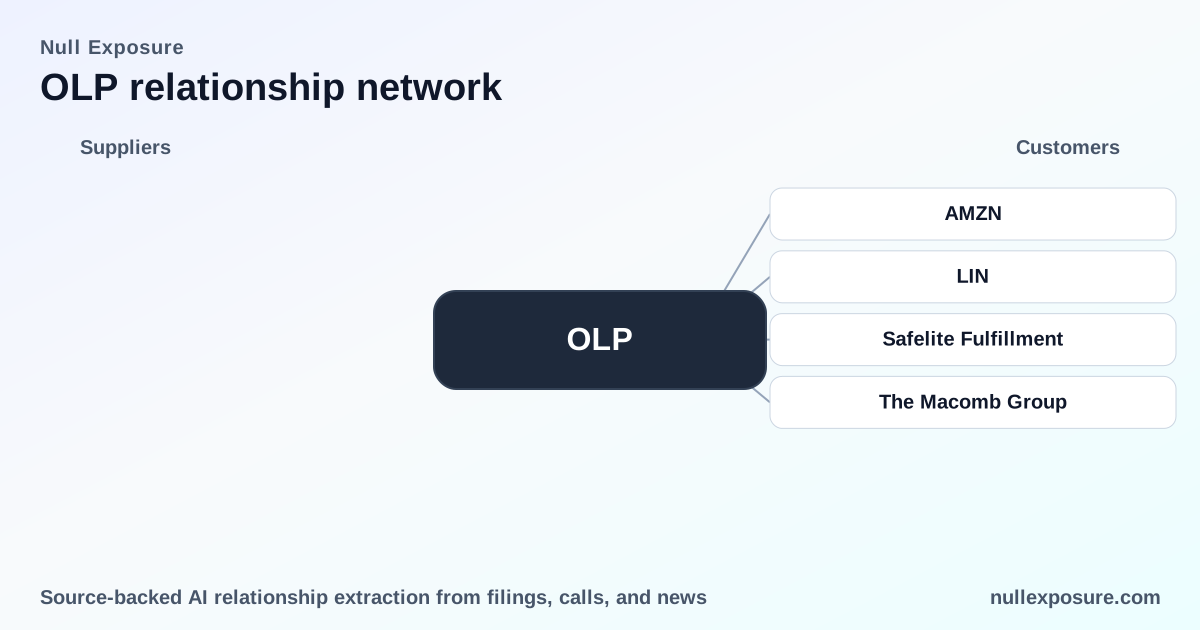
One Liberty Properties (OLP): Tenant Mix, Contracting Posture, and Where Cash Flow Comes From
One Liberty Properties is a self-managed REIT that acquires, owns and operates primarily industrial (and some retail) properties across the United States and monetizes through long-term net leases that produce rental income and predictable operating cash flow. For investors evaluating customer relationships, the most relevant signals are occupancy, tenant concentration, and the structure of those leases—factors that drive cash visibility and downside exposure. For a concise view of OLP’s position and documents, visit https://nullexposure.com/.
How OLP’s operating model converts real estate into dividends
One Liberty runs a classic net-lease REIT model: it sources industrial and retail assets, secures long-duration tenants, and collects base rent under net leases where tenants assume many operating expenses. The company’s charter and filings confirm a U.S.-only geographic focus, high occupancy, and a deliberate bias toward leases with multi-year terms—creating steady rent receipts that fund dividends and reduce short-term capital expenditure exposure. At the same time, the company shows concentration risk: roughly 21.1% of 2025 contractual rental income comes from five tenants, which amplifies the impact of tenant default or non-renewal on reported revenues.
- Contracting posture: long-term net leases predominate, supporting predictable cash flow and low capex volatility.
- Geography and maturity: investments are U.S.-centric and the portfolio presents high occupancy, but lease maturity profiles are something to monitor for rollover risk.
- Role & stage: OLP’s relationships with tenants are fundamentally seller/service relationships (landlord collecting rent), and the relationship set is currently active, per filings and public disclosures.
Tenant relationships investors should track now
Below I summarize every tenant relationship disclosed in the recent coverage and filings tied to OLP’s industrial portfolio acquisitions and property operating updates. Each entry is a plain-English summary with the public source noted.
Amazon (AMZN)
Amazon anchors one of OLP’s multi-tenant industrial portfolios; the Sewickley, Pennsylvania acquisition was described as 93% leased to 16 tenants and anchored by Amazon, a primary cash-generating tenant for that asset. This was reported in OLP’s December 2025 transaction announcements and subsequent press coverage. (Source: GlobeNewswire press release, Dec. 22, 2025; QuiverQuant recap, Mar. 2026.)
Linde Gas (LIN)
Linde Gas is listed as an anchor tenant on the same six-building multi-tenant industrial property; the asset is projected to produce about $3.4 million of annual base rent with contractual rent escalators of 2–3%. OLP cited Linde as a stable industrial occupier in public notices. (Source: Investing.com/sec filings summary, May 3, 2026.)
Mondelez Global (MDLZ)
Mondelez Global is a named tenant in a separate set of industrial properties that were fully leased to six tenants; OLP expects lease renewals across that block to push base rent higher in the relevant 12-month horizon. Coverage highlights Mondelez as a core tenant in those holdings. (Source: Investing.com press coverage of SEC filings, May 3, 2026.)
Bimbo Bakeries USA
Bimbo Bakeries USA is another tenant in the fully leased industrial cluster; reporting identifies it among six tenants that contribute to the asset-level cash flow and expected rent uplift on renewals. (Source: Investing.com/sec filings summary, May 3, 2026.)
HABE USA
HABE USA appears in the list of tenants occupying the industrial properties OLP acquired; it is cited as one of six tenants providing immediate base rent on that block. (Source: Investing.com/sec filings summary, May 3, 2026.)
L&W Supply Corporation
L&W Supply Corporation is listed as a tenant across the fully leased industrial properties acquired; it contributes to the immediate revenue stream for those assets. (Source: Investing.com/sec filings summary, May 3, 2026.)
Owens & Minor Distribution (OMI)
Owens & Minor Distribution is named among the six tenants on the industrial portfolio that was acquired, and is factored into OLP’s near-term rental roll projections. (Source: Investing.com/sec filings summary, May 3, 2026.)
Husqvarna U.S. Holdings (HUSQ)
Husqvarna U.S. Holdings is included among the six tenants on the acquired properties; press summaries list it as a stable industrial occupant. (Source: Investing.com/sec filings summary, May 3, 2026.)
The Macomb Group
The Macomb Group is cited as one of the tenants anchoring the Sewickley multi-tenant property (part of the 93% leased portfolio), contributing to the asset’s occupancy and rent base. (Source: QuiverQuant & CityBiz coverage of OLP’s Sewickley acquisition, Mar. 2026.)
Safelite Fulfillment
Safelite Fulfillment is also listed as an anchor tenant on the Sewickley portfolio and shows up repeatedly in transaction communications as part of the leased tenant roster. (Source: GlobeNewswire press release, Dec. 22, 2025; CityBiz recap, Mar. 2026.)
What the relationship set says about risk and opportunity
- Concentration is material. OLP disclosed that about 21.1% of 2025 contractual rents come from five tenants, which creates a non-trivial single-tenant/cluster exposure that investors must price. (Company filing excerpt, 2025.)
- Cross-default mechanics exist. Management highlights that multiple retail properties are net-leased to the same tenant and that four of those leases contain cross-default provisions, increasing correlation risk across properties if a single counterparty fails to perform. (Company disclosure.)
- Leases tilt long-term and income-focused. Filings and press releases describe many assets as held under long-term net leases, supporting steady distributions but requiring attention to expiration schedules and renewal economics.
- U.S.-centric footprint reduces currency and overseas regulatory complexity but concentrates macro risk in the domestic industrial/retail cycle. (Company charter and regional statements.)
Investment takeaways for operators and researchers
- Positive: stable, rental-income driven model with high occupancy and explicit rent escalators on some assets. The presence of blue-chip tenants such as Amazon, Mondelez and Linde supports valuation multiple defensibility in a normalization scenario.
- Negative: tenant concentration and cross-default provisions create asymmetric downside. A significant portion of rent tied to a small group of tenants requires active monitoring of lease maturities and tenant credit health.
- Operational focus: asset-level cash flow and lease roll timelines are the primary drivers of dividend sustainability. Investors should track the timing of renewals and expected base rent increases reported for the 12 months following recent acquisitions.
For a practical next step, review OLP’s transaction press releases and SEC filings for exact lease maturities and tenant-specific rent schedules; for an aggregated view of these customer relationships and comparable landlord strategies, visit https://nullexposure.com/.
Bold conclusion: One Liberty’s model delivers predictable rent cash flow through long-term net leases, but investors must underwrite concentration and cross-default clauses as central valuation risks.