Olaplex customer relationships: who pays for the bond-builder and what that means for investors
Olaplex operates a three-legged commercial model—salon/professional distribution, third‑party retail partnerships, and direct-to-consumer (DTC) sales—and monetizes through product sales across those channels while leveraging brand premium and salon endorsement to sustain pricing. For investors evaluating customer risk and revenue durability, the company’s mix of large retail partners, thousands of small salon customers, and growing DTC channels defines both concentration exposure and optionality. For a broader view on counterparty signals and relationship mapping, see https://nullexposure.com/.
How Olaplex sells products and where revenue comes from
Olaplex sells through: (1) professional distributors that supply salons and licensed professionals; (2) resellers and national retailers that carry Olaplex in-store and online; and (3) DTC channels—Olaplex.com and third‑party e-commerce platforms. According to company disclosures, products are sold in more than 70 countries, and net sales were roughly split 50/50 between the U.S. and international in 2024, underscoring a global footprint with meaningful North American concentration (company reporting, FY2024). The professional channel is populated predominantly by small business salon customers and individual professionals, while national retail partners compress sales into larger counterparties.
The customer list—what every named relationship contributes
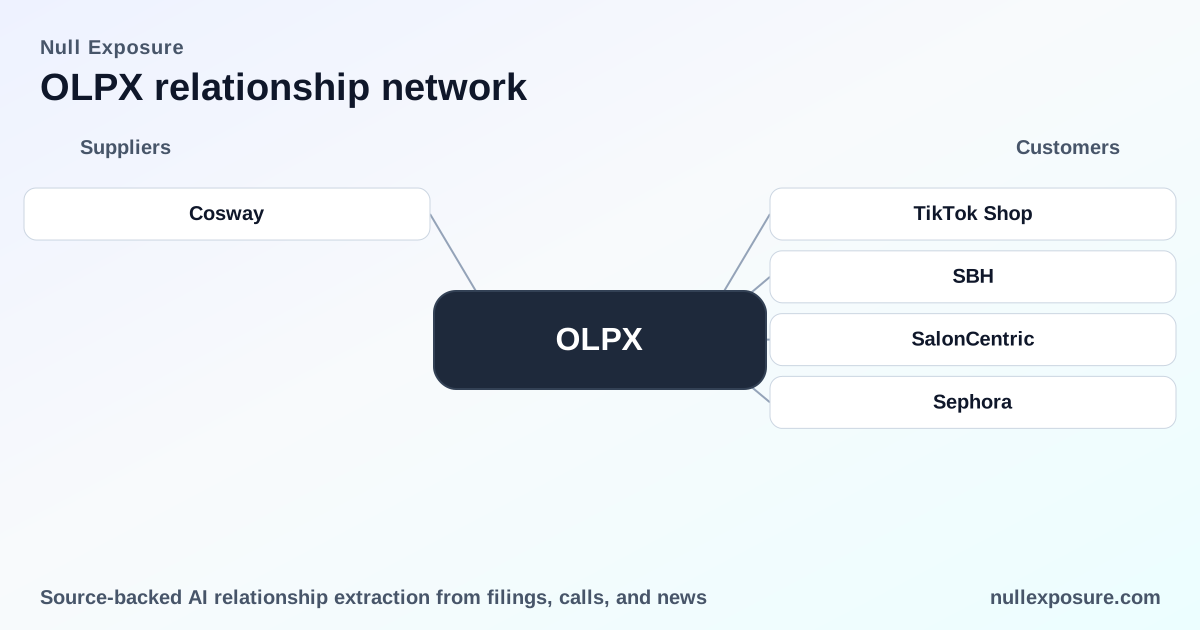
Below are plain-English takeaways on each customer or counterparty identified in public sources, with source context.
TikTok Shop
Olaplex launched sales on TikTok Shop in Q4 2025, and the channel “significantly outperformed our expectations” despite contributing only a small share of overall revenue, signaling successful short‑form commerce traction for promotional product launches. Reported in the Q4 2025 earnings call transcripts published by InsiderMonkey and Investing.com (March–May 2026).
Sephora
Sephora is identified as one of Olaplex’s largest retail customers historically, representing a strategic national retail placement that supports brand visibility and premium retail pricing. Business of Fashion referenced Sephora among the biggest customers in coverage tied to Olaplex’s IPO-era disclosures (FY2021).
Sally Beauty / Beauty Systems Group (SBH)
Sally Beauty’s Beauty Systems Group is named alongside Sephora and SalonCentric as one of Olaplex’s major retail distribution partners, indicating access to a broad professional-consumer retail channel and wholesale scale. Business of Fashion’s FY2021 coverage lists Sally Beauty Holding Inc’s Beauty Systems Group as a major customer (FY2021).
SalonCentric
SalonCentric is cited as another principal professional retail partner, providing penetration into salon supply networks and reinforcing the company’s professional-channel credibility. Business of Fashion identified SalonCentric among Olaplex’s largest customers in its FY2021 reporting (FY2021).
Henkel AG & Co. KGaA (Henkel)
Henkel agreed to acquire Olaplex in a cash transaction priced at $2.06 per share, implying an equity value of approximately $1.4 billion; the transaction has attracted shareholder scrutiny and multiple law‑firm inquiries into process and price, positioning Henkel as the strategic acquirer and the single most consequential counterparty in 2026. Coverage of the sale and ensuing shareholder notices is available via Globenewswire and BusinessChief (April–May 2026).
Gilead Sciences
Gilead Sciences appears in shareholder notices related to the sale process; filings and shareholder alerts reference inquiries “including whether Gilead Sciences is paying fair value to shareholders,” which suggests Gilead surfaced either as a rumored bidder or a party cited in fairness discussions during the sale process. This mention comes from shareholder‑notice coverage posted on Globenewswire (April 2026).
What the counterparty and channel signals imply for operations and risk
The relationship evidence supports a diversified but channel-concentrated operating model:
- Contracting posture: Olaplex operates a hybrid posture—direct contracts for DTC and branded sites, and distributor/reseller arrangements for professional and retail channels—creating multiple commercial interfaces and varied margin profiles across channels (company reporting, FY2024 disclosures).
- Concentration and counterparty importance: National retail partners such as Sephora, Sally Beauty (Beauty Systems Group), and SalonCentric represent material distribution points; while the firm reports sales through 55+ retailers, the presence of a few large retail partners creates concentration risk at the top end of the customer roster (Business of Fashion, FY2021).
- Customer criticality and stickiness: The professional salon community—largely small businesses and individual pros—serves as a durable brand amplifier and is critical to product credibility and continued retail demand, supporting recurring salon‑level consumption and professional endorsement (company social/professional channel disclosures).
- Maturity and strategic flexibility: The company’s DTC growth and experiments with platforms like TikTok Shop demonstrate active digital expansion and channel diversification late in the product lifecycle, signaling strategic flexibility to offset wholesale pressure and strengthen gross margin capture (earnings call Q4 2025).
- Geographic diversification: Sales in more than 70 countries with roughly 50/50 U.S./international split reduce single-market dependency but leave meaningful North American exposure that investors should monitor (FY2024 reporting).
Major investor takeaways and near‑term focus areas
- Distribution mix is the key driver of margin and revenue stability. National retailers deliver scale but compress margin; salons and DTC preserve brand and price but require ongoing marketing investment. Evidence: FY2024 reporting and FY2021 retail partner disclosures.
- The Henkel transaction is the dominant near‑term event for shareholders. The $2.06 per share deal value and multiple shareholder investigations into process/fairness materially shape the company’s valuation pathway in 2026 (Globenewswire, BusinessChief, April–May 2026).
- DTC momentum reduces single‑channel dependency. Early success on TikTok Shop suggests the company can scale promotional launches and capture incremental margin through owned and platform commerce (Q4 2025 earnings call transcripts).
- Investor monitoring should focus on retail concentration, distributor terms, and the outcome of acquisition‑related litigation/notice activity. Those elements will determine cash flow stability and buyer/seller negotiation dynamics through the close.
For a structured feed of similar counterparty signals and a visualization of how relationships map to revenue and risk, visit https://nullexposure.com/ to explore more on relationship analytics and customer intelligence.
Olaplex’s commercial position combines a defensible brand and salon advocacy with real exposure to large retail counterparts and an acquisition process that now supersedes ordinary operating risks—investors should value relationships both for their revenue impact and for how they shape strategic outcomes in the current sale process.