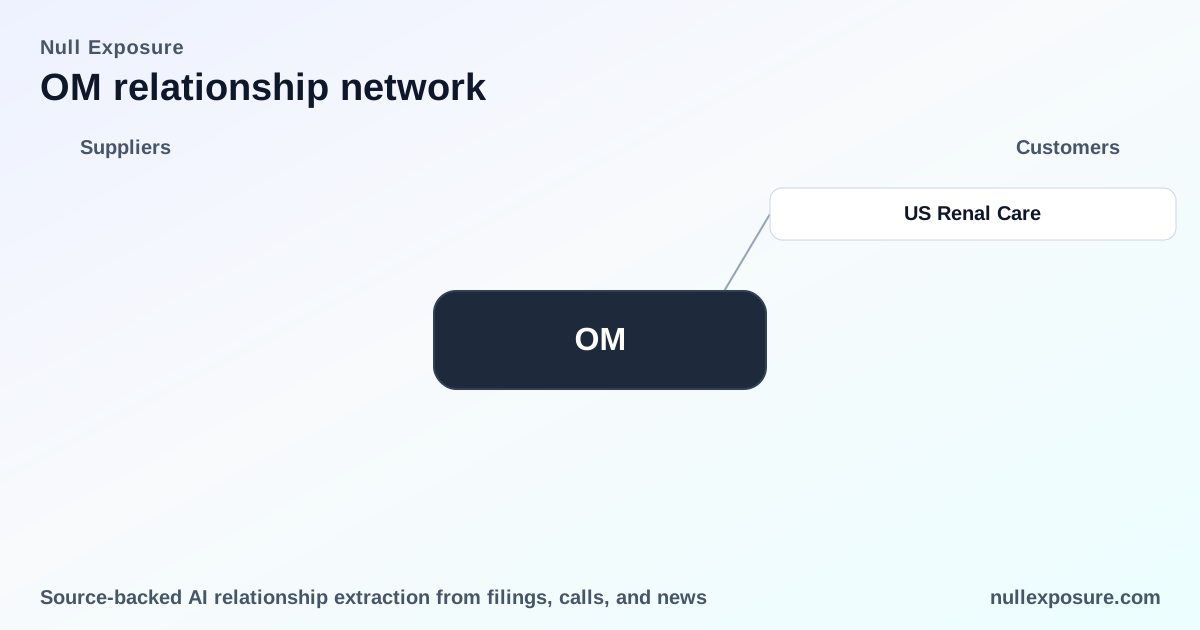
Outset Medical (OM) — customer relationships that define product adoption and revenue durability
Outset Medical sells the Tablo hemodialysis system and associated consumables, monetizing through up-front console sales, recurring consumables sales (cartridges and accessories), and field service contracts; revenue is primarily U.S.-based and recognized as a mix of up-front product placement and ongoing service/consumables. For investors evaluating customer risk and growth potential, the core question is whether Tablo’s clinical outcomes and customer economics drive repeat consumable purchases and long-term service revenues or leave the company exposed to short, terminable contracts and spot sales. This review focuses on the documented customer relationships and firm-level operating constraints that determine that answer. For a fuller view of Outset’s data and signals, visit https://nullexposure.com/.
Why customers matter for Outset’s economics
Outset’s business model is built around a classic med-tech two-layer monetization: capital equipment sales that open a recurring aftermarket of consumables and service. The company recognizes a meaningful portion of revenue up-front when consoles are placed, while consumable replacement and field service create the recurring element that supports margin expansion over time. Outset’s reported TTM revenue and gross-profit profile show the company is still scaling that recurring base while operating at a loss, making the composition and stability of customer relationships central to forecasting cash flow and valuation.
The customer map: what the relationships reveal
Two customer relationships are documented in the available coverage: US Renal Care and AdventHealth. Together they illustrate both the enterprise adoption pathway (large dialysis providers and hospitals) and the clinical outcomes narrative Outset uses to expand its footprint. Company-level constraints drawn from filings and disclosures further clarify how those relationships convert into durable revenue.
Key company-level operating signals:
- Contracting posture: predominantly short-term service agreements (one-year terms; GPO/IDN contracts terminable on 60–90 days’ notice) and a nontrivial volume of spot or up-front console revenue where product placement revenue is recognized immediately.
- Geography: revenues are concentrated in North America / United States.
- Concentration: customer concentration is material; the largest customer represented ~16% of 2024 revenues.
- Roles: Outset acts as seller of Tablo consoles and related consumables and as a service provider via field maintenance and support teams.
- Lifecycle: relationships are active and Tablo is the core product driving revenue.
These signals imply a go-to-market that wins share through clinical proof and short commercial commitments, meaning durable upside depends on converting installations into recurring consumable and service revenue.
US Renal Care — a strategic multi-year home dialysis deal
Outset announced a multi-year agreement with US Renal Care to expand access to home dialysis using the Tablo system, a commercial step that positions Tablo for growth in the home-dialysis channel where device placement and consumables consumption both scale. According to a Medical Device Network report, the agreement was announced in April 2024 and frames US Renal Care as a channel partner for broader home adoption. (Medical Device Network, April 2024).
AdventHealth — clinical outcomes that support adoption
Outset published research demonstrating real-world outcomes across a broad sample of Tablo treatments, including a notable five‑year results set from a Florida hospital that insourced dialysis; the study reported a 94% reduction in serious cardiac or respiratory events at AdventHealth’s Ocala site and favorable staff-satisfaction and treatment-goal metrics, which the company highlighted at ASn Kidney Week 2025. That disclosure, covered by TradingView in November 2025, strengthens the clinical-evidence case that Outset uses to persuade hospital and health-system buyers. (TradingView / Zacks, November 2025).
How these relationships convert to cash — the mechanics investors must track
Outset’s revenue recognition combines up-front console placement (spot) and recurring consumables/service, so the economic value of a relationship depends on conversion from initial sale to ongoing purchases and maintenance contracts. The documented deals illustrate two routes:
- Large dialysis organizations (e.g., US Renal Care) provide volume channels for both home and in-center Tablo placements; they are critical for scaling consumable revenue if installations convert to repeat purchases.
- Health systems and hospitals (e.g., AdventHealth) provide clinical validation and the ability to insource dialysis, strengthening the sales pitch to other hospitals and IDNs.
Key operating sensitivities:
- Customer concentration is material: with one customer responsible for ~16% of 2024 revenue, loss or non-renewal of a major account affects near-term top-line visibility.
- Contract tenure is short: typical one-year terms and GPO/IDN termination rights (60–90 days) create predictable churn risk unless customers commit to longer consumable flows or bundled service agreements.
- Geographic concentration in the U.S. constrains diversification and ties performance to U.S. payor dynamics and reimbursement policy.
Commercial and risk implications for investors
Outset’s commercial model scales only if installations lead to predictable consumable and service streams. The clinical data — particularly the AdventHealth results — is an asset because it reduces the friction for hospitals to internalize dialysis (creating a higher-margin installed base). However, the prevalence of short-term and spot arrangements means management must convert trial or initial placements into long-term consumable revenue quickly.
- Upside driver: faster conversion of console placements into recurring cartridge and accessory revenue across large IDOs and health systems, supported by positive outcome data.
- Downside risk: reliance on a small number of large customers, short contract terms and U.S.-centric sales leave revenue visibility and cash generation vulnerable to idiosyncratic churn or slower-than-expected consumable adoption.
What to watch next (practical signals)
- New multi-year roll-outs with large dialysis providers (expansion of the US Renal Care relationship or similar deals).
- Evidence of longer-term contracting or bundled consumable/service agreements that reduce the short-term churn risk.
- Consumable attach rates and recurring revenue growth reported in quarterly filings, which will indicate whether placements are converting to durable revenue.
- Further clinical publications replicating the AdventHealth outcomes across additional sites and payor environments.
Bottom line: adoption is clinical-proofs-first, revenue is conversion-driven
Outset’s pathway to durable revenue and margin expansion is straightforward: turn console placements into recurring consumable and service cash flows. The documented relationships with US Renal Care and AdventHealth both validate the commercial routes—volume channels and clinical proof—but the firm-level signals (short-term contracts, significant customer concentration, U.S. focus) mean conversion and retention are the critical operational levers for investors to monitor. For a systematic analysis of Outset’s customer footprint and comparable med‑tech commercial patterns, see additional resources at https://nullexposure.com/.
Bold takeaway: clinical outcomes win the trial; recurring consumables and longer service contracts win the valuation uplift.