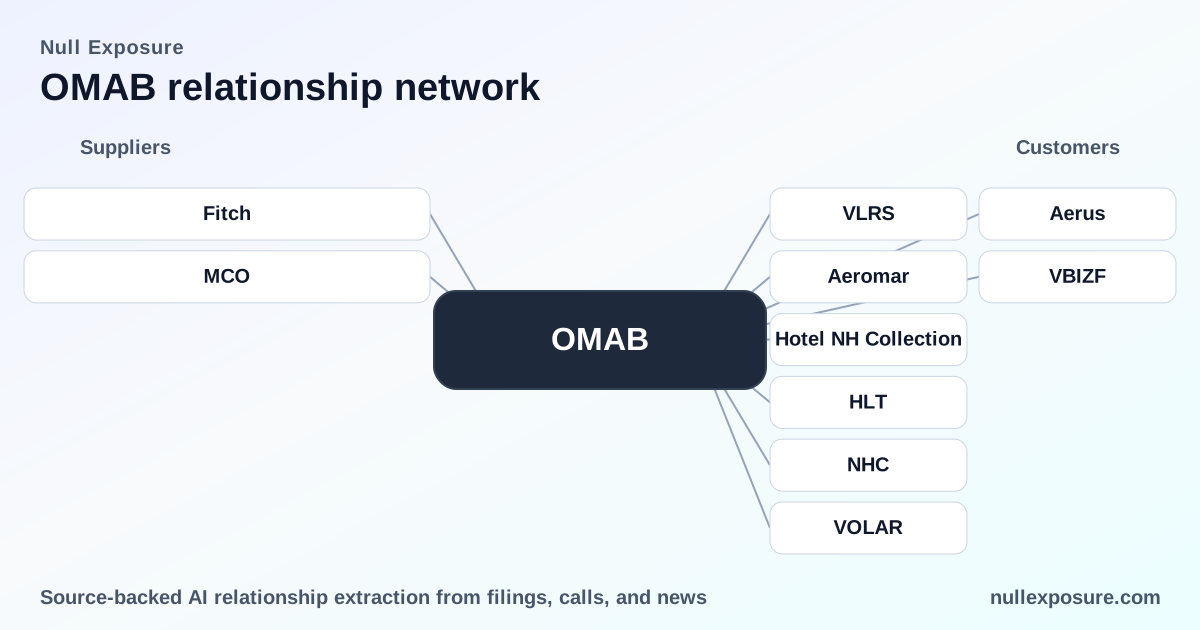
OMA (OMAB) — Customer relationships that underwrite an airport concession cash engine
Grupo Aeroportuario del Centro Norte (OMA) runs a geographically concentrated network of Mexican airport concessions and monetizes through aeronautical charges and high-margin non-aeronautical operations (retail, parking, hotels and route stimulation). Its cash flow profile depends on stable, long-term concession posture and a small set of airline tenants that account for a large share of passenger throughput — a dynamic that both amplifies upside in traffic recoveries and concentrates downside risk. For a concise exposure map and ongoing monitoring, visit NullExposure.
How OMA’s operating model translates to revenue and risk
OMA’s business is fundamentally a concessions and infrastructure operator: long-dated contracts, fixed-capital airports, and a split between regulated aeronautical income and discretionary commercial revenues. That structure produces predictable base cash flow but leaves overall performance tightly linked to airline schedules, route decisions and the performance of a handful of anchor carriers.
Key operating characteristics investors should use to frame valuation and risk:
- Concentration: a few carriers account for the majority of passenger traffic, concentrating demand risk and pricing power.
- Contracting posture: concession-based, typically long maturities and fixed terms, which supports capex planning and tenancy stability.
- Criticality: airports are mission-critical assets for regional carriers; route additions or reductions materially change throughput.
- Maturity and diversification: established hotel leases and retail operations provide countercyclical revenue, partially insulating OMA from short-term airline volatility.
For a deeper look at customer-level relationships that drive these characteristics, see the mapping below. If you track exposure across airports and counterparties, our platform aggregates and timestamps disclosures in one place: NullExposure.
Customer map: airline, hotel and route partners (what the filings and press say)
Volaris
Volaris is an anchor airline for OMA, accounting for roughly 24–25% of quarterly passenger traffic in recent disclosures and reporting mid-teens year-over-year passenger growth in early 2026. This level of concentration makes Volaris a top-line driver for OMA’s throughput and commercial sales. (Q1 2026 earnings call transcript, Investing.com; Q4 2025 transcript, InsiderMonkey; FY2025 local reporting on route additions)
Viva Aerobus (Viva)
Viva Aerobus is the other dominant carrier in OMA’s footprint, reported to comprise approximately 48–51% of passenger traffic in various quarters and contributing single-digit passenger growth in recent periods; Viva’s scale gives it equivalent influence over OMA traffic and non-aero revenue. (Q1 2026 earnings call transcript, Investing.com; Q4 2025 transcript, InsiderMonkey)
Aeromar
Aeromar is a minor operator within OMA’s network, representing only about 0.6% of consolidated traffic per past investor-call commentary, therefore exerting negligible revenue influence on a consolidated basis. (Q4 2022 earnings call transcript, InsiderMonkey)
Aeroméxico
Aeroméxico has partnered with OMA on specific international capacity decisions, with local reporting noting coordination to increase temporary flights — an example of how legacy carriers can influence route economics and airport international connectivity. (El Financiero, coverage of route increases to Madrid from Monterrey, 2022)
Iberia
Iberia has a confirmed route to Madrid in OMA’s disclosures, reflecting targeted international connectivity that supports higher-yield traffic and tourism flows at affected airports. International route commitments like this lift commercial yield per passenger for OMA. (Q1 2026 earnings call transcript, Investing.com)
Hilton Garden Inn (Hilton / HLT)
OMA operates or administers the Hilton Garden Inn at Monterrey Airport as part of its airport commercial portfolio; management describes the hotel as a mature, stable commercial asset that contributes recurring non-aeronautical revenue. (Reuters coverage reposted on TradingView, June 2025; Q4 2025 earnings call transcript, InsiderMonkey)
NH Collection Hotel (NH / NHC)
OMA administers the NH Collection hotel inside Terminal 2 of Mexico City and has extended the lease term to April 2034 under existing terms, signaling management’s preference for stable, long-duration hotel cash flows within terminals. This extension reduces near-term rollover risk in a commercial revenue category. (Q1 2026 earnings call transcript, Investing.com; Reuters/TradingView reporting, June 2025)
Aerus
Aerus has activated new frequencies connecting regional centers to Ciudad Victoria and other points within OMA’s network, illustrating how smaller regional carriers can meaningfully affect volume at select airports even if their consolidated footprint is limited. (Local reporting, OEM/El Sol de San Luis, coverage of FY2024 route activations)
What the counterparty list says about OMA’s economic profile
The relationship roster reinforces two fundamental investment facts: high customer concentration and a diversified commercial income stream. Volaris and Viva collectively accounted for about three-quarters of passenger traffic in recent quarters, an important concentration that both leverages and exposes OMA’s revenue to the fortunes and network strategies of these carriers (Investing.com transcripts; InsiderMonkey, FY2025–FY2026 commentary). At the same time, mature hotel leases and extensions (NH Collection, Hilton Garden Inn) supply reliable non-aeronautical cash and lower earnings volatility (Reuters/TradingView; Q1 2026 earnings call).
Investment implications and risk checklist for operators and allocators
- Positive: leverage to passenger recovery and international route additions, benefitting aeronautical fees and per-passenger commercial spend (Iberia route confirmation; recent passenger growth reports).
- Negative: single-carrier concentration risk — a material route cut or capacity shift by Volaris or Viva would quickly depress consolidated throughput.
- Stability from concession contracts and hotel leases — long-term concession terms and extended hotel leases reduce short-term rollover risk and support predictable cash flow.
- Regional route dynamics matter — small carriers like Aerus and Aeromar can change economics at individual airports even if they do not move the consolidated needle.
Company-level constraints signal
There are no explicit contract constraint excerpts in the reviewed relationship feed; at the company level, that translates into no additional public constraint data surfaced in this customer mapping.
Bottom line
OMA’s value proposition is a concession-backed, cash-generative airport network whose upside scales with passenger gains but whose downside is concentrated through a small number of large airline customers. Investors should underwrite both the concentration risk (Volaris and Viva) and the stabilizing effect of long-duration commercial leases when modeling free cash flow and downside scenarios.
For continuing coverage and a consolidated view of OMA’s counterparties and disclosure timestamps, visit NullExposure.