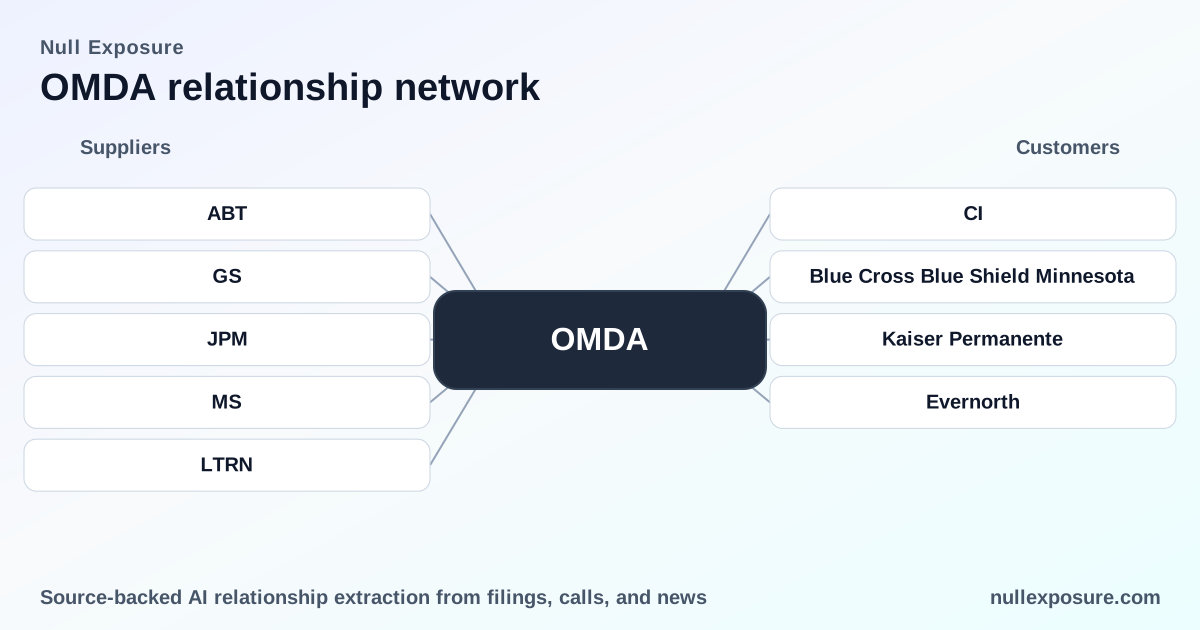
Omada Health (OMDA): payer partnerships are the commercial backbone
Omada Health operates virtual-first chronic disease management programs sold primarily to health plans and large employers; the company monetizes through contracted fees and preferred-formulary placements that drive reimbursement and volume of participants. Large payer relationships—most prominently Cigna/Evernorth—are both the primary revenue driver and the principal single-counterparty concentration risk for investors evaluating OMDA’s go-to-market durability. For a deeper look at partner exposure and implications for contracting and revenue predictability, see https://nullexposure.com/.
Why the customer map matters for an outcome-driven virtual care player
Omada’s product is a classic platform-to-payor model: scale depends on payer distribution deals, formulary preference, and integration with care management workflows. When a handful of national insurers give preferred status and write multi‑year contracts, Omada gains distribution scale quickly; when those contracts shift, revenue volatility follows. The excerpts collected here consistently show Omada’s commercial orientation toward national and regional health plans rather than direct-to-consumer channels.
Record-by-record review: every relationship in the results
Below I enumerate each relationship record from the collected sources. Each entry is a concise, plain-English summary with its source.
Record 1 — The Cigna Group (HC Innovation Group, FY2025)
Omada received nearly $90 million in payments from Cigna and its Evernorth unit in 2024 via a series of contracts, indicating a material revenue relationship with Cigna. Source: HC Innovation Group coverage of Omada’s IPO filing (March 2026) — https://www.hcinnovationgroup.com/clinical-it/digital-health-innovation/article/55291398/virtual-care-company-omada-files-ipo-papers.
Record 2 — CI (HC Innovation Group, FY2025)
The same HC Innovation report is indexed under the CI shorthand and reiterates that Cigna/Evernorth paid Omada almost $90 million in 2024, confirming that reporting treats CI/Evernorth as a consolidated commercial counterparty. Source: HC Innovation Group (March 2026) — https://www.hcinnovationgroup.com/clinical-it/digital-health-innovation/article/55291398/virtual-care-company-omada-files-ipo-papers.
Record 3 — Cigna (Abbott news release context, FY2019)
Omada is named among partners in a broader 2019 announcement, showing early-established relationships with major payers including Cigna; this signals multi-year market presence with large plans. Source: Abbott media release (October 2019) announcing partnerships where Omada is listed as a partner — https://abbott.mediaroom.com/2019-10-14-Abbott-and-Omada-Health-Partner-to-Offer-Integrated-Digital-Health-and-Coaching-Experience-for-People-with-Type-2-Diabetes.
Record 4 — Kaiser Permanente (Abbott news release context, FY2019)
Kaiser Permanente is listed among Omada’s partners in the 2019 release, evidencing integration or channel relationships with large integrated delivery networks as well as commercial insurers. Source: Abbott media release (October 2019) — https://abbott.mediaroom.com/2019-10-14-Abbott-and-Omada-Health-Partner-to-Offer-Integrated-Digital-Health-and-Coaching-Experience-for-People-with-Type-2-Diabetes.
Record 5 — Blue Cross Blue Shield Minnesota (Abbott news release context, FY2019)
Blue Cross Blue Shield of Minnesota appears in the 2019 partner list, confirming regional Blues plans are part of Omada’s payer footprint in addition to national carriers. Source: Abbott media release (October 2019) — https://abbott.mediaroom.com/2019-10-14-Abbott-and-Omada-Health-Partner-to-Offer-Integrated-Digital-Health-and-Coaching-Experience-for-People-with-Type-2-Diabetes.
Record 6 — CI (Abbott news release context, FY2019)
The Abbott release is also surfaced under the CI shorthand, again documenting Cigna’s role in Omada’s partner mix as far back as 2019 and supporting the view that the relationship has multi-year tenure. Source: Abbott media release (October 2019) — https://abbott.mediaroom.com/2019-10-14-Abbott-and-Omada-Health-Partner-to-Offer-Integrated-Digital-Health-and-Coaching-Experience-for-People-with-Type-2-Diabetes.
Record 7 — Evernorth (GlobeNewswire, FY2022)
Omada earned preferred status on the Evernorth Digital Health Formulary for its cardiometabolic chronic care programs, a commercial endorsement that materially improves access to Evernorth’s covered population. Source: GlobeNewswire press release announcing Omada financing and formulary status (February 2022) — https://www.globenewswire.com/news-release/2022/02/23/2390428/0/en/Omada-Health-Closes-192-Million-Series-E-Financing-to-Bring-Virtual-First-Care-to-Millions.html.
Record 8 — CI (GlobeNewswire, FY2022)
The GlobeNewswire item is also indexed under CI, reinforcing that Evernorth’s preferred designation is effectively a Cigna-aligned commercial channel for Omada’s cardiometabolic products. Source: GlobeNewswire (February 2022) — https://www.globenewswire.com/news-release/2022/02/23/2390428/0/en/Omada-Health-Closes-192-Million-Series-E-Financing-to-Bring-Virtual-First-Care-to-Millions.html.
Record 9 — Evernorth (HC Innovation Group, FY2025)
HC Innovation Group’s 2026 write-up restates that Cigna and its Evernorth arm have deep commercial ties to Omada, with the $90 million payment figure for 2024 spotlighted as evidence of scale in that payer channel. Source: HC Innovation Group (March 2026) — https://www.hcinnovationgroup.com/clinical-it/digital-health-innovation/article/55291398/virtual-care-company-omada-files-ipo-papers.
What the relationship map implies about Omada’s operating model
- Contracting posture: Omada sells through formal payer contracts and formulary processes rather than ad hoc, transactional payment. Preferred status on Evernorth’s formulary and multi-year payments from Cigna indicate a commercial posture built on negotiated access and reimbursement pathways.
- Concentration: The dataset documents a material concentration of revenues tied to Cigna/Evernorth (nearly $90 million in 2024), meaning single-counterparty risk is elevated and should be monitored in future filings and guidance.
- Criticality to customers: Preferred-formulary placement and explicit payer payments signal that Omada’s programs are sufficiently operationalized to be embedded in payer care-management offerings—this implies mid-stage commercial maturity rather than early pilot status.
- Maturity and scale: Multi-year partnerships with national payers and regional Blues and IDNs (Kaiser Permanente, BCBS Minnesota) show a diversified go-to-market mix across plan types, supporting scalable growth, but not removing the concentration risk from large national payers.
- Contract terms and renewal risk: The prominence of preferred formulary status and large contracted payments points to revenue visibility when contracts renew; however, renewals and formulary decisions are binary commercial events that drive step changes in volume.
Investment implications and risks
- Upside: Preferred status with Evernorth and the documented payments from Cigna provide clear distribution leverage and a pathway to accelerate enrollment and revenue growth when payer relationships expand. This is a positive signal for revenue scalability and institutional validation.
- Downside: Concentration with Cigna/Evernorth is the primary near‑term counterparty risk. A change in formulary status, pricing, or renewal outcomes at a single large payer would materially affect revenue cadence.
- Operational focus for management: Preserve diversified payer mix, secure multi-year contracts with termination protections, and demonstrate measurable clinical and cost outcomes to reduce renewal friction.
For investors and operators who want a structured breakdown of payer exposure and contract sensitivity, review the partner citations above and follow updates at https://nullexposure.com/.
Final takeaway
Omada’s commercial model is payer-first and validated by preferred formulary status and large payments from national insurers. That positions the company for scaled growth under favorable renewals, but it also concentrates risk where a small number of payers account for outsized revenue. Monitor contract renewals, formulary changes, and upcoming public disclosures for the clearest signals on revenue durability.