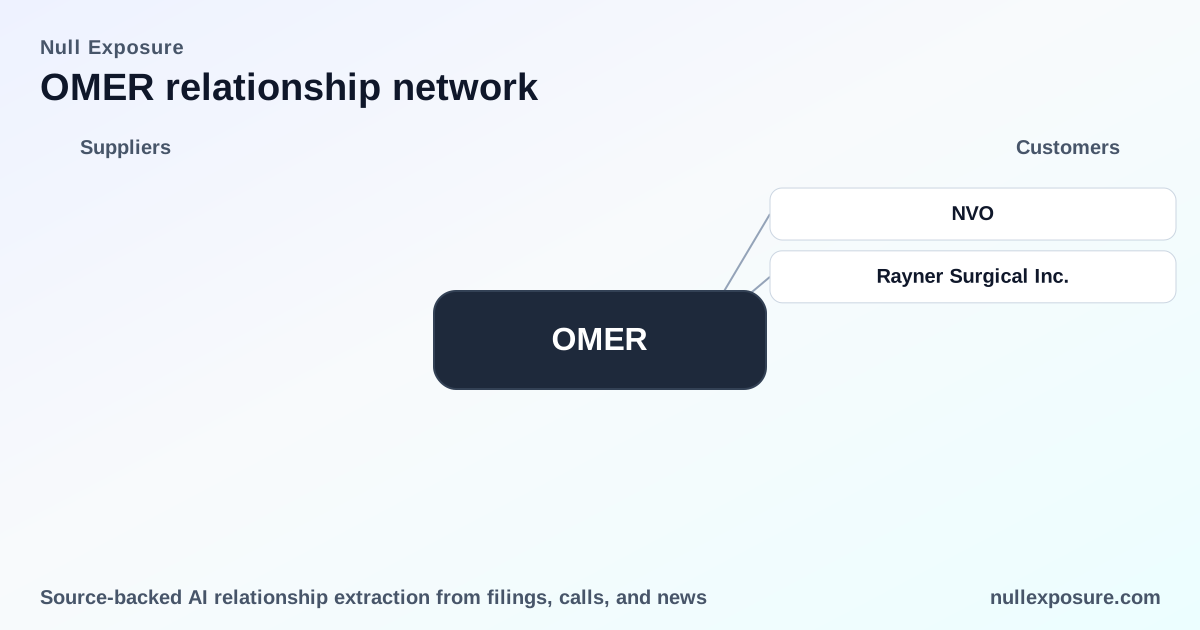
Omeros’ customer roadmap: monetization through royalties, partnerships and one transformational asset sale
Omeros Corporation operates as a commercial-stage biopharma that monetizes via product royalties and intermittent asset sales/licensing deals. The company collects royalties from legacy commercial products (OMIDRIA), partners product commercialization in select markets, and has shifted to an asset-light, milestone-driven cash model by divesting late-stage pipeline assets—most notably the MASP-3 program sold to Novo Nordisk. For investors and operators assessing counterparty exposure, the mix is clear: recurring royalties plus concentrated, high-impact licensing receipts drive near-term liquidity and change long-term upside capture. For a concise tracker of Omeros’ counterparty flows, visit https://nullexposure.com/.
How the Novo Nordisk transaction recalibrates Omeros’ revenue profile
Omeros completed an Asset Purchase and License Agreement (APLA) with Novo Nordisk that transfers global rights to zaltenibart (formerly OMS906), a MASP‑3 inhibitor. The transaction is described by Omeros management as valued up to $2.1 billion in aggregate consideration, and the deal structure includes upfront and milestone payments plus royalties on future net sales; Omeros’ Q3 2025 earnings call discussed royalties in the “high single‑digit to high‑teen” range and headline deal economics. (Source: Omeros 2025 Q3 earnings call, reported March 2026.)
Market and press coverage of the deal highlights immediate cash inflows reported by Omeros—press outlets have cited upfront and near‑term payments reported between roughly $240 million and $340 million, with the full $2.1 billion figure reflecting potential milestones. The agreement grants Novo Nordisk exclusive global development and commercialization rights across indications for zaltenibart. (Sources: Pharmaceutical‑Technology report, Mar 10, 2026; FiercePharma summary and Omeros press coverage, Mar–May 2026.)
Novo Nordisk — one-line relationship summary
Novo Nordisk acquired exclusive global rights to Omeros’ zaltenibart (OMS906) under an asset purchase and license agreement; the transaction is structured as upfront and milestone payments plus royalties and is valued at up to $2.1 billion according to Omeros’ disclosures and press coverage. (Sources: Omeros 2025 Q3 earnings call; Pharmaceutical‑Technology, Mar 10, 2026; FiercePharma, Mar 2026.)
Royalties and commercialization partners still generate cash: Rayner Surgical and Mallinckrodt
Omeros’ business still collects routine royalty revenue tied to OMIDRIA sales and relies on partners for commercialization in certain geographies.
Rayner Surgical Inc. — one-line relationship summary
Omeros earned OMIDRIA royalties of $9.2 million in Q4 2025 on reported U.S. net sales of $30.7 million, indicating ongoing royalty cash flow associated with Rayner Surgical’s U.S. net sales reporting. (Source: Omeros fourth‑quarter and year‑end 2025 financial results press release, Biospace, May 2026.)
The Q3 2025 release recorded a similar royalty pattern—OMIDRIA royalties of $9.2 million on U.S. net sales of $30.5 million—showing consistent quarter‑to‑quarter royalty receipts tied to one commercialization partner’s reported sales. (Source: Omeros third‑quarter 2025 financial results press release, Biospace, Mar 2026.)
Mallinckrodt Pharmaceuticals — one-line relationship summary
Omidria is marketed in the United States through a partnership with Mallinckrodt Pharmaceuticals, which serves as an important commercialization channel for the product while Omeros collects royalties and coordinates international filings as appropriate. (Source: MarketBeat reporting of Omeros partnership references, Jan 2026.)
Operating model signals and investor implications: contracting posture, concentration, criticality, maturity
-
Contracting posture — opportunistic seller and licensor. Omeros demonstrates an explicit willingness to sell or license late‑stage assets (e.g., zaltenibart) to realize large near‑term cash inflows while retaining royalty upside where negotiated; Omeros’ historical language about retaining marketing rights and the explicit sale of OMIDRIA in prior years supports an opportunistic, deal‑driven posture. (Company disclosures cited in filings and press releases; company‑level signal from constraints data.)
-
Concentration risk — revenue skewed to a few counterparties. The company’s near‑term revenue mix is concentrated: a small number of partners (Rayner Surgical/Mallinckrodt and Novo Nordisk) account for the lion’s share of commercial and near‑term licensing receipts, increasing counterparty risk and sensitivity to single‑partner performance and reporting.
-
Criticality — partner receipts are cash anchors. Royalties from OMIDRIA and milestone/asset sale proceeds are material to liquidity and debt dynamics; the Novo Nordisk transaction in particular supplies a large, discrete cash infusion that materially shifts Omeros’ cash runway and strategic options.
-
Maturity — transition from development to commercialization and licensing. Omeros’ model is transitioning from early‑stage discovery to a hybrid of commercial royalties plus selective asset monetization, signaling a move toward capital efficiency and de‑risking of the pipeline through third‑party commercialization.
These are company‑level constraints and operating observations derived from Omeros’ public disclosures and the constraint evidence that flags Omeros’ seller activity (sale of OMIDRIA and an explicit licensing posture).
What investors and operators should watch next
-
Milestone realization and timing from Novo Nordisk — milestones and royalty start dates will determine how much of the advertised $2.1 billion is economically relevant to Omeros over the near term versus longer‑dated potential payments. (Source: Omeros 2025 Q3 earnings call; press coverage, Mar–May 2026.)
-
Quarterly royalty trends from OMIDRIA partners — Q‑over‑Q royalty stability from Rayner/Mallinckrodt is the most reliable near‑term revenue signal; monitor reported U.S. net sales and partner disclosure cadence. (Sources: Omeros Q3/Q4 2025 financial results press releases, Biospace; MarketBeat, Jan 2026.)
-
Concentration and reinvestment strategy — with proceeds from asset sales, management’s capital allocation (debt repayment, new R&D, share repurchase, or M&A) will determine whether Omeros continues to monetize assets or rebuilds retained commercial capability. (Company filings and press releases, 2025–2026.)
For a practical, counterparty‑focused dashboard and deeper relationship mapping for OMER and other tickers, explore our coverage at https://nullexposure.com/.
Bottom line
Omeros has shifted into a hybrid monetization model: recurring royalties from OMIDRIA and other partnered commercial efforts provide steady, if limited, cash flow, while large, concentrated licensing transactions such as the Novo Nordisk APLA drive material, discrete capital inflows. For investors and operators, the company’s near‑term health now rests on partner sales performance, milestone realization schedules, and management’s allocation of proceeds—factors that warrant active monitoring in the coming quarters.