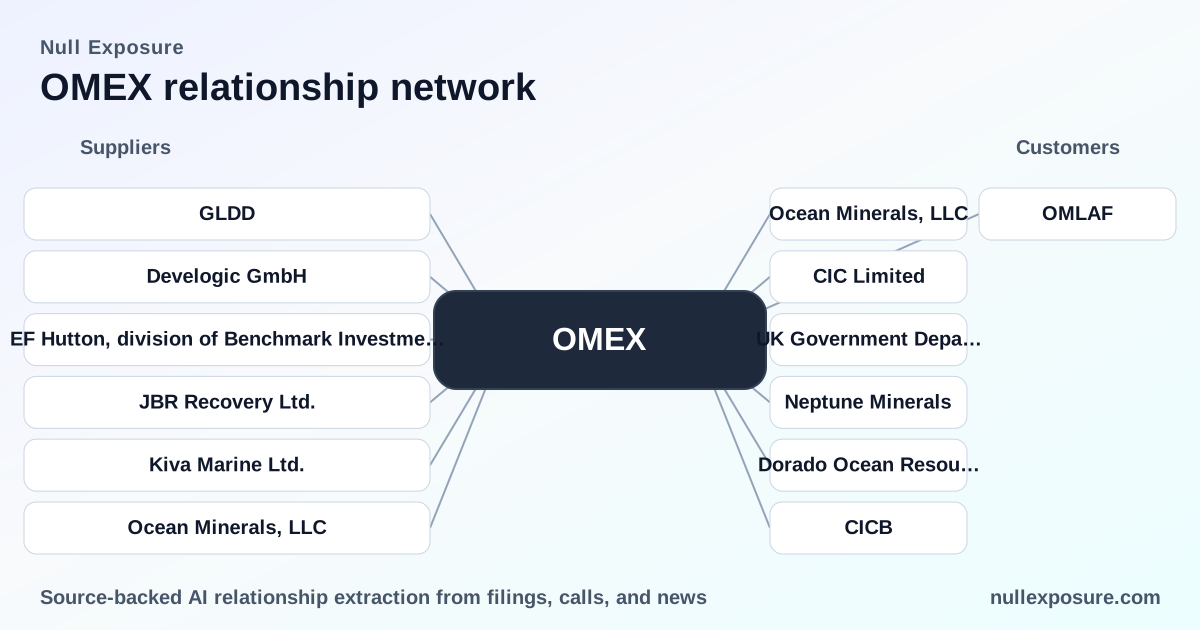
Odyssey Marine Exploration (OMEX): customer map and commercial implications
Odyssey Marine Exploration monetizes proprietary deep-ocean expertise by contracting marine and technical services to industry and government clients, and by taking equity positions in project partners; the company invoices recurring back‑office and technical fees, charges cost‑plus project services and sometimes accepts equity as partial compensation. Revenue is heavily concentrated and structurally tied to a small set of related parties and joint‑project partners, creating high customer dependency and operational leverage to a handful of counterparties. For relationship-level intelligence, visit https://nullexposure.com/.
Quick take: how Odyssey runs and gets paid
Odyssey operates as a specialist service provider and minority investor in seabed exploration ventures. It sells:
- Marine services and technical consulting billed in cash (recurring monthly fees for back‑office services),
- Cost‑plus project work on deep‑sea mineral initiatives, and
- Equity in partners as partial compensation on select contracts.
This combination produces a hybrid monetization model: steady service fees plus upside from equity holdings. The tradeoff is extreme concentration risk—two related parties generated 100% of revenue in recent years—so revenue volatility is driven by contract renewals, project timing and equity realizations.
What the company‑level signals say about operating constraints
- Concentration and criticality are material: Odyssey disclosed that two customers, CIC and OML, together accounted for 100% of revenue for the twelve months ended December 31, 2024 and 2023, making those relationships critical to near‑term cash flows (Omex Form 10‑K, FY2024).
- Contracting posture is service‑centric and structured: Odyssey provides back‑office and deep‑sea services under a Services Agreement that includes recurring monthly fees and cost‑plus arrangements; compensation can be a mix of cash and equity (Omex 10‑K and subsequent 10‑Q disclosures, FY2024–FY2025).
- Counterparty mix includes government customers: Odyssey states it provides services to companies and governments, which signals that public‑sector contracting is part of its addressable workstream (company disclosures).
- Maturity and legacy projects exist: historical salvage contracts and minority stakes in partner ventures indicate the company operates long‑duration, multi‑year engagements (press coverage from 2010–2011).
Together these characteristics imply high counterparty concentration, operational dependence on a few long‑dated contracts, and exposure to partner equity performance—a profile that matters for investors assessing downside risk and upside optionality.
Customer relationships — line by line
Below are the relationships reported in publicly available materials and news coverage, summarized for investor review.
CIC Limited
Odyssey reports providing technical and back‑office services to CIC Limited under a Services Agreement that pays recurring monthly fees and cost‑plus compensation, sometimes settled with a combination of cash and equity; CIC is one of two customers that made up 100% of revenue in 2024. According to Odyssey’s Form 10‑K for FY2024 and related disclosures, receivables and invoicing confirm CIC as a key related‑party customer (10‑K, FY2024; TradingView coverage of OMEX filings, March 2026).
CIC / CICB (alternate filings)
CIC is also referenced in Omex filings under the symbol CICB in receivables disclosures; the FY2024 10‑K shows 23.6% and 42.1% of accounts receivable balances attributable to the same two customers (named in the filing), underscoring receivable concentration tied to CIC and its related entities (OMEX 10‑K, FY2024).
Ocean Minerals, LLC
Ocean Minerals is a direct customer for marine services; Odyssey invoiced Ocean Minerals approximately $0.2 million in both 2024 and 2023 for marine services, recorded in consolidated statements of operations, and Ocean Minerals is identified among the two customers accounting for 100% of revenue (OMEX 10‑K, FY2024; TradingView SEC 10‑Q coverage, March 2026).
OML / OMLAF (alternate notations)
OML is presented in filings with the inferred symbol OMLAF and is explicitly considered a customer of Odyssey in the FY2024 10‑K; invoiced amounts for 2023–2024 are recorded under Marine services, making OML a materially important counterparty for operational revenue (OMEX 10‑K, FY2024).
UK Government Department for Transport
Odyssey was awarded a salvage contract by the UK Department for Transport in September 2011 for the cargo of the SS Mantola, demonstrating the company’s historic capability to secure government salvage work and operate under public‑sector contract terms (Bernews coverage, September 2011).
Neptune Minerals
Odyssey has held a minority stake in Neptune Minerals and provided proprietary deep‑ocean expertise and equipment to Neptune under contract, illustrating Odyssey’s blend of service provision and equity participation in project partners (HeritageDaily report, September 2011).
Dorado Ocean Resources
Odyssey owned approximately 41% of Dorado Ocean Resources (as of 2010 reporting) and provided deep‑ocean expertise and equipment to Dorado under contract, demonstrating a strategic pattern of taking minority ownership in exploration ventures while supplying technical services (NBC News profile, 2011).
Why these relationships matter to investors
- Revenue concentration is the dominant risk factor. With two related parties accounting for all reported revenue in the referenced period, contract renewals or payment delays would have outsized effects on cash flow and liquidity (OMEX 10‑K, FY2024).
- Contract terms create mixed cash/equity exposure. The cost‑plus and equity‑compensation elements give upside through partner successes but reduce near‑term cash visibility and increase earnings volatility (10‑K and 10‑Q disclosures).
- Government work and legacy salvage projects provide credibility and lifecycle diversity. Government contracts and long‑running salvage engagements increase technical validation but tie revenue to long procurement cycles and political/legal risk (historic press reports).
Investment implications and monitoring checklist
- Monitor collection and receivables concentration by counterparty each quarter; accounts receivable tied to CIC/OML drive short‑term liquidity (10‑K FY2024).
- Track contract renewals, any equity‑for‑services arrangements, and disclosures of partner solvency or financing events that would affect Odyssey’s equity receipts.
- Watch for new non‑related counterparty wins to reduce concentration; any sustained diversification in marine services revenue would materially de‑risk the story.
For deeper relationship analytics and ongoing monitoring on OMEX customers, visit https://nullexposure.com/ for subscription options and real‑time coverage.
Bold conclusion: Odyssey’s business model is commercially coherent—specialist services plus equity upside—but operationally fragile due to extreme customer concentration and mixed cash/equity compensation mechanics. Investors should underwrite both the upside potential of partner equity realizations and the downside of concentrated counterparty credit and contract timing.