OneMain Holdings (OMF): Customer Relationships That Finance Growth—and Transfer Risk
OneMain is a specialty consumer lender that originates fixed‑term personal and auto loans, distributes ancillary insurance products, services receivables, and monetizes credit through interest income, fees, and the sale of loan pools. The company runs a branch-heavy omnichannel originations engine, retains a large servicing platform, and transfers funded credit risk to institutional buyers through recurring forward‑flow and securitization programs—creating a hybrid earnings stream of net interest margin, origination economics, servicing income, and sale gains. For investors, the key questions are how durable funding/loan‑sale channels are, how concentrated counterparties are, and how dependent insurance and dealer distribution partners are on OneMain’s flow. Learn more at https://nullexposure.com/.
Funding and risk transfer: who is buying OneMain loans
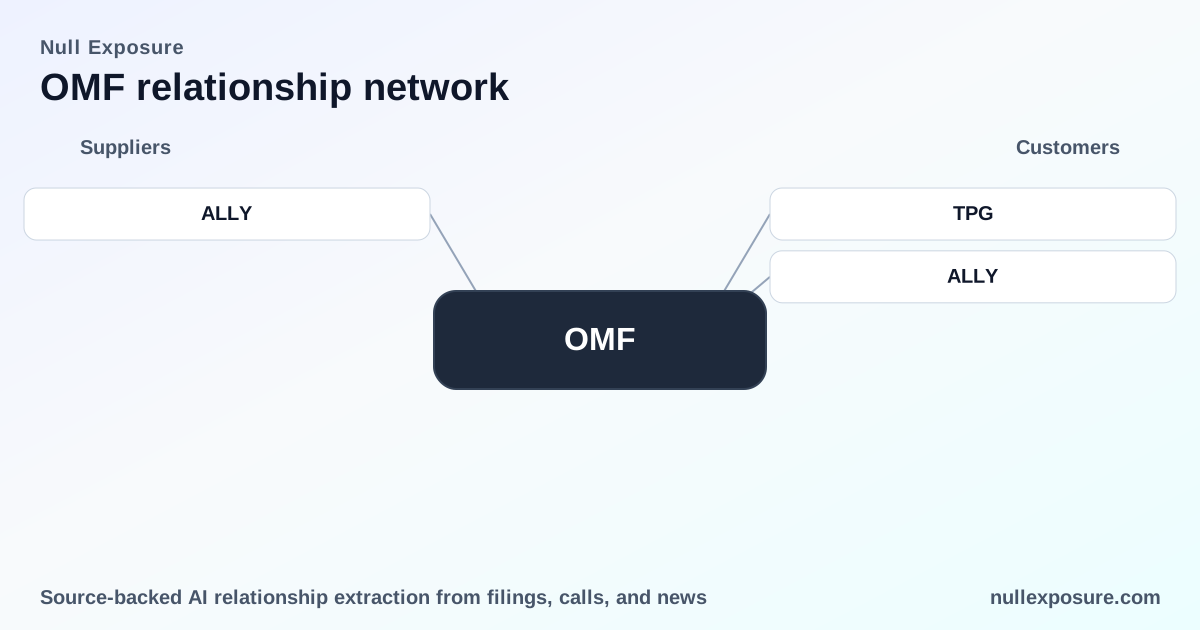
TPG — the large forward‑flow counterparty
TPG has agreed to buy roughly $2.4 billion of OneMain loans on a continuing forward‑flow basis through June 2028, providing a predictable outlet for originated receivables and reducing held balances. This arrangement is reported via Bloomberg and cited in coverage from InsiderMonkey and MarketScreener in early 2026. (InsiderMonkey / Bloomberg, March 2026; MarketScreener, Jan 2025–reported 2026.)
Ally Financial — auto finance distribution and pass‑through work
OneMain expanded a partnership with Ally Financial to create a pass‑through arrangement tied to Ally’s ClearPass program, broadening auto finance distribution and dealer reach; the ClearPass collaboration had grown to roughly 1,700 participating dealers as noted on the company’s recent call. OneMain management disclosed the Ally pass‑through in its Q4 2025 earnings call and analysts cited the expanded relationship in March–May 2026 coverage. (OneMain Q4 2025 earnings call; analyst notes reported March–May 2026.)
American Health and Life Insurance Company (AHLIC) — distribution reliance
AM Best’s review noted that AHLIC is dependent on OneMain as a primary distribution source for credit life, disability and related insurance products, signaling that OneMain’s branch and origination footprint is a core channel for AHLIC’s product delivery. (AM Best commentary reported on Yahoo Finance, May 2026.)
Triton Insurance Company — channel dependence for insurance sales
Similarly, AM Best’s commentary highlights that Triton Insurance relies on OneMain for distribution, which makes OneMain a critical commercial partner for these insurers’ credit‑protection product flows. (AM Best commentary reported on Yahoo Finance, May 2026.)
How the partner map translates into commercial and credit dynamics
OneMain’s partner set mixes a large institutional buyer (TPG), a strategic auto‑finance ally (Ally), and insurance carriers that depend on OneMain distribution (AHLIC, Triton). Each relationship serves a distinct monetization or operational purpose:
- TPG provides predictable funding and a capital outlet for receivables, shrinking held balances and supporting originations growth without proportionally increasing on‑balance sheet leverage. The TPG forward‑flow contract runs through mid‑2028 and is a material buyer of newly originated consumer loans. (Bloomberg reporting cited in InsiderMonkey and Sahm Capital, March 2026.)
- Ally expands dealer reach and auto product distribution, enabling OneMain to scale secured auto volumes and cross‑sell ancillary products at point of purchase; this strengthens origination throughput and dealer‑channel economics. (OneMain Q4 2025 earnings call; analyst coverage, March–May 2026.)
- AHLIC and Triton illustrate OneMain’s role as a distribution platform for insurance carriers, generating fee and product revenue but also concentrating distribution risk if branch flows decline. (AM Best coverage via Yahoo Finance, May 2026.)
Company‑level operating characteristics investors should weight
Below are firm‑level signals—drawn from OneMain disclosures and the relationship evidence—that define its operating model and commercial exposure:
- Contracting posture: predominantly long‑term lending and recurring sale arrangements. OneMain’s personal loans are fixed‑term (generally three to six years), and the company uses multi‑year forward‑flow agreements and revolving securitizations to monetize originations. This creates predictable lifetime cash flows on retained loans and structured outlets for saleable receivables. (Company product descriptions and forward‑flow reporting, 2025–2026.)
- Counterparty profile: retail individuals are the borrower base. OneMain operates squarely in the consumer finance segment, serving borrowers with limited bank access; its originations therefore reflect a higher‑spread, nonprime profile. (Company filings through FY2025–2026.)
- Geography and distribution breadth: national but U.S.‑centric. The firm operates in 48 states, combining 1,300+ branch locations with digital and phone channels—supporting scale and making OneMain materially integrated into some insurers’ distribution strategies. (Corporate disclosures, 2025.)
- Role duality: both seller of loans and servicer/operations provider. OneMain sells receivables to institutional buyers while also servicing loans (including VIEs where it is the primary beneficiary), creating both a revenue diversification advantage and an operational dependency on its servicing platform. (Company financial disclosures, 2025.)
- Relationship maturity and activity: active, ongoing programs. The balance sheet includes approximately $24.8 billion of finance receivables and active servicing of third‑party owned loans, indicating mature originations and servicing operations entering 2026. (Company filings, Dec 31, 2025.)
Investment implications: concentration, criticality and optionality
- Concentration risk: The $2.4 billion TPG forward‑flow is large relative to incremental originations and represents a single counterparty with material purchase commitments through 2028; investors should monitor renewal terms, pricing, and counterparty credit. (Bloomberg reporting cited in InsiderMonkey and Sahm Capital, March 2026.)
- Distribution criticality: AHLIC and Triton’s dependence on OneMain for distribution highlights OneMain’s commercial leverage with insurers—this is a competitive strength but creates counterparty interdependence if origination volumes weaken. (AM Best commentary via Yahoo Finance, May 2026.)
- Operational optionality: Ownership of servicing infrastructure and active pass‑through deals with Ally give OneMain flexibility to retain servicing‑based income even as it sells principal; that capability supports margins and offers a path to preserve recurring revenue if sale markets tighten. (OneMain Q4 2025 earnings call; analyst notes, 2026.)
- Maturity and durability: Fixed‑term loan structure and multi‑channel origination create stable lifetime cash flow profiles, but performance is tied to nonprime borrower credit cycles—monitor delinquencies and seasoning effects in the portfolio.
Key takeaways for investors: OneMain’s model converts origination volume into diversified revenue via sales to institutional buyers (TPG), strategic dealer partnerships (Ally), and insurance distribution relationships (AHLIC, Triton)—a structure that reduces some balance‑sheet concentration but concentrates counterparty risk around large forward‑flow buyers and ties insurance revenue to origination flow. For deeper company relationship mapping and signals, visit https://nullexposure.com/.
Bottom line
OneMain blends lending, servicing, and distribution into a scalable consumer finance platform. The company’s partner relationships are simultaneously growth enablers and concentration vectors: TPG supplies exit capacity; Ally expands dealer reach; AHLIC and Triton rely on OneMain’s distribution. Investors should watch forward‑flow renewal economics, dealer penetration metrics, and insurance distribution volumes as the primary indicators of revenue durability and counterparty risk.