ONBPO: Customer Relationships That Drive Preferred Share Stability
Old National Bancorp issues the Series C preferred depositary shares traded as ONBPO; the underlying franchise is a regional bank that monetizes through net interest margin, fee income from payments and wealth management, and transactional deposits across the Midwest and Southeast. For preferred shareholders, the creditworthiness and revenue mix of Old National determine dividend coverage; understanding customer relationships — from business divestitures to community engagement — is essential to assessing dividend durability and operational risk. For deeper company-level signals and relationship tracking, see Null Exposure for structured briefs and source links: https://nullexposure.com/.
How Old National operates and why customer ties matter
Old National Bancorp operates as a diversified regional financial services firm. The company provides commercial and consumer lending, deposit services, private banking, capital markets, brokerage, wealth management, trust and investment advisory through Old National Bank and non-bank affiliates. The firm’s revenue base was reported at approximately $2.51 billion (Revenue TTM) with a profit margin of 30.2% and return on equity around 10.1%, indicating a profitable regional banking franchise that supports preferred dividends through stable earnings and capital management.
Customer relationships drive both interest-earning balances and fee revenue. Retail depositors and small businesses form the primary counterparty mix, while wealth and capital markets clients drive higher-margin fees. Changes to that mix — for example, divesting a fee-generating HSA custodial book — alter the revenue composition and are therefore relevant to holders of ONBPO.
What public constraints tell investors about commercial posture
The company disclosures and extracted constraints generate a coherent operating signal:
- Contracting posture: short-term contingent exposures exist. Standby letters of credit are described as typically one year or less, which signals a short-term horizon for many contingent liabilities and a need for active liquidity management.
- Customer concentration: broad retail and small-business orientation. Filings specify lending to individuals (home equity, residential) and to small businesses (BBCC loans), indicating a diversified but retail-heavy credit book rather than large corporate concentration.
- Geographic focus: Midwest and Southeast core markets. This regional footprint reduces global macro exposure but increases sensitivity to local economic cycles and regional real estate dynamics.
- Relationship role and maturity: active service provider across multiple client segments. The company functions as a full-service provider to individuals and small businesses, with active, ongoing client engagements rather than one-off transactional relationships.
These signals together describe a mature, retail- and SME-focused bank with short-term contingent liabilities and a regional concentration — a profile that supports stable deposit funding but requires ongoing monitoring of local economic trends and credit performance.
Public customer relationships investors should know
Every public customer relationship identified in our review is summarized below with source context.
UMB Bank — sale of a $500M HSA business (FY2022)
Old National sold a $500 million health savings account (HSA) custody and servicing business to UMB Bank, a transaction reported in June 2022; the divestiture reduces Old National’s fee-bearing custodial assets while shifting servicing risk and custody revenue to UMB. According to a St. Louis Business Journal report in June 2022, UMB Bank agreed to acquire Old National’s HSA business valued at $500 million (source: St. Louis Business Journal, June 28, 2022 — https://www.bizjournals.com/stlouis/news/2022/06/28/umb-bank-to-buy-hsa-business-old-national-bank.html).
Key takeaway: divesting an HSA book trims non-interest fee income and non-deposit liabilities, a strategic choice that rebalances revenue toward core lending and deposit spreads.
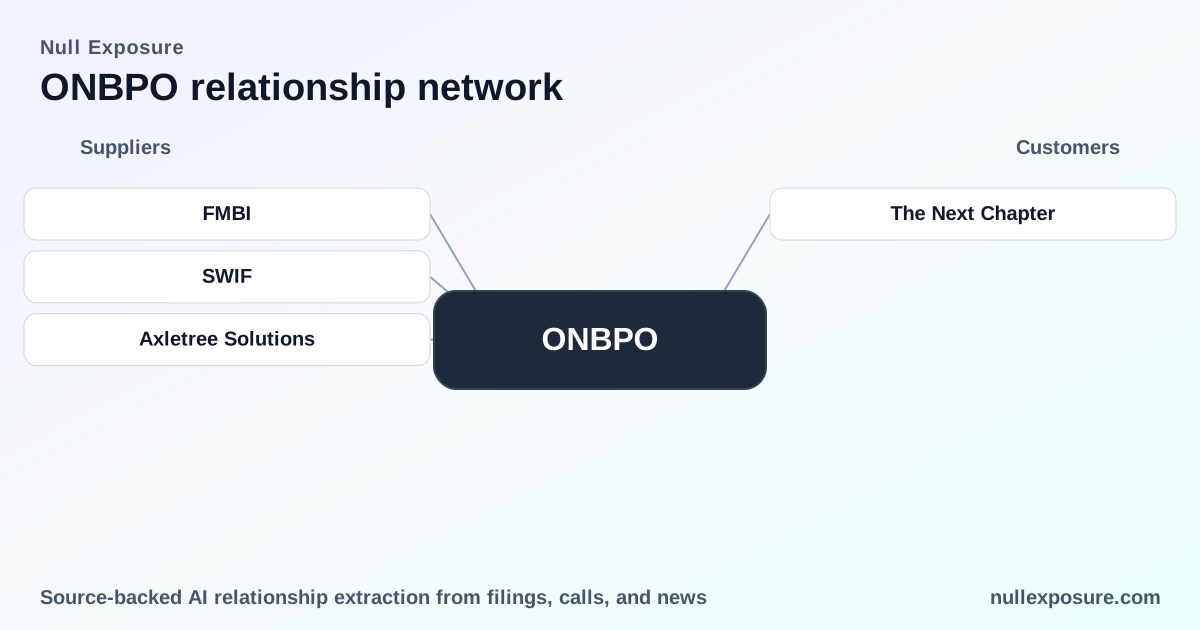
The Next Chapter — local small-business finalist in a sponsored program (FY2025)
Old National Bank served as a presenting sponsor of a Small Business Assist Program with the Indiana Fever, where local business The Next Chapter was named a finalist; this reflects Old National’s continued investment in community and small-business branding and customer acquisition. A March 2026 report in the Dubois County Free Press described The Next Chapter’s nomination and finalist status in the program presented by Old National Bank (source: Dubois County Free Press, March 2026 — https://duboiscountyfreepress.com/next-chapter-in-running-for-small-business-grant-from-indiana-fever-and-old-national-bank/).
Key takeaway: community sponsorships and small-business programs drive local customer acquisition and deepen SME deposit and lending relationships in core markets.
Investor implications: what these relationships mean for ONBPO holders
These relationship datapoints and company-level constraints translate into several clear investment implications for ONBPO holders:
- Revenue mix impact: The HSA sale to UMB reduces fee-bearing custodial assets and shifts income composition toward net interest income. For preferred shareholders, the net effect is neutral to positive if interest margins and loan growth offset lost fees; monitor sequential fee revenue disclosures.
- Liquidity and contingency profile: Short-term standby letters of credit and active retail servicing imply a near-term liquidity management requirement. Preferred dividends are sensitive to quarterly earnings and loan loss provisioning cycles driven by regional credit performance.
- Customer diversification and criticality: The bank’s customer base is broad across individuals and small businesses, which mitigates single-counterparty concentration risk but increases exposure to regional economic cycles; community programs act as demand-generation tools that support deposit stability.
- Maturity and strategic posture: Active service-provider role across segments denotes a mature operating model that prioritizes deposit gathering and cross-sell; tactical divestitures of non-core fee businesses indicate a focus on higher-return core banking activities.
Monitor the following metrics and signals to judge preferred-share stability:
- Sequential fee income trends and disclosures around custodial / trust revenues.
- Quarterly net interest margin and deposit cost trends.
- Regional loan performance (residential and small-business segments).
- Liquidity ratios and usage of standby letters of credit.
For a consolidated feed on these relationship movements and source-level tracking, visit Null Exposure: https://nullexposure.com/.
Where to watch next and final verdict
Old National’s customer actions — selling an HSA book to UMB and sponsoring local small-business initiatives — reflect active portfolio management and persistent community engagement. For ONBPO holders, the central question is whether core earnings and capital management continue to support the fixed dividend profile. Given the firm’s diversified retail/SME customer base, regional focus, and short-term contingent exposures, investors should prioritize monitoring fee-income trends and regional credit performance.
Bottom line: ONBPO holders gain exposure to a profitable, regionally diversified bank with a prudent operating posture; the firm’s customer relationship moves are consistent with a strategy to concentrate on core lending and deposit activities while using community programs to sustain customer acquisition and deposit growth.