Old National (ONBPP): Customer relationships that matter for credit and operations
Old National Bancorp issues depositary shares represented by ONBPP, and the bank monetizes through traditional regional banking activities—deposit gathering, lending, fee income from wealth and capital markets, and occasional loan sales or standby instruments that support commercial counterparties. For investors in the preferred tranche, credit and operational health of Old National’s customer relationships is a direct input to dividend coverage and balance-sheet stability. If you track counterparties or integration events as a proxy for franchise execution risk, the recent public reports below are material. For a concise reference on coverage and signals, see Null Exposure’s research hub: https://nullexposure.com/.
How to read these relationship signals — the operating model in plain terms
Old National runs a service-centric regional bank focused on the Midwest and Southeast United States, offering a broad mix of depository, lending, wealth, and capital markets services. From the constraint evidence, the bank’s customer engagements skew toward short-term commercial instruments and individual retail relationships, and the company acts both as a service provider and as a seller of loan assets. Those attributes create an operating posture where:
- Contracting is often short-term and transactional: standby letters of credit and similar instruments commonly expire within a year, indicating recurrent renewal activity rather than long-duration locked-in contracts.
- Counterparty mix includes a large retail/individual component, which increases volume and servicing demands but reduces single-counterparty concentration risk.
- Geographic concentration is regional (Midwest/Southeast), which provides local franchise depth but raises exposure to region-specific economic cycles.
- The business is service-led and maturity is mixed: many relationships are ongoing (deposit and advisory flows) while some product lines (loan sales, LCs) are shorter-term and episodic.
These constraints imply operational execution and customer service quality are economic levers for Old National: onboarding problems or integration frictions will have immediate visibility and can affect deposit retention and fee income. Learn more about how we track these events at Null Exposure: https://nullexposure.com/.
On-the-ground relationship reports (each reported match)
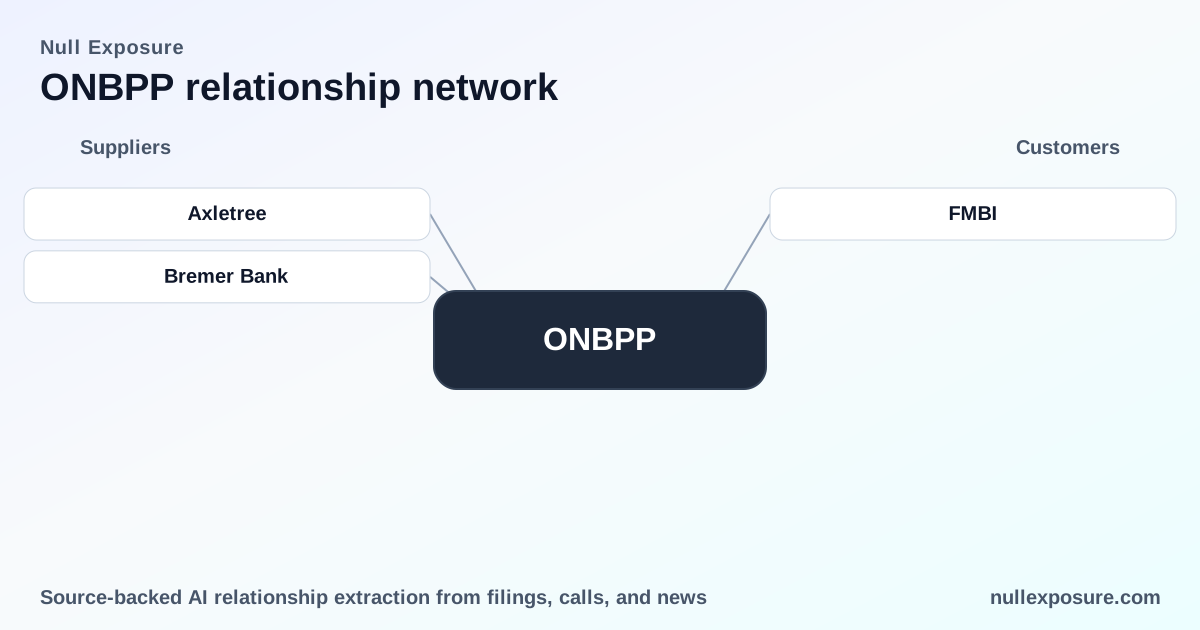
First Midwest Bank (FMBI) — merger onboarding problems reported (FY2022; reported March 10, 2026)
Customers transitioning from First Midwest Bank to Old National reported hours-long phone waits, malfunctioning or missing debit cards, and online access failures during the integration, citing significant friction in account conversion. This reporting traces to a March 10, 2026 Patch article covering consumer complaints around the merger implementation (FY2022 integration activity).
Source: Patch coverage of account transition problems, March 10, 2026 (reported issue tied to First Midwest Bank / FMBI integration).
(Note: the same Patch report is indexed twice in public feeds; both entries reference the identical customer-impact narrative.)
Bremer Bank — commercial leadership transition after partnership completion (FY2026; reported May 3, 2026)
Old National completed a partnership with Bremer Bank in 2025 and formally folded a commercial banking leader into Old National’s management team, an integration milestone reported in May 2026 that signals consolidation of regional commercial capabilities. The MonitorDaily story on May 3, 2026 described the completion of that partnership and the leadership alignment under Old National.
Source: MonitorDaily article highlighting Old National’s alignment of commercial banking leadership following the Bremer partnership, May 3, 2026 (FY2026 reference).
What these relationships mean for investors and operators
Both relationship reports point to distinct operational vectors that drive risk and opportunity:
- Execution risk on integrations is high-impact but observable: the First Midwest onboarding complaints are operational, consumer-facing failures that work through deposits and fee income quickly; these are not long-tail credit issues but they affect near-term liquidity and reputation.
- M&A and partnership integration is an active growth channel: the Bremer completion shows Old National continues to expand via strategic deals, which boosts scale but raises integration complexity.
- Short-term contracting behavior increases renewal and servicing cycles: standby instruments and short-tenor commercial products mean management must execute consistently on renewals and underwriting, not rely on long-duration contract tailwinds.
- Regional concentration and retail orientation favor diversification across many small counterparty relationships but leave the company exposed to local economic cycles and operational shocks.
These factors together produce a franchise where operational execution and deposit retention are as material to preferred shareholders as traditional credit metrics.
Risk focal points and monitoring checklist
For active investors and operators evaluate these signals with an emphasis on measurable execution and trending indicators:
- Monitor onboarding complaints, social/news sentiment, and call-center metrics after any announced merger or conversion event.
- Track deposit flows and noninterest income in the quarters immediately following integrations; rapid outflows or fee declines flag execution shortfalls.
- Watch renewal volumes and utilization for short-term commercial instruments (LCs, commercial lines) given the one-year typical tenor.
- Follow management commentary on integration progress and retention rates for acquired customer cohorts.
Bottom line: what to watch and why it matters
Old National’s customer relationships are a central operational input to capital stability and dividend reliability for ONBPP holders. The firm’s service-led, regionally concentrated model means that integration execution and retail servicing are immediate drivers of financial performance, while short-tenor commercial contracts create recurring underwriting and servicing demands rather than durable locked-in revenue. Investors should weight operational KPIs—onboarding quality, deposit retention, and renewal rates—alongside traditional credit metrics.
For deeper signal tracking and ongoing relationship alerts, visit Null Exposure: https://nullexposure.com/.
Bold takeaway: integration frictions (like the FMBI conversion) are not hypothetical—when they occur, they show up in deposits and service volumes within weeks, and the completed Bremer integration demonstrates the opposite lever: successful consolidation increases commercial scale but requires disciplined execution.