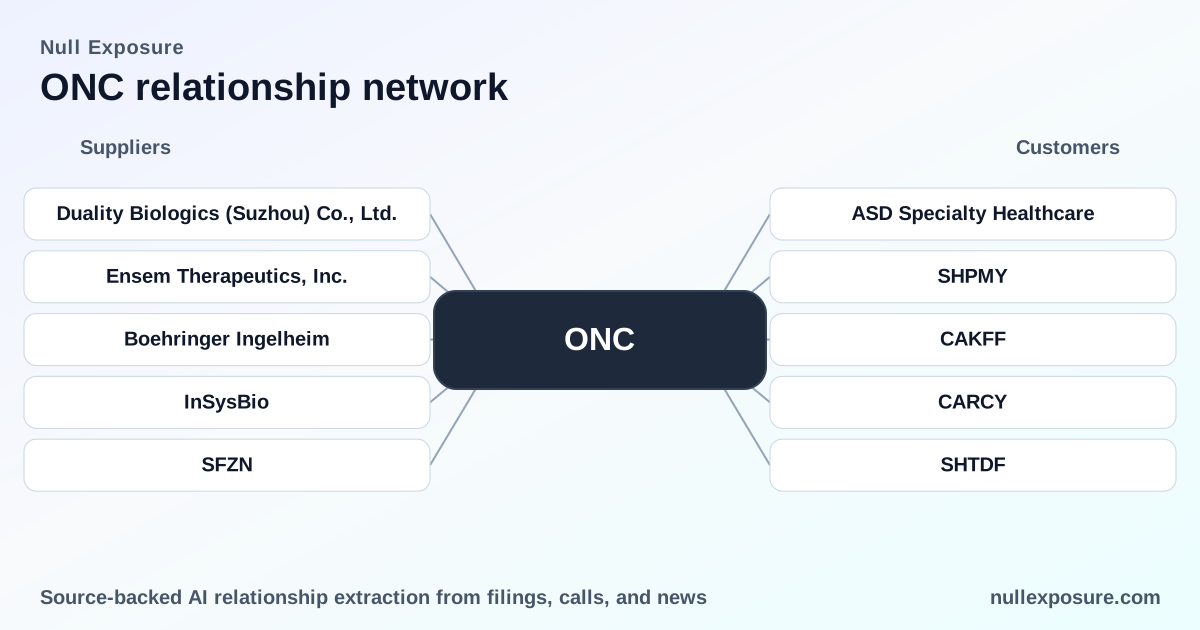
BeiGene (ONC) — concentrated distributor relationships that shape commercial exposure
BeiGene operates as a global oncology commercial-stage biopharma that discovers, develops and sells cancer therapies through a mix of direct commercial channels and third‑party distributors. The company monetizes principally by capturing product revenue from a small number of large national distributors and health systems across China, the U.S., and Europe, with top distributors representing a material share of product sales in both 2023 and 2024. Investors should value growth from flagship products like BRUKINSA against measurable customer concentration and government procurement exposure in APAC markets.
Explore full customer mapping at Null Exposure
What the top-line customer data tells you about the business model
BeiGene’s revenue mix and partner footprint show a commercial strategy built on a global sales organization plus reliance on major national distributors to reach institutional buyers, particularly in China. For the year ended December 31, 2024, the company disclosed that ASD Specialty Healthcare, McKesson and Shanghai Pharmaceutical accounted for roughly 18.0%, 16.9% and 11.1% of product revenue, respectively, illustrating a concentrated customer base on the product side. According to the same filing, net product revenue was $3.8 billion in 2024, driven by strong growth in BRUKINSA and in‑licensed products.
This model creates a mix of advantages and exposures:
- Efficient scale and reach: Global commercial organization plus major distributors accelerate market penetration without proportionally higher field expense.
- Concentration risk: A handful of distributors account for a substantial portion of product revenue, increasing counterparty and operational dependency.
- Regulatory/governmental channel dependence in APAC: China’s centralized procurement mechanisms mean sales flow through government-led channels and a Two‑Invoice distribution regime, concentrating negotiation leverage at the national/provincial level.
Company-level operating constraints and what they imply for contracting posture
The 10‑K discloses several structural constraints that shape how BeiGene contracts and manages partners:
- The company relies on third‑party distributors for distribution of both in‑licensed and internally developed medicines; in some Chinese cases this is sole distribution, imposing execution and counterparty risk.
- Government procurement regimes in China dominate the procurement channel for public hospitals (centralized bidding and the NHSA), elevating counterparty concentration risk with public systems and provincial bidding authorities.
- Geographic mix is global but materially weighted: the U.S., China and Europe constitute the bulk of revenue, with explicit product revenue line items by region in the 2024 filing.
- The product portfolio has commercial maturity for core medicines (BRUKINSA and several in‑licensed drugs), with BRUKINSA sales growing rapidly—evidence the relationships are active and revenue‑critical.
Taken together, these signals indicate a contracting posture that must manage sole‑distributor dependencies, government procurement cycles in APAC, and a concentrated counterparty list—conditions that favor formal contract terms, strong distribution oversight, and active re‑negotiation strategies as markets mature.
Detailed partner briefs — what the 10‑K lists and why it matters
ASD Specialty Healthcare
ASD Specialty Healthcare represented approximately 18.0% of product revenue in FY2024, making it the single largest distributor disclosed for that period and a critical commercial conduit in BeiGene's distribution mix. According to BeiGene’s 2024 Form 10‑K, ASD was one of the three largest product distributors for the year ended December 31, 2024.
McKesson (CAKFF)
McKesson accounted for approximately 16.9% of product revenue in FY2024, reflecting substantial U.S. and channel sales concentration with a major global pharmaceutical wholesaler. This figure is disclosed in BeiGene’s Form 10‑K for the year ended December 31, 2024.
Shanghai Pharmaceutical (SHPMY)
Shanghai Pharmaceutical accounted for around 11.1% of product revenue in FY2024, and was also a top distributor in 2023 with material shares cited in the filing; it functions as a major Chinese distributor through which BeiGene routes institutional sales. The company lists Shanghai Pharmaceutical among its largest product distributors in the FY2024 10‑K.
China Resources (CARCY)
China Resources represented roughly 11.4% of product revenue in FY2023, according to the company’s historical disclosure of its four largest product distributors for the year ended December 31, 2023; it remains a named large distributor in the filing and an important partner in China’s institutional channel.
Sinopharm (SHTDF)
Sinopharm was disclosed as representing approximately 16.0% of product revenue in FY2023, making it one of the largest distributors in that year and a strategic distribution partner for reaching public hospitals under China’s procurement system as noted in the FY2024 10‑K disclosures.
What investors and operators should monitor now
BeiGene’s top distributor list is stable but concentrated; management execution and contract stewardship determine how durable revenue streams are as procurement rules and competitive dynamics change. Key monitoring items:
- Renewal and exclusivity language with sole distributors in China and any shift toward multi‑distributor models.
- Outcomes of provincial and national tenders administered by the NHSA and changes to the Two‑Invoice System that affect margins and channel partners.
- BRUKINSA growth trajectory and whether new products reduce reliance on the top distributors over time.
- Counterparty credit and operational risk at named distributors, especially where a single partner represents double‑digit percentages of product revenue.
For a structured view of BeiGene’s customer concentration and how it connects to revenue sensitivity, Null Exposure maps these relationships and their materiality. Investigate customer concentration tools for portfolio-level monitoring.
Bottom line: concentrated exposure — manageable if actively governed
BeiGene’s commercial strength comes from a focused product portfolio and an efficient distribution strategy that leverages major national distributors. That focus creates concentrated counterparty exposure—a material risk vector for revenue volatility tied to renegotiations, procurement cycles and distributor execution. Investors should reward visible diversification of distribution channels and product breadth; operators should prioritize contract robustness, distributor performance metrics, and active management of government procurement dynamics to protect revenue continuity.