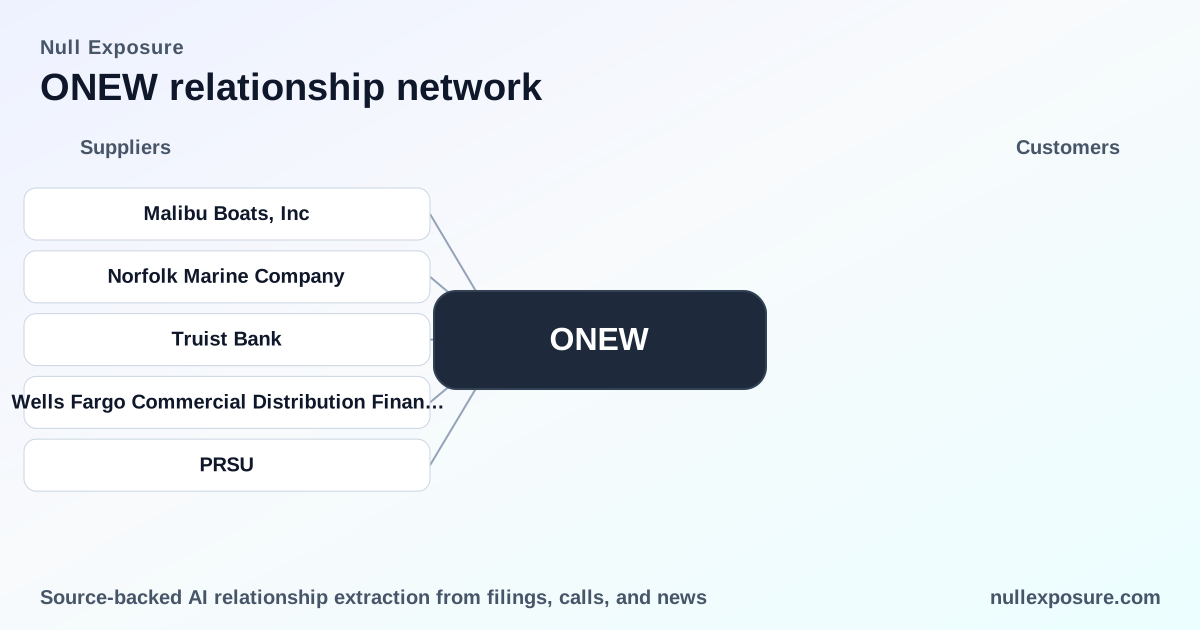
OneWater Marine (ONEW): Customer Relationships, Constraints, and What Investors Should Price In
OneWater Marine runs a vertically integrated recreational marine retail platform that monetizes through new and pre‑owned boat sales, parts and accessories, service and storage, and a small but strategic distribution business. Revenue is driven by high‑margin dealership operations complemented by an aftermarket distribution arm that represents roughly 8% of revenues, while financing, insurance, and service activities widen lifetime value per customer. For investors and operators evaluating counterparty and customer exposure, the firm presents a U.S.‑centric retail profile with low customer concentration and multiple operating levers to monetize vessel ownership. For a deeper supplier and customer signal readout, view more at https://nullexposure.com/.
How OneWater actually runs the business and where the cash comes from
OneWater is primarily a dealer network: it operates 95 retail locations across 19 states, runs 9 distribution centers/warehouses, and sells through online marketplaces in addition to on‑site sales. The Dealership segment is the company’s core revenue engine, covering boat sales, service, parts, slip/storage and financing/insurance facilitation, while the Distribution segment—composed of PartsVu, Ocean Bio‑Chem and T‑H Marine—handles manufacturing, assembly and wholesale distribution channels that serve retailers and big‑box partners. The company generated $1.835B in trailing revenues with a positive operating margin and a TTM gross profit of $429M, underscoring a durable retail margin profile as boat inventory and service cycles recover.
Key commercial mechanics: direct retail to individual boat buyers, recurring aftermarket demand (service parts and storage), and a modest wholesale/distribution channel that diversifies revenue streams away from pure retail cycles.
Operational constraints and company‑level signals investors need to price
Treat the following as company‑level signals that shape contracting posture, concentration risk, criticality, and maturity of OneWater’s customer relationships:
- Counterparty mix: OneWater’s end customers are predominantly individual consumers, reflecting a retail contracting posture focused on high‑volume low‑ticket interactions rather than a few large enterprise contracts. This is explicit in how the Distribution and Dealership segments are described.
- Geographic concentration: The business is U.S.‑centric, operating in 19 states and positioning OneWater as one of the largest recreational marine retailers in the United States. This makes macro exposure concentrated to North American consumer discretionary cycles.
- Customer concentration: No single customer or affiliate contributed ≥10% of revenues, so revenue is broadly distributed across many retail customers—this materially reduces counterparty concentration risk.
- Role diversity: OneWater acts as seller, service provider, distributor and manufacturer across segments—retail sales and services are core while distribution/manufacturing is a smaller but complementary line.
- Materiality and criticality: Distribution represents ~8% of revenues, so while strategically useful for margins and cross‑sell, it is not the critical revenue driver; dealership operations are the primary business.
- Maturity and stage: The company’s footprint (95 locations, 9 warehouses) indicates an active, mature retail network rather than an early‑stage rollup—with recurring aftermarket demand and service capabilities that drive customer lifetime value.
(These signals derive from the company’s reporting as of September 30, 2025 and related segment disclosures.)
Customer relationships in the record: what we found
Below is a concise readout of every customer relationship captured in our results for ONEW.
KVHI — connectivity provider with accelerating vessel subscriptions
KVHI is recorded in our results as a named counterparty; management reported that subscriber vessels rose 11% to about 9,000 since the prior quarter and 26% year‑to‑date, driven by demand for Starlink and OneWeb low‑Earth orbit (LEO) connectivity services. For OneWater investors, this is relevant because adoption of LEO connectivity among boat owners expands potential aftermarket services and digital monetization avenues (remote diagnostics, premium telematics, connected navigation).
Source: KVHI 2025 Q3 earnings call (reported March 7, 2026).
What the relationship map implies for commercial risk and upside
- Low counterparty concentration reduces single‑counterparty revenue shock risk. With no customer accounting for ≥10% of revenues, OneWater’s retailer model spreads exposure across many consumers and regional dealerships. This supports stable cash flow absent systemic consumer‑spend declines.
- Distribution is strategically useful but not central. The Distribution segment contributes ~8% of revenues and includes PartsVu, Ocean Bio‑Chem and T‑H Marine; it supports aftermarket margins and cross‑sell but does not concentrate risk into a single supplier or buyer.
- Retail exposure to North America cycles is the dominant macro lever. The business is largely domestic, so consumer discretionary conditions, interest rates (financing of boat purchases), and regional weather/seasons are the primary demand drivers.
- Service and parts create recurring revenue buffers. Repairs, maintenance, insurance brokering and storage offerings produce recurring cash flows and increase lifetime value per customer, partially insulating earnings from new‑boat cycle variability.
Near‑term operational issues and investor watchlist
- Track inventory turns and financing penetration: Dealer economics rely on managing inventory and trade cycles; higher days inventory or a pullback in dealership financing can compress margins.
- Monitor aftermarket attachment rates: Upsell of parts, service plans and storage matter because they are higher margin and less cyclical.
- Watch adoption of connected services among boat owners: the KVHI data point signals a structural shift that OneWater can monetize through aftermarket packages and connectivity sell‑through at point of sale.
- Keep an eye on regional concentration effects—being U.S.‑focused increases sensitivity to domestic discretionary spending patterns.
For operators and credit teams, the combination of a broad individual consumer base, diversified revenue streams across dealership and distribution lines, and modest distribution materiality points to manageable counterparty risk and multiple levers for margin improvement.
Bottom line: investment frame and next steps
OneWater is a scale retail platform in a specialized discretionary vertical with diversified customer touchpoints and low single‑customer concentration. The business model benefits from recurring aftermarket revenue and strategic distribution assets, while primary risks are tied to U.S. consumer cycles and inventory/financing dynamics. For deeper proprietary diligence and counterparty mapping, visit https://nullexposure.com/ for the full service offering.
What to do next: review the company’s latest quarter for inventory trends and financing penetration, and watch connectivity adoption among vessel owners as an incremental monetization channel.