Onfolio Holdings (ONFO): Customer Relationships and Revenue Dynamics
Onfolio acquires and operates a portfolio of online businesses and directly monetizes through a mix of direct product sales, subscription services, and B2B marketing/SEO service contracts; it augments growth by buying customer streams and paying contingent seller consideration tied to future gross revenues. The company recognizes gross revenue when it is the primary obligor, balances spot and subscription receipts through standard deferral rules, and funds acquisitions with equity and operating cash — a model that drives scaling by buying customer economics rather than building them organically. For additional context and ongoing coverage visit Null Exposure.
How Onfolio paid for customers from First Page — the deal investors should know
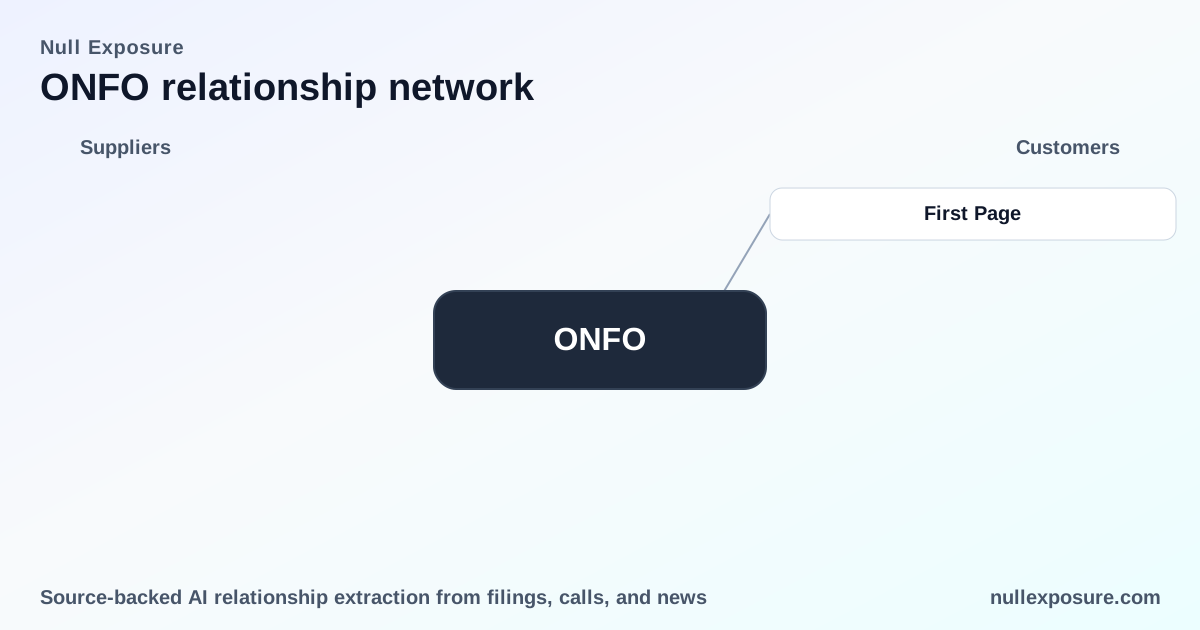
On April 1, 2024 Onfolio closed an acquisition of certain customers from First Page and agreed to pay an additional revenue share equal to 18% of gross revenues for those acquired customers for three years following the acquisition date. This structure creates a near-term drag on gross margins for the acquired book while preserving upside if the customers grow under Onfolio’s platform. According to Onfolio’s FY2024 Form 10‑K, the revenue-share obligation is explicit and time‑limited to three years after closing.
One-by-one: the reported customer relationship(s)
- Onfolio — First Page (acquired customers): Onfolio purchased a portfolio of customers from First Page on April 1, 2024, and committed to pay 18% of gross revenues generated by those customers for three years after closing. This is disclosed in Onfolio’s FY2024 10‑K as a contingent revenue‑share consideration tied to the acquired customer revenues.
Revenue mix: spot sales, subscriptions, and revenue recognition posture
Onfolio’s operating model blends spot product sales with subscription revenue and services. The company recognizes product sales at shipment, which signals a transactional, fulfillment-led revenue posture for D2C lines, while annual subscriptions purchased upfront are deferred and recognized over the subscription period. The 10‑K explicitly states these two recognition practices and supports a dual revenue profile — predictable recurring cash from subscriptions and more volatile spot sales.
Critically, Onfolio declares itself the primary obligor in arrangements where suppliers ship directly at the company’s request, and therefore recognizes those transactions on a gross basis. That accounting posture increases reported revenue but also amplifies exposure to cost of goods and return/credit risk, so investors must read reported top-line growth in parallel with gross profit trends.
Customer types and geography: wide footprint, retail focus
Onfolio serves a mix of individual consumers and business customers. Its B2C brands (for example Proofread Anywhere, Mighty Deals, Vital Reaction) target end consumers and clinicians, while the B2B segment houses SEO and marketing service firms. The company operates out of Boulder, Colorado, and ships domestically and internationally, which creates cross‑border logistics and foreign demand exposure reported in the filings.
Services business and how it complements product lines
Onfolio’s acquisitions include service businesses such as RevenueZen and multiple SEO/marketing agencies. The 10‑K lists its B2B operating units — Eastern Standard, RevenueZen, DDS Rank, SEO Butler, Contentellect, DealPipe and others — and describes management services revenue recognized monthly. That service line provides professional recurring billings and a higher margin profile per client, complementing the lower‑ticket D2C product sales and helping diversify revenue concentration.
Operational constraints and what they imply for investors
The company filing surfaces several operational characteristics that translate to investor-relevant constraints:
- Contracting posture: Combination of spot and subscription contracts—spot recognized at shipment, subscriptions deferred—creates mixed visibility into future cash flow and requires careful tracking of deferred revenue versus shipped-sales timing.
- Customer concentration & type: A material portion of revenue flows from retail and individual consumers, with separate B2B service clients; this reduces single-customer concentration but increases volatility from consumer demand cycles.
- Criticality and gross recognition: Because Onfolio is frequently the primary obligor and recognizes revenue gross, operational execution (fulfillment, refunds, supplier coordination) is directly tied to revenue and working capital variability.
- Maturity stage: Onfolio is a small, acquisitive consolidator — trailing twelve‑month revenue of $10.73M with negative EBITDA (~‑$1.05M) and market capitalization near $6.8M, signaling early‑stage economics and exposure to integration and margin compression risk.
These signals come from Onfolio’s public disclosures and financial summary through its latest reported periods.
Financial and governance signals that matter
Financials and ownership structure embedded in public filings reinforce the growth‑by‑acquisition narrative. Key datapoints: Revenue TTM $10.73M, EBITDA -$1.05M, Profit margin -24%, and Return on Equity -61%, reflecting operating losses while the company consolidates acquired assets. Insider ownership is meaningful at ~21%, while institutional ownership is roughly 13%, indicating management control and limited large‑investor oversight. Volatility is elevated — beta above 2 — and the stock trades well below replacement economics on a price‑to‑sales basis, which is consistent with a roll‑up in its scaling phase.
What the First Page deal means for margins and near-term performance
The 18% revenue‑share for three years on the acquired First Page customers is a material contractual cost tied directly to gross customer revenues. For investors, that converts an acquisition headline into a near‑term margin headwind until the arrangement expires or the customer base is materially repriced. Operationally, Onfolio’s gross revenue recognition means the payout will be visible against top line rather than buried in net commissions, simplifying investor assessment of the deal’s cost but also making reported revenue less predictive of durable profits.
Investor takeaways and risk checklist
- Acquisition-led growth: Onfolio scales primarily by buying customers and brands, not by organic marketing scale — that is a strategic lever and a risk if acquisition multiples rise.
- Mixed revenue stability: The blend of spot and subscription revenue produces partial predictability; track deferred revenue and churn for forward visibility.
- Gross recognition amplifies volatility: As primary obligor, the firm’s top line is sensitive to returns, supplier costs, and revenue‑share mechanics.
- Near‑term margin pressure from purchase agreements: Time‑limited revenue‑share obligations (e.g., First Page 18% for three years) compress reported margins on acquired cohorts.
- Early-stage financials: Small market cap, negative EBITDA, and concentrated insider ownership suggest idiosyncratic execution risk that markets will price through volatility.
For a concise repository of Onfolio disclosures and ongoing customer‑relationship tracking, see Null Exposure. Investors evaluating ONFO should weigh the company’s roll‑up economics, contractual payout structures, and gross‑revenue accounting posture when modeling forward cash generation and acquisition ROI.