ONFOW: Customer Relationships and Commercial Implications for Investors
Onfolio Holdings (ONFOW) operates as an acquirer and operator of digital businesses, monetizing through a mix of direct-to-consumer product sales, subscription offerings, and business-to-business digital services and retainers. The company builds revenue by integrating acquired customer bases into its platform, operating online properties, and collecting ongoing management fees or negotiated revenue shares on acquired customer cohorts. For investors, the key structural drivers are recurring subscription/retainer economics, portfolio-level diversification across D2C and B2B verticals, and contingent payment obligations tied to acquisitions—factors that together determine cash flow stability and acquisition payback dynamics. Visit https://nullexposure.com/ for more structured signals and disclosure extraction on ONFOW.
What the customer picture looks like today
Onfolio reports a blended revenue model. For the trailing twelve months the company reported $10.73 million in revenue and $6.43 million in gross profit, while operating and net margins remain negative (operating margin -37.4%, profit margin -24.1%) and adjusted EBITDA is a loss (approximately -$1.05 million). These numbers reflect a business still investing behind integration and service delivery for acquired brands, with recurring subscription and retainer contracts prominent across both B2C and B2B segments. The firm’s portfolio strategy reduces single-customer concentration but creates layered contractual obligations—some fixed, some variable—that influence near-term cash flow volatility.
Customer-level disclosures every investor should note
Onfolio’s public filings disclose a specific acquisition-related customer relationship that has explicit financial commitment terms. Below I summarize that relationship and the broader company-level commercial signals extracted from filings.
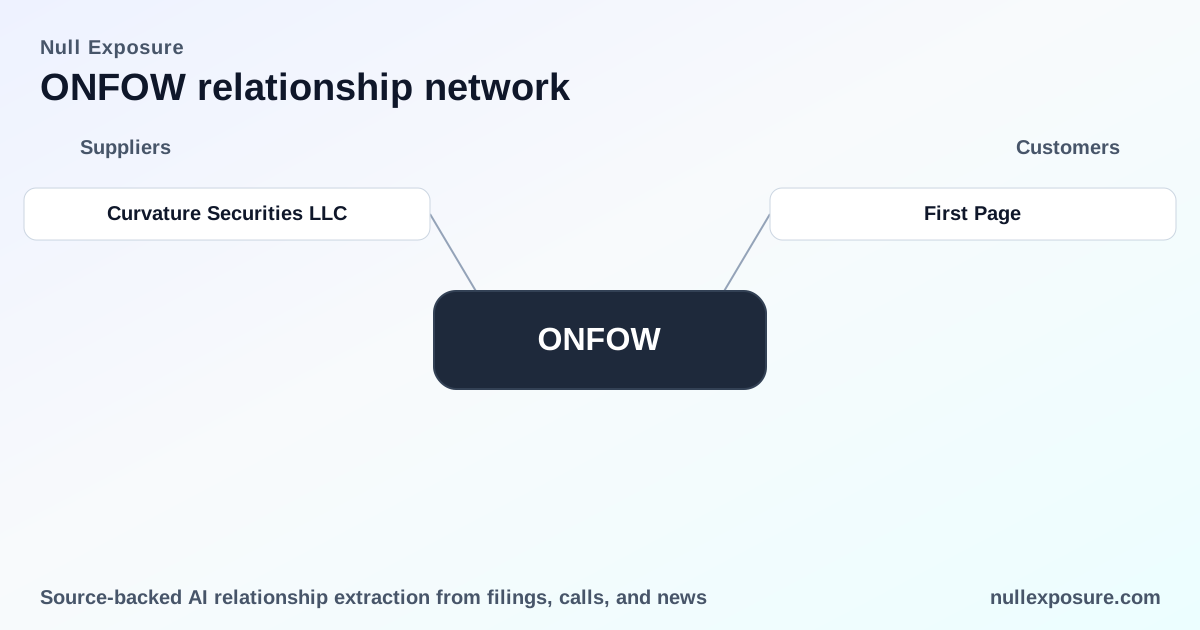
First Page — acquisition and a three-year revenue share
On April 1, 2024, Onfolio closed on the acquisition of certain customers from First Page and agreed to pay a revenue-share equal to 18% of gross revenues for the acquired customers for three years following the acquisition date, subject to the acquisition agreement’s terms and conditions. According to the company’s FY2024 Form 10‑K, that revenue-share obligation is a contractual payout tied to the performance of the acquired customer cohort and therefore creates a predictable, time-bound outflow linked to revenue generation for those customers. (Source: Onfolio 2024 Form 10‑K, acquisition closing and payment terms).
How the contractual and customer signals shape the operating model
The filings produce a clear set of company-level constraints and behavioral signals that explain how Onfolio operates and what underpins its commercial economics:
- Contracting posture — subscription and retainer bias. Filings describe revenue earned from online course subscriptions (monthly or annual) and B2B businesses that collect monthly retainers and success fees. This produces a revenue base with recurring elements and performance-linked upside for some relationships, supporting more predictable cash flows than one-time website sales.
- Counterparty mix — significant direct-to-individual exposure. The company explicitly segments B2C brands (Proofread Anywhere, Mighty Deals, Vital Reaction) where end customers are individual consumers and sales focus on digital product transactions; this generates a high volume but lower-ticket customer base. That contrasts with B2B SEO/marketing service brands where engagements are fewer and higher touch.
- Geographic reach — global distribution with U.S. operational roots. Onfolio operates out of Boulder, Colorado, but ships and serves customers across the U.S. and internationally—supporting scale but requiring cross-border operational controls and marketing diversification.
- Role duality — seller and service provider. Onfolio operates both as the owner/seller of digital products and as a service provider delivering website management, SEO, and digital marketing services, which diversifies revenue streams but raises complexity in margin management.
- Relationship maturity and stage — active management focus. Management services are recognized monthly as provided, indicating ongoing service delivery and active portfolio management rather than a pure buy-and-hold asset approach.
- Segment concentration — core product plus services. The company runs a combined model of D2C e-commerce core products and B2B services, meaning performance swings in consumer demand and client retention in services both materially affect consolidated results.
- Spend band signal — mid-sized transaction scale. The company previously sold a business unit for $780,000 in cash, suggesting that individual deal sizes and certain portfolio transactions sit in the $100k–$1M range, which is meaningful for liquidity planning and acquisition financing.
Collectively, these constraints indicate a commercial model that blends recurring top-line drivers with acquisition-related contingent payouts, requiring active working capital and careful integration discipline to convert acquired customers into net positive cash contributors.
Risks and opportunities for investors
- Risk — acquisition-related contingent liabilities. The First Page revenue-share (18% of gross revenues for three years) is a material contractual outflow tied directly to top-line performance of the acquired cohort; high initial revenues on those customers will drive outsized cash outflows during the three-year period.
- Risk — profitability pressure from services and integration costs. Negative operating and profit margins illustrate that ongoing service delivery and acquisition integration expenses compress near-term profitability.
- Opportunity — recurring revenue and cross-sell. Subscription products and monthly retainers offer a path to stable revenue if Onfolio successfully upsells across acquired customer bases and increases lifetime value through cross-marketing.
- Opportunity — scalable arbitrage on mid-sized deals. The company’s history of buying, optimizing and, in some cases, selling digital businesses at transaction sizes in the mid-six-figure range signals a repeatable playbook that can compound returns if integration economics are maintained.
Practical takeaways for investors and operators
- Focus on cash conversion: monitor gross revenues from acquired cohorts and the corresponding revenue-share outflows to understand short-term cash flow drag.
- Track recurring revenue composition: increases in subscription and retainer revenue will materially improve predictability and valuation multiples versus one-off product sales.
- Assess integration efficiency: margins will only normalize if acquisitions are integrated cost-effectively and cross-sell gains are realized.
For deeper signal extraction and to monitor Onfolio’s evolving contractual commitments, visit https://nullexposure.com/ for additional filings and relationship analytics.
Conclusion: a portfolio-growth story with near-term payout mechanics
Onfolio’s model is clear: aggregate digital businesses, operate them as mixed subscription/service properties, and accept short-to-medium term contractual payout obligations tied to acquisitions. The First Page deal crystallizes this structure with an explicit 18% revenue-share for three years, and company-wide signals show the business is built around recurring revenue with active service delivery. For investors, the trade-off is between acquisition-driven growth and the timing and magnitude of acquisition-related cash outflows; monitoring cohort-level revenues and retention in the next 12–36 months will be decisive for valuation and liquidity assessments.