ONIT: Customer concentration and the servicing backbone that drives cash flow
Onity Group Inc. (ONIT) is a mortgage-originator and servicer that earns the bulk of its revenue from servicing and subservicing fees, operating both forward and reverse mortgage channels through brands such as PHH Mortgage and Liberty Reverse Mortgage. The business model monetizes scale in mortgage servicing rights (MSRs) and servicing float while relying on a concentrated roster of large institutional clients and government-sponsored entities; this concentration creates both predictable fee income and material counterparty risk. For a focused read on counterparty exposures and servicing transition risk, visit https://nullexposure.com/.
The short thesis for investors
Onity’s financial profile is dominated by its servicing segment, which accounted for roughly 89% of revenue in 2024; servicing economics produce steady fee income but also high operating leverage to contract renewals, client retention and portfolio composition. The company’s servicing relationships with large MSR investors and GSE/Ginnie Mae-backed programs underpin distribution and liquidity, while a handful of large clients account for a disproportionate share of UPB and delinquent loans—concentration that can rapidly change the company’s cash flow and operating scale.
Relationship rundown: the client list that matters
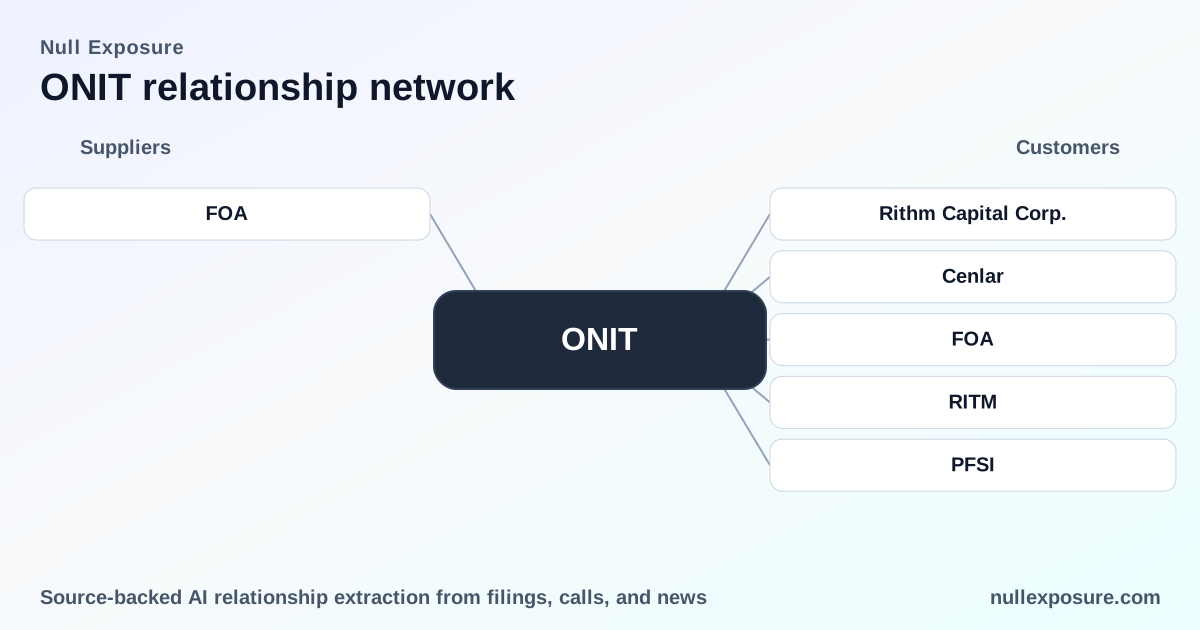
Below are the customer relationships identified in Onity’s filings and investor communications. Each entry includes a concise plain-English takeaway and the source.
Rithm Capital Corp. (Rithm / RITM)
Rithm is a material subservicing client, representing $41.2 billion of unpaid principal balance (UPB), about 14% of Onity’s servicing/subservicing UPB, and roughly 63% of the delinquent loans Onity serviced as of December 31, 2024; Rithm-generated fees were meaningful to 2024 servicing revenue. According to Onity’s 2024 Form 10‑K, Rithm’s size creates a meaningful dependency, and management noted on the Q4 2025 earnings call that the Rithm subservicing relationship is scheduled for transition beginning in 2026, with the company describing the portfolio as among its least profitable. (Sources: Onity 2024 Form 10‑K; Onity Q4 2025 earnings call; earnings transcript reporting in March 2026.)
Cenlar
Cenlar surfaced in Onity’s Q4 2025 commentary only as part of a market-development note: management referenced the announcement that PennyMac is acquiring Cenlar, highlighting industry consolidation that affects servicer and subservicer dynamics. The mention signals Onity’s attention to competitor consolidation rather than a direct client-specific update. (Source: Onity Q4 2025 earnings call.)
PennyMac (PFSI)
PennyMac was mentioned in Onity’s Q4 2025 remarks in connection with its announced acquisition of Cenlar; Onity referenced the transaction as an example of consolidation among large servicing platforms that could shift competitive dynamics for subservicing and servicing markets. (Source: Onity Q4 2025 earnings call.)
Finance of America Reverse (FOA / Finance of America Reverse)
Onity executed a strategic partnership with Finance of America Reverse to reposition its participation in the reverse mortgage market, a move management framed as simplifying the business and improving future earnings and shareholder returns. That partnership is presented as a deliberate repositioning of Onity’s reverse mortgage exposure rather than a pure-volume servicing arrangement. (Source: earnings call transcript published on InsiderMonkey, March 2026.)
What the constraints reveal about Onity’s operating model
The disclosures and evidence build a clear picture of how Onity contracts, where risk concentrates, and what is critical to its economics.
-
Contracting posture — short-term and renewable: Onity’s subservicing agreements with Rithm include automatic one-year renewals unless terminated with advance notice, signalling a contractual posture that provides recurring optionality for both parties but also creates renewal and transition risk on short notice. (Company-level evidence references Rithm’s renewal structure in the 10‑K.)
-
Concentration — high and concentrated among large counterparties: The company explicitly identifies large institutional servicers, GSEs and Ginnie Mae as core counterparties, and the Rithm relationship alone represents a material share of UPB and delinquency; this is a structural concentration in Onity’s revenue base. (Company 10‑K disclosures and constraint excerpts.)
-
Criticality — servicing operations are central to value creation: Servicing and subservicing are Onity’s principal value drivers (89% of revenue in 2024) and the firm has operational control in roles that include loan administration, advances, loss mitigation and foreclosure actions—functions that position Onity as a critical service provider to MSR investors. (10‑K operational descriptions.)
-
Maturity and stage — active but undergoing transitions: Many servicing agreements are active, and management has signaled transitions beginning in 2026 for major subservicing portfolios; these transitions affect near-term profitability, servicing float and corporate scale. (Earnings calls and news transcripts.)
-
Geography and operating footprint — global delivery for U.S. servicing: Onity runs operations across the U.S., USVI, India and the Philippines with roughly 76% of its workforce outside the U.S., indicating a globally distributed operating model that supports volume servicing economics and cost flexibility. (Company disclosure.)
Investment implications — what to watch and why it matters
-
Concentration is the primary risk vector. Rithm’s share of UPB and delinquency means a termination or transition materially affects servicing fee revenue, pledged MSR liabilities, and servicing float, with direct implications for liquidity and expense base. (10‑K and Q4 2025 comments.)
-
Transition execution will define near-term margins. Management has flagged the Rithm portfolio as less profitable and scheduled transitions for 2026; investors should focus on transition timelines, expected loss of float, and cost right-sizing actions that could compress or improve margins. (Earnings call commentary.)
-
Government and GSE exposure is strategic. Reliance on programs administered by GSEs and Ginnie Mae shapes Onity’s ability to sell loans and monetize MSRs; this is a structural dependency that stabilizes distribution but limits pricing independence. (10‑K program disclosures.)
-
Reverse mortgage repositioning is a potential upside. The FOA partnership is pitched as simplifying reverse exposure and improving returns; monitor earnings impact and any capital or servicing commitments tied to that deal. (InsiderMonkey transcript, March 2026.)
For a deeper, counterparty-focused view on how servicing concentration translates into earnings sensitivity, see more at https://nullexposure.com/.
Quick due-diligence checklist for operators and investors
- Confirm Rithm transition milestones and the expected P&L and liquidity impacts during and after transition.
- Monitor servicing fee run-rate post-transition and any disclosed cost reductions tied to reduced servicing scale.
- Review contractual notice and termination mechanics for other large clients and GSE program participation terms.
- Track FOA partnership deliverables and any capital commitments or revenue-sharing details that affect reverse mortgage economics.
Bottom line
Onity’s business model generates stable, fee-driven cash flow from mortgage servicing but does so with concentrated counterparty exposure and short-term renewal mechanics that create asymmetric downside if major clients transition away. The Rithm relationship is the single largest outsized risk and operational driver; how management executes the 2026 transitions and repositions reverse mortgage activity will determine whether Onity converts concentration into sustainable margin expansion or short-term dislocation.