Orion Office REIT (ONL): Customer Map, Revenue Drivers, and Risk Signals
Orion Office REIT is an internally managed, U.S.-focused suburban office REIT that monetizes through long-term single-tenant net leases, rental reimbursements and landlord-funded tenant improvements. The business extracts predictable cash flow from large, creditworthy occupiers and supplements yield with leasing activity and TI recoveries; investors should evaluate both tenant concentration and the company’s capital commitments to support new occupancies. For a consolidated view of tenant exposure and counterparty narratives, visit https://nullexposure.com/.
Why tenant relationships matter for ONL: a compact investment thesis
Orion’s model is simple and directional: buy suburban office assets, sign long-duration net leases to strong counterparties, and collect rental income with embedded inflation protection. That posture produces stable base rent, but it also concentrates credit risk—notably government tenants account for a meaningful share of rent—and requires periodic capital outlays (tenant improvements and leasing costs) that compress short-term cash flow while supporting long-term durability.
Contracting posture, concentration and cash‑flow durability
Orion signals an explicit preference for long-term, single-tenant net leases and a U.S.-only geographic focus. Company disclosures highlight operating leases with non‑cancelable terms up to 16 years and a strategy to invest in “stable cash flow from primarily long-term leases with high credit quality tenants.” The portfolio is concentrated in North American suburban markets, with a weighted-average remaining lease term and active leasing program indicating durability but also lumpy re-leasing risk. Management reported aggregate commitments for rent concessions and leasing costs of approximately $95.9 million, including $64.3 million of tenant improvement allowances, which positions the company to secure new leases but represents near-term cash demand. According to public filings and the 2025 disclosures, government tenants represent a material exposure, accounting for about 16.8% of annualized base rent, a company-level concentration that elevates counterparty-credit considerations. For more context on tenant-level coverage, see the relationship breakdown below or visit https://nullexposure.com/ for deeper signals.
What the recent win-losses say about ONL’s book of business
Orion’s recent public comments and media reports document a mix of new large leases, ongoing renewals, and tenant departures. The pipeline shows high-impact leases that will start in early 2026, offsets of vacancies where tenants left in prior periods, and continued reliance on capital-intensive leasing activity to restore occupancy and cash flow.
Relationship-by-relationship breakdown (each item from disclosed results)
United States government
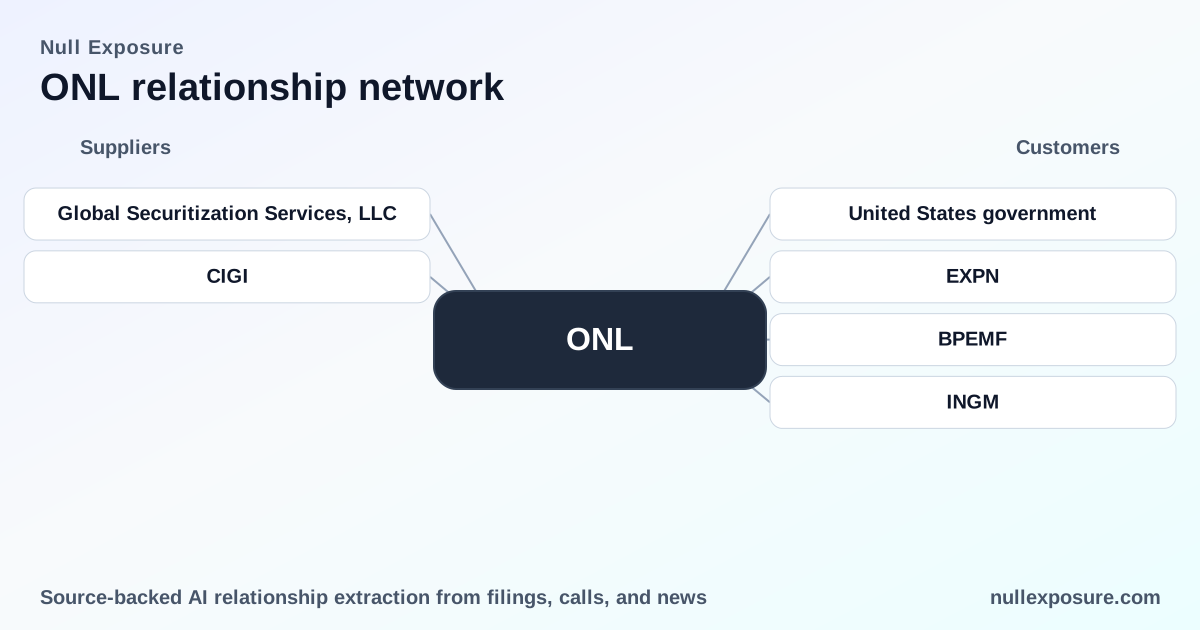
Orion disclosed that an 886,000 square foot lease with the United States government commenced in February 2026, representing a large, high-credit tenant addition to the portfolio and consistent with the company’s stated government exposure. This was announced in the company’s 2025 Q4 earnings call in March 2026.
Home Depot (HD)
The Kennesaw, Georgia property is leased to Home Depot with roughly three years remaining on that specific store lease, contributing to an aggregated portfolio lease term of more than eight years for the asset mix cited. This detail was referenced in an earnings-call transcript summary published on Investing.com covering Orion Office REIT’s Q2 2025 remarks (Investing.com, FY2025).
Experian (EXPN)
A suburban office asset previously leased by Experian was vacated earlier in the year, creating vacancy and associated re-leasing risk for that property; the vacancy was discussed in regional coverage of Orion’s suburban office portfolio. The Real Deal reported on the property and the vacancy situation in a December 2023 article that remains relevant to FY2023 portfolio changes (The Real Deal, FY2023).
EXPN (duplicate entry referencing the same Experian mention)
The dataset includes a separate mention labeled EXPN that repeats that Experian vacated space earlier in the year, confirming media coverage of tenant turnover at a specific Orion asset reported by The Real Deal in late 2023 (The Real Deal, FY2023).
BPEMF
Orion referenced the Barilla Group (ticker BPEMF) in context of customer descriptions, noting the Barilla Group’s global scale as a large food manufacturer and indicating a tenant profile that includes substantial corporate occupiers. This characterization came from Orion’s 2025 Q4 earnings call commentary (ONL Q4 2025 earnings call, March 2026).
Barilla Group
A separate entry names the Barilla Group directly and reiterates the same profile: a large, recognizable corporate tenant whose operations are familiar on U.S. grocery shelves, cited in the 2025 Q4 earnings call. The duplication in the results reflects the same mention (ONL Q4 2025 earnings call, March 2026).
INGM
Orion’s 2025 Q4 earnings call described work underway at a Buffalo, New York property tied to a new 160,000 square foot lease with Ingram Micro, expected to commence in April 2026, signaling a near-term revenue inflection tied to that tenant. This was disclosed on the company’s Q4 2025 call (ONL Q4 2025 earnings call, March 2026).
Ingram Micro
A companion entry names Ingram Micro explicitly and confirms the 160,000 square foot lease commencement expected in April 2026, reinforcing the same development and its anticipated contribution to future occupancy and rental income. Source: ONL’s Q4 2025 earnings call (March 2026).
How these relationships drive investor risk and opportunity
- Concentration and credit quality: Government tenants are a material portion of ABR (~16.8%), which supports credit quality but also concentrates counterparty exposure; large institutional tenants like Home Depot, Barilla and Ingram Micro diversify counterparty risk across industries.
- Contract tenor and cash stability: The portfolio’s emphasis on long-term, single-tenant net leases underpins recurring cash flow, yet weighted-average remaining lease terms and recent tenant vacancies create near-term cash volatility tied to leasing costs.
- Capital intensity: The company-level commitment of roughly $95.9 million in rent concessions and leasing costs (including $64.3 million of TIs) is a double-edged sword—necessary to secure long-term rent roll but a drag on near-term free cash flow.
- Geographic concentration: Orion operates exclusively in U.S. suburban office markets, giving investors clarity on market exposure but limited geographic hedging.
Bottom line for investors and operators
Orion’s customer roster shows the company executing its stated strategy: long-duration net leases with creditworthy and recognizable occupiers, supplemented by active leasing and meaningful TI commitments to stabilize occupancy. The simultaneous presence of large new leases (U.S. government 886k ft², Ingram Micro 160k ft²) and tenant departures (Experian vacancy) underscores a transitional phase where near-term cash flow will be influenced heavily by leasing execution. Investors should weigh the upside from newly commencing large leases against the cash demands of re-leasing and TI spend.
For investors seeking an aggregated, signals-driven lens on tenant relationships and counterparty risk, additional analysis and historical monitoring are available at https://nullexposure.com/.