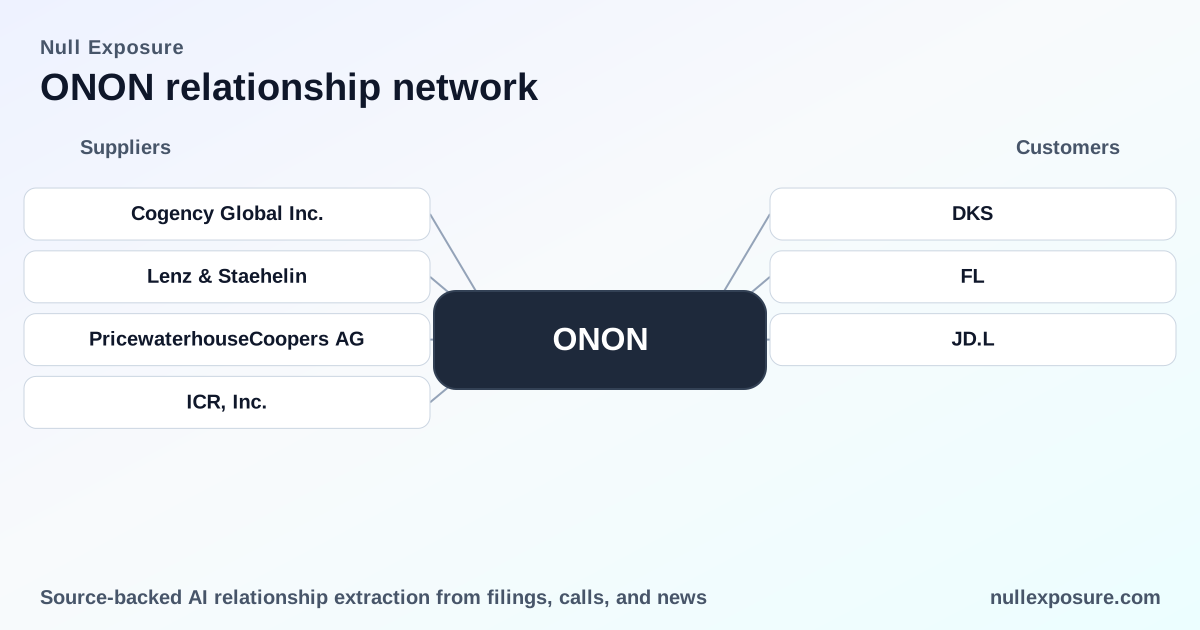
On Holding’s retail partners are strategic shelf space — not transactional customers
On Holding (ONON) monetizes by selling premium footwear and apparel through a mix of direct-to-consumer channels and selective wholesale partnerships, using owned retail and key account distribution to scale brand presence and margin capture. The company combines high-margin product design with selective shelf placement at large sports retailers to drive volume growth and customer frequency; retail partnerships are a distribution lever that directly influences market share, inventory cadence, and brand premiumization. For investors, the relationship map with major chains is a signal of both reach and exposure to retail execution risk.
Explore the full coverage at NullExposure
How On uses partners to move from niche to mass premium
On’s operating posture is deliberate: it focuses on selective expansion with a small number of large retail partners while growing owned retail and apparel to capture higher margin dollars. Wholesale accounts widen penetration rapidly, but On retains control over product cadence and placement to protect pricing power. The company reported TTM revenue of roughly $3.01 billion and healthy gross profit, which demonstrates that the hybrid model — DTC plus selective wholesale — scales profitably while relying on a handful of strategic retail relationships to reach mainstream consumers.
Customer relationships reported in the news (each entry included)
Below are every customer relationship extracted from the signal set, each with a plain-English summary and a source citation.
Dick’s Sporting Goods (Dick’s)
On cites Dick’s Sporting Goods as a key account driving growth through expanded shelf space and selective expansion, meaning On leans on Dick’s national footprint to convert awareness into consistent sell-through. SG Bonline covered this direct comment from management on March 10, 2026: https://sgbonline.com/exec-on-holding-sees-owned-retail-stores-and-apparel-as-keys-to-brand-growth/.
DKS (duplicate entry)
A second entry lists DKS as the same core relationship discussed by management: the duplicate mention reinforces that On is highlighting Dick’s as a top-tier wholesale partner for FY2025. This duplicate was recorded in the same SG Bonline coverage on March 10, 2026 (identical source).
Foot Locker
On’s leadership explicitly called out Foot Locker as another strategic partner where shelf expansion and share gains are supporting growth, indicating that On is deepening assortment or distribution in the mall-anchored and youth-focused channel. Management comments were reported by SG Bonline on March 10, 2026: https://sgbonline.com/exec-on-holding-sees-owned-retail-stores-and-apparel-as-keys-to-brand-growth/.
JD (JD Sports)
JD Sports is identified as a selective international account helping On scale outside North America, with management naming JD alongside Dick’s and Foot Locker as part of a concentrated channel strategy that increases visibility and reach. The mention comes from the same SG Bonline article dated March 10, 2026: https://sgbonline.com/exec-on-holding-sees-owned-retail-stores-and-apparel-as-keys-to-brand-growth/.
What these relationships collectively reveal about On’s operating model
- Concentration with strategic partners. On’s go‑to‑market relies on a relatively small set of large retail partners — Dick’s, Foot Locker, and JD — to accelerate penetration. That increases scalability but concentrates exposure to execution at those chains (allocation, promotions, and shelf cadence).
- Contracting posture is tilted toward selective, high-control wholesale. Management’s language emphasizes “selective expansion” and shelf-space economics; On preserves pricing and brand presentation rather than pursuing broad low-margin distribution.
- Channel criticality is material but manageable. These retailers provide national and international reach that is difficult to replicate quickly via owned stores alone; however, On’s substantial DTC and owned retail growth plans reduce single-channel dependency over time.
- Maturity signal: premium brand scaling. With TTM revenue near $3.0B, positive operating margins (~11%), and institutional ownership above 70%, On is in a scale phase where partnerships move the revenue needle but the company is not in a pure startup posture.
Financial context that frames partner risk and opportunity
On has meaningful financial scale — market capitalization roughly $11.35B and EBITDA around $420M — which supports investment in owned retail and elevated brand initiatives. Valuation metrics (trailing P/E ~44.5, forward P/E ~23.2) imply market expectations for growth and margin expansion driven in part by execution with large retail accounts. High institutional ownership (about 74%) and insider stakes near 24% signal investor attention and management alignment; conversely, a beta above 2 implies the stock price is sensitive to sentiment shifts that could be triggered by retail sell-through or inventory missteps.
Investment implications and risk checklist
- Positive: Strategic relationships with Dick’s, Foot Locker, and JD multiply On’s distribution reach without diluting brand positioning, accelerating revenue while allowing direct channels to preserve margins.
- Risk: Concentration risk at a few large partners means that promotional resets, allocation squeezes, or inventory mismanagement at those chains could disproportionately affect short-term revenue and perception.
- Execution: On’s plan to expand owned retail and apparel is a de-risking vector; success reduces wholesale concentration and increases margin control, but it requires capital and time to scale.
- Valuation: Current multiples embed significant growth; investors should monitor retail sell-through metrics and inventory dynamics at the named partners for early signals of demand sustainability.
If you want a quick way to monitor partner-driven signals for ONON, see our broader relationship coverage at NullExposure: https://nullexposure.com/
Bottom line
On’s customer map reads as a targeted distribution strategy: rely on a handful of powerful retail partners to drive scale while building owned retail and apparel for margin capture and brand control. For investors, the critical questions are whether On can maintain sell-through and favorable allocation at Dick’s, Foot Locker, and JD while converting owned-channel investment into a durable reduction in wholesale concentration. Monitor management commentary on shelf space, allocation, and inventory turnover at these partners as primary leading indicators of the company’s next phase of growth.