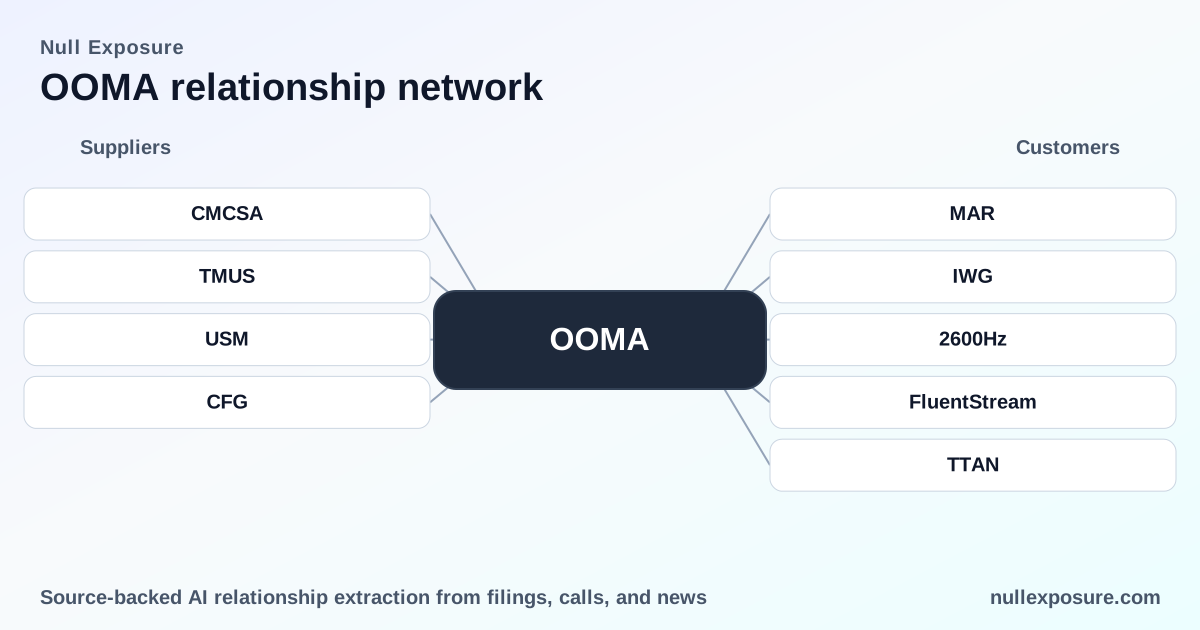
Ooma’s customer map: where revenue comes from and what relationships tell investors
Ooma sells cloud-based voice, conferencing and communications services to residential and business users, monetizing primarily through subscription plans and related services, with selective usage-based offerings and channel-driven upsells. The company scales by combining direct subscriptions, reseller partnerships, and embedded CPaaS integrations that create recurring revenue and occasional large account wins that can move near-term growth metrics. For a concise investor primer on Ooma’s customer exposure, see https://nullexposure.com/.
How Ooma makes money and how that shapes customer ties
Ooma’s revenue base is recurring and service-oriented: the company emphasizes monthly and annual subscriptions for both residential PureVoice services and business unified communications, while offering metered plans for certain reseller platforms. This structure produces predictable recurring revenue but also produces discrete volatility from large channel wins and rightsizing at major accounts. Ooma positions itself across customer segments — small business, mid-market, and large enterprise — and primarily serves the North American market, which concentrates commercial risk in the U.S. and Canada.
- Contracting posture: subscription-first with available multi-year terms and usage-based options for specific partners.
- Customer concentration: company-level disclosures indicate no single customer represented >10% of revenue for recent fiscal years, which points to revenue diversification despite episodic large-account impacts.
- Criticality and maturity: services are operationally critical for business communications but delivered through mature SaaS and CPaaS integrations, creating stable retention but raising competition and margin pressure.
Customer relationships disclosed in source materials
Below I cover every relationship referenced in Ooma’s recent materials and public transcripts. Each entry includes a plain-English summary and the primary source.
Marriott (first mention)
Ooma reported that Marriott has certified AirDial for use at its properties, signaling a channel certification that enables deployment across hotel properties and potential scale for the AirDial product. Source: Ooma Q1 2026 earnings call (March 7, 2026).
MAR (duplicate mention of Marriott)
The second listing repeats the Marriott certification point; the company reiterated that Marriott certification is a material go-to-market enabler for AirDial adoption in hospitality settings. Source: Ooma Q1 2026 earnings call (March 7, 2026).
IWG (Inspire/Regus network reference)
Ooma said that overall results were dampened by expected rightsizing at its largest customer, Regus, which operates under IWG, indicating that workspace consolidation or footprint adjustments at a major reseller can depress near-term revenue. Source: Ooma Q1 2026 earnings call (March 7, 2026).
Regus (explicit customer named)
Regus — part of the IWG group — was identified as Ooma’s largest customer undergoing rightsizing, which directly reduced service volumes and illustrates how a single large reseller relationship can swing utilization-based or seat-based revenue. Source: Ooma Q1 2026 earnings call (March 7, 2026).
2600Hz
Ooma disclosed progress integrating Ooma’s IP onto the 2600Hz platform and successfully upselling a significant number of 2600Hz’s existing customers to Ooma services, demonstrating Ooma’s strategy to leverage platform integrations for expansion. Source: InsiderMonkey transcript of Ooma’s Q3 FY2026 discussion (reported March 10, 2026; covers FY2025 activity).
FluentStream
Ooma described a partnership with FluentStream that brings Ooma scale to FluentStream’s vendor relationships, joint feature development, and channel leverage to sell AirDial, indicating a co-selling and technical collaboration that expands Ooma’s channel reach. Source: InsiderMonkey coverage of Ooma Q3 FY2026 remarks (reported March 10, 2026; references FY2025 initiatives).
ServiceTitan (first mention)
Ooma compared a new CPaaS-style opportunity to its large customer win last year with ServiceTitan, implying that ServiceTitan represents a template for embedding Ooma services into software platforms that serve service businesses. Source: Ooma Q1 2026 earnings call (March 7, 2026).
TTAN (duplicate mention of ServiceTitan)
A duplicate entry references the same ServiceTitan win; the company explicitly frames this as a model CPaaS integration that drives volume and upsell opportunities into vertical software platforms. Source: Ooma Q1 2026 earnings call (March 7, 2026).
(If you want the original transcripts and notes compiled in one place, Ooma’s filings and call transcripts are accessible via public filings and press coverage; for a curated view visit https://nullexposure.com/.)
What the relationship set implies about Ooma’s operating model
- Recurring revenue orientation: The company’s product mix—monthly subscriptions, annual and multi-year plans—creates recurring cash flow that underpins valuation multiples tied to subscription revenue growth and retention. Evidence for subscription prevalence is explicit in company disclosures.
- Mixed contract economics: Ooma runs both subscription and usage-based (metered) plans; this hybrid model improves entry flexibility for resellers and consumers but introduces revenue variability when large customers rightsise.
- Channel and platform dependence: Partnerships with platform providers (2600Hz, FluentStream) and integration wins (ServiceTitan) are strategic levers for distribution; these relationships convert platform reach into incremental subscriptions and upsells.
- Concentration control with episodic impact: Company statements that no single customer exceeded 10% of revenue in recent years indicate broad diversification, but the Regus rightsizing example shows that large resellers can still move quarterly results materially.
- North American focus: Primary offerings in the U.S. and Canada concentrate market opportunity and regulatory exposure regionally rather than globally.
Investment implications and headline risks
- Upside drivers: Continued platform integrations and channel certifications (Marriott, FluentStream, 2600Hz, ServiceTitan) deliver scalable distribution and recurring upsell potential. AirDial certification with Marriott and partner-led upsells are immediate revenue catalysts.
- Tail risk: Rightsizing at large resellers (Regus/IWG) can depress near-term revenue and increase churn risk for metered or seat-based contracts. No single-customer >10% is positive for long-term diversification but does not eliminate quarterly volatility.
- Valuation context: With a market capitalization near $492m and forward P/E materially lower than trailing P/E, Ooma trades on a growth-plus-margin narrative that is sensitive to large-account churn and the success of channel integrations.
For a deeper, consolidated view of Ooma’s customer exposures and how they drive revenue scenarios, visit https://nullexposure.com/ for research and transcript aggregations.