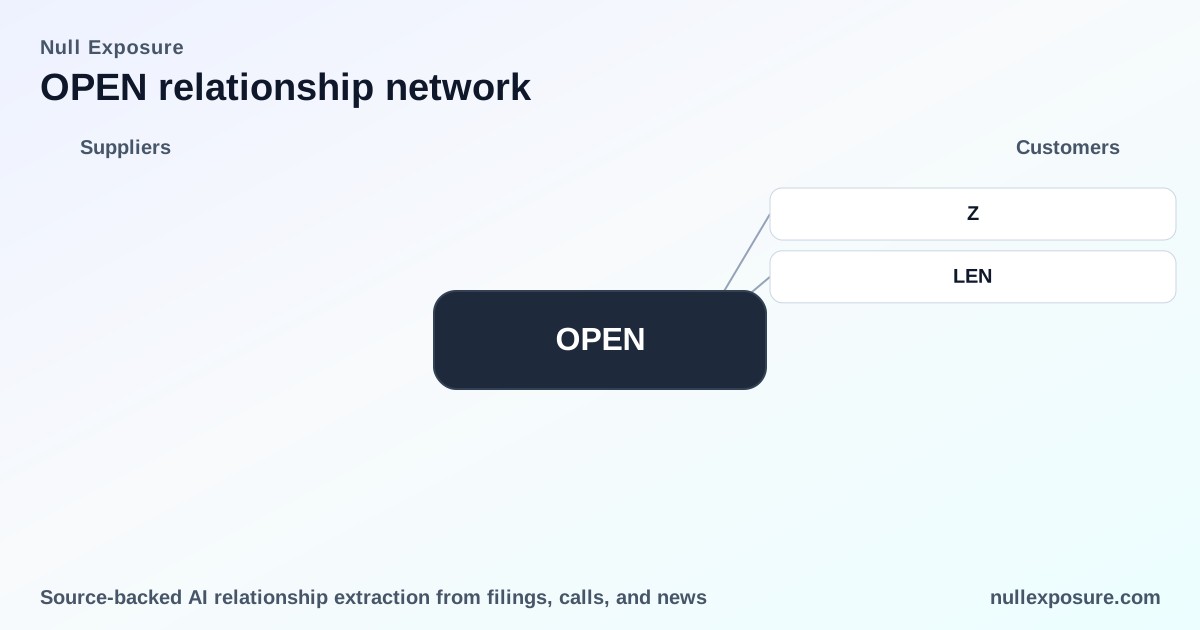
Opendoor (OPEN) — Customer Relationships that Drive a Capital-Light Real Estate Engine
Opendoor operates a digital-first residential real estate platform that monetizes by buying homes, reselling them, and charging for integrated services (title, escrow, brokerage) while increasingly routing volume through a capital-light marketplace. Revenue is driven by home resale margins and ancillary services, while customer acquisition and channel partnerships are the structural levers that compress CAC and scale throughput. Learn more at https://nullexposure.com/.
Why customer relationships matter more than ever for OPEN
Opendoor’s unit economics depend on two linked dynamics: the gross margin on homes it acquires and sells, and the distribution of those homes across direct consumers, builder channels, and third-party platforms. Partnerships that funnel originations into Opendoor’s fulfillment stack reduce marketing spend and stabilize inventory turns, which is critical for a business with negative operating margins but substantial revenue scale. Operationally, the firm is balanced between an asset-heavy buy-resell model and a growing asset-light marketplace; both sides leverage the same customer relationships differently.
How the company-level constraints shape strategy and risk
Opendoor’s documented operating posture and segment signals translate into strategic constraints investors should weigh:
- Contracting posture: The company runs both owned inventory and a marketplace model; the marketplace (launched 2022) is evidence of a deliberate shift toward capital-light distribution while retaining services revenue streams. This means management can scale reach without proportionally increasing balance-sheet exposure.
- Customer concentration: The business generates the majority of sales to individual consumers, with institutional buyers participating via marketplace channels. That concentration in consumers keeps revenue exposed to housing cycle dynamics and consumer mobility trends.
- Geographic footprint and maturity: Opendoor operates across the U.S. — historically expanding since 2014 to 50 markets and hundreds of thousands of transactions — providing a national-scale testing ground for partnerships and product iterations.
- Service criticality: Integrated title and escrow services are high-frequency, high-share revenue add-ons: in markets where these are offered they represented over 80% of Opendoor transactions in 2024, increasing capture of transaction economics.
- Segment mix: The core product remains buying and reselling homes, but a meaningful and growing share of revenue and risk management comes from services and the marketplace. That product mix alters capital intensity and margin volatility.
These constraints define why certain customer relationships are strategic: they either lower CAC, increase throughput, or deepen services capture.
Every customer relationship flagged in the results
Below I cover each relationship item surfaced in the results. Each entry is a concise, plain-English summary with the cited source.
1) Z (listed as Z) — partnership with Zillow on instant offers
Opendoor is the fulfillment partner behind Zillow’s “instant offer” feature, which channels sellers into Opendoor’s buy-and-resell engine and substantially reduces Opendoor’s customer acquisition cost by converting Zillow-originated leads into executed transactions. (FinancialContent, Feb 19, 2026 — https://markets.financialcontent.com/stocks/article/finterra-2026-2-19-opendoor-20-from-the-brink-of-delisting-to-the-ai-native-future-of-real-estate)
2) Zillow Group Inc. — duplicate entry confirming the Zillow fulfillment role
The Zillow relationship is reiterated under its full corporate name: Zillow routes instant-offer sellers to Opendoor’s fulfillment stack, anchoring a high-intent feed of inventory that supports Opendoor’s resale volume and reduces marketing spend. (FinancialContent, Feb 19, 2026 — https://markets.financialcontent.com/stocks/article/finterra-2026-2-19-opendoor-20-from-the-brink-of-delisting-to-the-ai-native-future-of-real-estate)
3) LEN (Lennar) — strategic investment signals potential builder-channel growth
Lennar’s reported 18.8 million share stake signals strategic validation and potential preferential access to builder-originated volume, but investors should watch for whether that stake converts into sustained builder-channel sales. (247WallStreet, Feb 19, 2026 — https://247wallst.com/investing/2026/02/19/live-will-opendoor-beat-earnings-tonight/)
4) Lennar — the same news framed as a builder partnership opportunity
Lennar’s equity position catalyzed a share-price reaction, and management must translate the relationship into repeatable mortgage or purchase flows from new-build inventory to drive meaningful volume. (247WallStreet, Feb 19, 2026 — https://247wallst.com/investing/2026/02/19/live-will-opendoor-beat-earnings-tonight/)
5) LEN — experimental mortgage product testing with Lennar
Opendoor is testing a mortgage product with Lennar, which would deepen the company’s buyer-side value proposition and allow it to capture additional financing and closing economics on builder-related transactions. (InsiderMonkey Q4 2025 earnings call transcript coverage — https://www.insidermonkey.com/blog/opendoor-technologies-inc-nasdaqopen-q4-2025-earnings-call-transcript-1699722/)
6) Lennar — duplicate mention of mortgage testing in the earnings discussion
The earnings call reiterates that mortgage testing with Lennar is underway, indicating management is exploring vertical integration of financing to increase unit revenue per transaction. (InsiderMonkey Q4 2025 earnings call transcript coverage — https://www.insidermonkey.com/blog/opendoor-technologies-inc-nasdaqopen-q4-2025-earnings-call-transcript-1699722/)
What investors should take from these relationships
- Zillow partnership is strategically central. Zillow supplies high-intent seller leads via instant offers and directly reduces CAC by routing traffic into Opendoor’s acquisition funnel; that dynamic improves OPEX leverage and inventory efficiency.
- Builder channels are potential accelerants but need conversion. Lennar’s stake and mortgage testing signal meaningful opportunity to access new-build supply and integrated buyer financing, which could boost volume and cross-sell of services if piloted programs scale.
- Service integration amplifies economics. Market-level title and escrow penetration (over 80% in markets where offered) gives Opendoor a path to higher transaction capture beyond mere resale margins.
Risks and monitoring checklist
- Customer concentration in individuals exposes revenue to consumer mobility and macro housing cycles; watch quarterly transaction volumes for demand trends.
- Execution risk on partnerships: Zillow integration converts lead flow into transactions only with operational discipline; Lennar’s strategic stake needs conversion into durable builder volume.
- Margin sensitivity: Opendoor’s operating and EBITDA margins are negative, so improvements depend on throughput efficiency, better pricing on sales, and increased services penetration.
Conclusion — where relationships meet valuation
Opendoor’s current valuation and near-term earnings trajectory hinge on two factors underpinned by customer relationships: the ability to lower CAC through distribution partnerships (Zillow) and the capacity to unlock predictable volume from builder and institutional partners (Lennar and others) while monetizing services that stick to each transaction. Investors should focus on execution milestones around instant-offer conversions, marketplace growth, and the scaling of title/mortgage products.
For deeper coverage and dataset-driven relationship mapping, visit the research hub at https://nullexposure.com/.