OPENLANE (OPLN): Marketplace economics, counterparty signals, and what customer ties reveal
OPENLANE operates a cross-border digital wholesale marketplace that connects commercial vehicle sellers (manufacturers, rental fleets, finance companies) to dealer buyers and complements auction fees with a suite of ancillary services and short-term inventory financing. The company monetizes through transaction fees, logistics and reconditioning services, inspection and certification, titling and collateral recovery, and floorplan financing — a mixed services + software revenue model that drives recurring service flows and episodic financing income. For investor diligence and competitive analysis, the customer relationships below reveal practical evidence of both market reach and product adoption. Learn more about how we surface these signals at https://nullexposure.com/.
How the customer footprint maps to the business model
OPENLANE’s operating model balances platform economics with integrated service delivery. Key structural characteristics investors should treat as business-level signals:
-
Contracting posture: The platform sells a combination of short-term, transaction-linked arrangements and recurring services. Short-term, inventory-secured financing is standard — typical loan terms run 30 to 90 days with routine extensions — which embeds working-capital exposure into the core offering and drives fee income tied to turnover rather than long-duration contractual lock-ins. Evidence for short-term financing is documented in company disclosures describing floorplan loan tenors and AFC dealer credit lines.
-
Revenue composition and monetization mechanics: Auction fees are the foundational revenue stream, supplemented by value-added services (transport, reconditioning, inspection, titling) and SaaS-based remarketing tools. This combination generates both variable transaction revenue and higher-margin ancillary sales, consistent with the company’s reporting that marketplace services and software offerings are integral revenue drivers.
-
Geographic footprint and market diversification: OPENLANE operates across North America and Europe (EMEA), and its marketplaces and logistics footprint are explicitly described as spanning both regions. That cross-border exposure supports scale benefits but also requires operational complexity in logistics and regulatory processes.
-
Concentration and materiality: Company disclosures state no single customer accounted for more than 10% of revenues in presented years, signaling low revenue concentration at the customer level. Simultaneously, floorplan financing is called out as an important component of buyer services, meaning some revenue lines are strategically material even if individual customer concentration is low.
-
Customer roles and maturity: OPENLANE serves sellers, buyers and service users simultaneously — acting as marketplace operator, service provider, and financier — and reports a broad base of active dealer participants and logistics centers, implying mature, operationally active relationships rather than pilot-stage contracts.
-
Typical spend cadence: Average dealer exposures and line sizes (for example, AFC’s average line of credit near $375k) place typical customer spend in the $100k–$1m band, a practical guide for assessing per-customer economics and potential revenue churn.
These characteristics together describe a commoditized transaction platform upgraded by value-added services and embedded short-duration credit — a structure that generates recurring service revenue while exposing the firm to working-capital and operational logistics risk.
What each disclosed customer relationship signals for investors
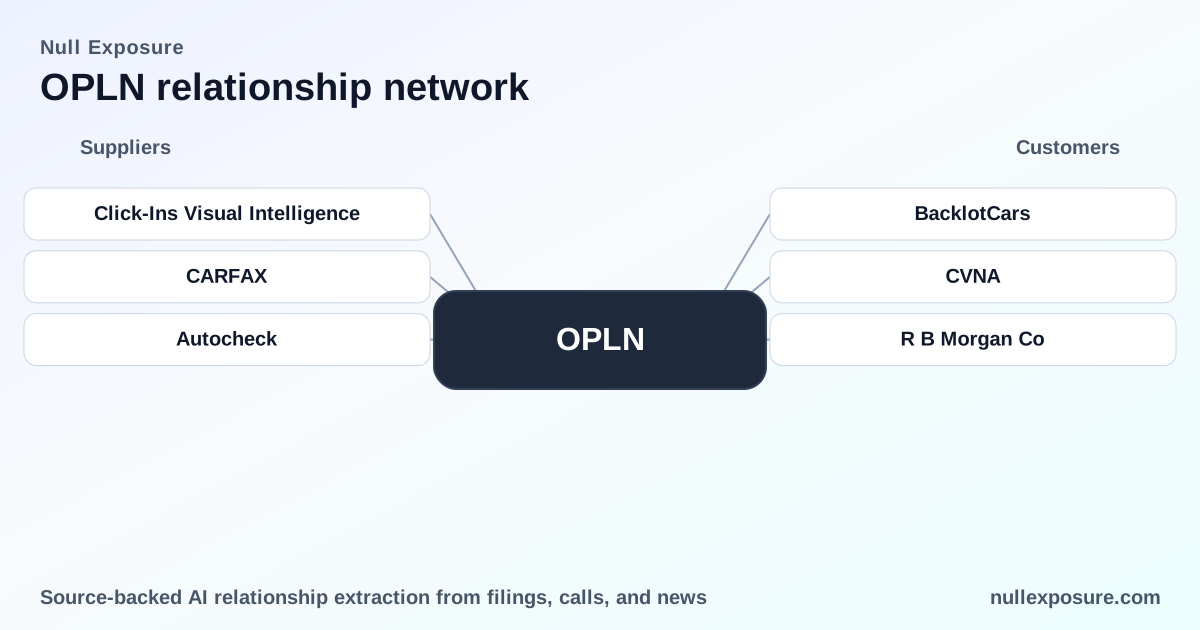
BacklotCars: platform consolidation and immediate migration
OPENLANE combined BacklotCars’ off-lease and retail-refinance vehicle inventory into its U.S. marketplace; existing BacklotCars customers were enabled to transact on the new consolidated marketplace immediately and legacy platforms were retired. This demonstrates platform consolidation, customer migration capability, and an appetite for inorganic channel integration. Source: Auto Rental News, March 2026.
Carvana / CVNA: leadership, carve-out legacy and market transactions
Press coverage links a senior operator with OPENLANE’s ADESA subsidiary and references the carve-out and sale of ADESA U.S. to Carvana in 2022, underscoring that OPENLANE’s corporate pedigree includes physical auction operations and executive mobility between brick-and-mortar and digital auction players. This history informs counterparty dynamics and competitive positioning versus large retail remarketers. Source: Repairer Driven News, May 2025.
R B Morgan Co: product adoption on inspection tools
An OPENLANE corporate release quotes R B Morgan Co’s general manager reporting that Visual Boost AI significantly increases confidence in major-damage detection — estimating a 60–70% uplift in confidence. This is concrete evidence of value realization from inspection/AI tooling among dealer customers, supporting the company’s cross-sell of higher-margin software-enabled services. Source: OPENLANE press release (corporate.openlane.com), 2026.
How these relationships translate into investor-level risks and opportunities
-
Revenue durability and margins: The auction-fee base produces steady variable revenue tied to vehicle throughput; ancillary services and SaaS tools lift margins and create upsell pathways. The R B Morgan endorsement of Visual Boost AI illustrates the practical lever for margin expansion through software-enabled services.
-
Working capital and credit exposure: The embedded 30–90 day floorplan financing model accelerates volume but creates cyclical balance sheet exposure during inventory downturns. Investors should treat financing as both a revenue lever and a liquidity risk vector that requires active credit management.
-
Concentration and counterparty risk: Public statements that no single customer exceeds 10% of revenue reduce single-counterparty concentration risk; however, the materiality of financing as a product line means systemic downturns in dealer liquidity could depress both transaction volumes and finance revenue simultaneously.
-
Geographic operational complexity: North America–EMEA operations diversify demand cycles but introduce execution and regulatory complexity in logistics, titling, and cross-border vehicle flows — areas where operational execution will determine margin capture.
Valuation and strategic implications for operators and investors
OPENLANE’s hybrid model combines marketplace scale with services-driven margin expansion; this positions the company to capture incremental revenue per transaction while maintaining volume sensitivity to used-vehicle cycles. Key investment considerations are the sustainability of transaction volume, the pace of adoption for higher-margin software and inspection products, and the credit performance of short-term financing lines.
- If the company continues migrating legacy platforms (as with BacklotCars) and upselling software tools (as with Visual Boost AI), revenue per transacted vehicle should expand.
- If macro credit stress or inventory glut materializes, financing losses and depressed volumes will compress earnings given the firm’s embedded floorplan exposure.
For more detailed signals and continuous monitoring of OPENLANE customer relationships, see additional intelligence at https://nullexposure.com/.
Bottom line for investors
OPENLANE operates a transaction-led marketplace augmented by services and short-term financing that scales with volume while offering pathways to margin expansion through software and inspection services. Customer newsflow shows active consolidation, executable migrations, and product-level adoption — favorable for revenue mix improvement — balanced by working-capital exposure and cross-border operational complexity that investors must monitor closely.