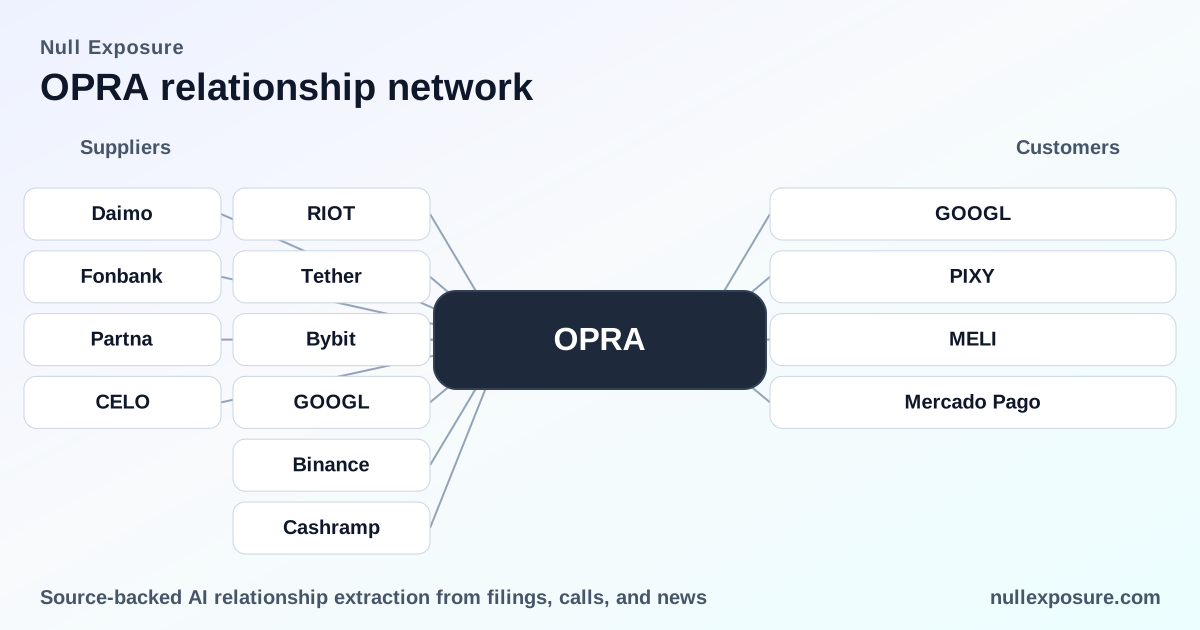
Opera Ltd (OPRA): The customer map that explains growth and risk
Opera operates a cross-platform browser and embedded fintech stack that monetizes through search and advertising partnerships, commerce affiliates, and in‑browser payments and wallet services. The company converts attention in its mobile and desktop properties into partner revenue (search revenue and affiliate fees) while pushing payments and stablecoin rails into Latin America and other emerging markets to create new revenue per user. For investors this is a hybrid advertising/commerce/payments operator where partner contracts — not pure ad CPMs — determine near‑term topline variability. Learn more at https://nullexposure.com/.
How to read this customer roll call (what matters to investors)
The relationships below are the operating levers that drive Opera’s revenue mix and risk profile: search partnerships drive the majority of recurring revenue, commerce affiliates amplify monetization per user, and payments/crypto partners create upside but also new operational complexity. Where a partner represents concentrated revenue, contract renewal cadence and regulatory context are principal risks; where partners expand functionality (AI connectors, wallets) they raise stickiness and potential new monetization.
Customer relationships that matter — line by line
Google (GOOGL)
Opera receives a large portion of its search revenue from Google, and public commentary highlights revenue concentration tied to that partnership; Opera disclosed a renewed agreement following DOJ‑related adjustments in the US. According to an InsiderMonkey write‑up on Opera (March 2026), Google accounts for a significant share of Opera’s revenue and the company recently renewed a U.S. arrangement. https://www.insidermonkey.com/blog/opera-limited-opra-a-bull-case-theory-4-1660059/
AliExpress / Alibaba (BABA)
Opera’s commerce channel includes affiliate recognition from AliExpress, where the company was named “Affiliate of the Year,” signaling meaningful commercial integration and revenue from affiliate referrals. This was cited in Opera’s Q1 2026 earnings call reporting and covered in investing.com’s Q1 transcript. https://ca.investing.com/news/stock-market-news/earnings-call-transcript-opera-q1-2026-beats-expectations-stock-rises-93CH-4591649
Shopee (SE)
Shopee is another key commerce partner recognized by Opera for affiliate performance, reflecting Opera’s strategy to monetize regional e‑commerce flows through referral economics. The Q1 2026 earnings transcript referenced Shopee recognition in late 2025. https://www.insidermonkey.com/blog/opera-limited-nasdaqopra-q1-2026-earnings-call-transcript-1749919/
n8n
Opera’s MCP Connector for the AI‑focused Opera Neon browser enables external workflow and automation clients such as n8n to access live browser context and act inside real sessions, positioning Opera as a platform for third‑party automation. SahmCapital’s March/April coverage documented this March 2026 announcement about the MCP Connector. https://www.sahmcapital.com/news/content/is-operas-open-ai-workspace-bet-reshaping-its-competitive-moat-in-browsers-and-automation-opra-2026-04-06
PIX (PIXY)
Opera rolled out a “Pay like a local” feature in Latin America enabling real‑time payments from stablecoin balances to platforms including PIX, linking Opera’s wallet work to local rails and increasing utility for users in key markets. Finviz’s coverage of Opera’s FY2025 results highlighted PIX integration as part of the payments push. https://finviz.com/news/323008/opera-reports-fourth-quarter-and-full-year-2025-results-ahead-of-expectations-announces-300-million-share-repurchase-program
Celo (CELO)
Opera signed a multi‑year commercial framework with Celo to deepen its role in the Celo stablecoin ecosystem and extend MiniPay wallet support, formally embedding a blockchain payments partner into Opera’s commerce roadmap. Simply Wall St reported on the three‑year commercial framework and expanded Celo support in 2026. https://simplywall.st/stocks/us/software/nasdaq-opra/opera/news/a-look-at-opera-opra-valuation-after-expanded-celo-stablecoi
Lovable (Lovable.BSE)
Lovable is listed among third‑party AI clients integrated via Opera’s MCP Connector, indicating Opera’s go‑to‑market for AI features relies on multiple external AI vendors to add browser capabilities. Finviz coverage of Opera Neon’s MCP Connector named Lovable among supported clients. https://finviz.com/news/341148/browse-with-your-own-ai-inside-opera-neon
Claude
Claude, as an external AI client named in the MCP Connector rollout, represents Opera’s strategy to embed conversational and agentic AI inside the browser, extending product differentiation beyond UI into agent orchestration. Finviz covered Claude as one of the supported AI clients in March/April 2026. https://finviz.com/news/341148/browse-with-your-own-ai-inside-opera-neon
ChatGPT
ChatGPT is explicitly supported by Opera’s MCP Connector, allowing ChatGPT to access live browsing context and take actions within sessions — a direct product play to raise user engagement and retention. Finviz’s March/April 2026 article lists ChatGPT as a supported client. https://finviz.com/news/341148/browse-with-your-own-ai-inside-opera-neon
OpenClaw
OpenClaw is another named AI client in the MCP Connector announcement, underscoring the breadth of Opera’s AI partner set and its position as a browser that allows agent‑level integrations to act on behalf of users. Finviz’s coverage includes OpenClaw among the supported clients. https://finviz.com/news/341148/browse-with-your-own-ai-inside-opera-neon
Mercado Pago / MELI (MELI)
Opera’s “Pay like a local” capability connects stablecoin balances to Mercado Pago and other local payment rails in Latin America, signaling direct monetization paths through payments flow and merchant integrations; this milestone was reported alongside Opera’s FY2025 results. AIJourn and Finviz coverage of Opera’s FY2025 results referenced Mercado Pago and MercadoLibre’s ecosystem integration. https://aijourn.com/opera-reports-fourth-quarter-and-full-year-2025-results-ahead-of-expectations-announces-300-million-share-repurchase-program/
What these relationships imply about Opera’s operating model and constraints
- Concentration: Multiple sources explicitly note a significant share of revenue comes from Google, which creates a concentrated dependency on a single search partner — a structural revenue concentration investors must underwrite. (Company and media commentary, March 2026.)
- Contracting posture: Public statements about a renewed Google agreement tied to DOJ developments indicate Opera negotiates formal, multi‑jurisdictional search contracts that are material to results; contract renewals are discrete events that can move near‑term revenue. (Q1 2026 earnings commentary.)
- Criticality and diversification: Commerce partners (AliExpress, Shopee, Mercado Pago) and Celo signal a deliberate diversification away from pure search revenue toward affiliate and payments flows that increase ARPU per user and reduce single‑counterparty risk over time.
- Product maturity and openness: The MCP Connector and multiple AI client integrations demonstrate a mature product approach to third‑party embeddings — this raises user stickiness and creates optionality for new revenue streams tied to automation and merchant conversions.
- Geographic and regulatory exposure: Payment rails and stablecoin support in Latin America create new regulatory and operational complexity that is not trivial; this is a deliberate strategic play but introduces execution and compliance constraints at the company level.
(There were no explicit constraint excerpts outside the relationship data; the above are company‑level signals distilled from the relationship set.)
Investment implications and risks to watch
- Key watch: the cadence and terms of the Google search agreement — renewal economics and any US regulatory impacts directly affect Opera’s top line given concentration.
- Upside: payments/wallet adoption (MiniPay, Celo, PIX, Mercado Pago) could materially increase revenue per user if merchant flows and conversion rates scale.
- Technology moat: AI connector integrations increase product stickiness and create distribution for partner monetization; success will be measured by engagement and monetization metrics, not just announcements.
- Risks: regulatory complexity in crypto/payments and single‑partner concentration on search remain the principal downside vectors.
If you evaluate Opera’s commercial risk/reward, monitor search revenue contribution by contract, adoption metrics for MiniPay/Celo, and conversion figures from affiliate partners; these three signals will determine whether Opera’s diversified strategy materially reduces concentration over the next 12–24 months.
Further analysis and a data‑driven customer exposure view are available at https://nullexposure.com/.
Conclusion: Opera is a mid‑cap digital operator where partner contracts and new payments/AI integrations together define the path from browser scale to durable monetization; investors should price both the concentration risk and the scaled monetization optionality into any valuation thesis.