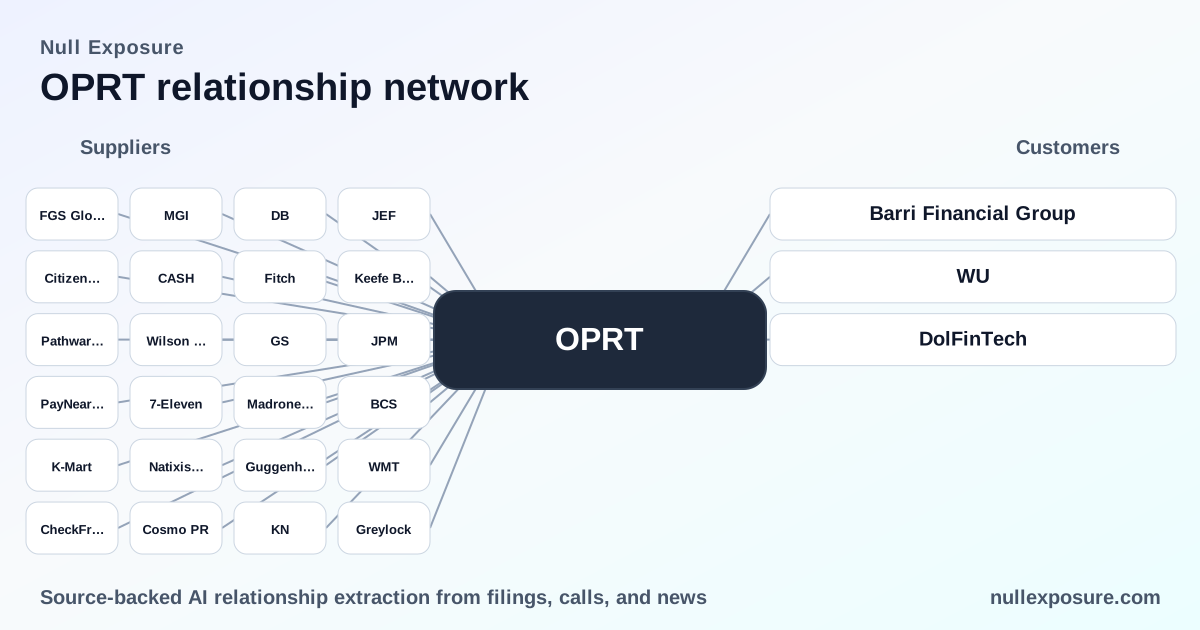
Oportun (OPRT) — Customer relationships that scale Lending-as-a-Service and loan inventory sales
Oportun operates a two‑pronged financial services model: it originates consumer loans to underbanked borrowers and monetizes through net interest margin, fees, and the selective sale of loan receivables, while simultaneously packaging its underwriting and origination platform as Lending‑as‑a‑Service (LaaS) to distribution partners. This hybrid commercial strategy creates recurring net interest income on held loans, fee revenue from partners, and periodic liquidity events when loans are sold to investors — a combination that drives both top‑line growth and balance‑sheet flexibility. For deeper signals and document-level sourcing, see NullExposure. (https://nullexposure.com/)
Quick read for investors: what the partner list means for revenue and distribution
Oportun has expanded beyond direct channels (mobile/app, telesales, retail) into partnerships that embed its loan product into third‑party customer flows. Those partnerships materially extend distribution, reduce customer acquisition costs, and create alternative funding and exit channels for originated loans. The current partner set in public reporting includes retail and payments networks that push Oportun’s loans through phone, online, and physical locations — a clear commercialization of the company’s LaaS offering.
The partnerships investors should know
Barri Financial Group — a retail footprint for Oportun loans
Oportun added Barri Financial Group as a strategic Lending‑as‑a‑Service partner, enabling Barri customers in select locations to apply for loans that are originated, funded, and serviced by Oportun. This expands Oportun’s point‑of‑sale distribution into Barri branches. (CityBiz coverage, FY2021: https://www.citybiz.co/article/164235/oportun-adds-barri-financial-group-as-strategic-partner/)
Western Union (WU) — payments network distribution
Oportun lists Western Union among partners in its LaaS expansion, providing loans through Western Union’s phone, online and retail channels and tapping a large payments network to reach customers who transact in cash and cross‑border flows. This relationship leverages Western Union’s customer footprint to distribute Oportun’s credit product. (TradingView summary of Oportun’s SEC 10‑Q, FY2025)
DolFinTech — digital channel and fintech partnership
DolFinTech is identified alongside Western Union as a LaaS partner, representing Oportun’s strategy of partnering with fintech and digital platforms to place loans via phone and online channels. This supports scalable, lower‑cost customer acquisition through third‑party digital funnels. (TradingView summary of Oportun’s SEC 10‑Q, FY2025)
What the contract and constraint signals imply about Oportun’s operating model
Oportun’s public filings and reported agreements reveal a deliberate operating posture that mixes multi‑channel distribution with balance‑sheet management tools.
-
Contracting posture — medium‑term commitments that provide predictability. The company disclosed a forward flow whole‑loan sale agreement entered in November 2022 that commits it, through December 2025, to sell a minimum of $2.0 million per month of unsecured loan originations with an option to sell up to $4.2 million per month under eligibility criteria. That structure creates predictable liquidity windows while preserving upside on higher‑quality originations. (Company filing excerpts, referenced in constraints.)
-
Counterparty mix — retail borrowers plus institutional investors. Primary counterparties are individual consumers, accessed through Oportun’s app, website, telesales and retail locations; state concentration is meaningful with large shares of principal in California and Texas. At the same time, the firm transacts with large institutional investors as buyers of whole loans and receivable pools. This dual pattern drives both origination economics and periodic balance‑sheet exits. (Company disclosure excerpts; borrower geography and forward flow sale language.)
-
Criticality and revenue concentration — lending is the business. The core lending product is the majority of Oportun’s revenue and profitability, and the company explicitly cites opportunity to leverage partner distribution to grow beyond its historical regional footprint (including use of a partnership with Pathward, N.A.). That makes the performance of originations and partner channels central to results. (Company disclosure language used in constraints.)
-
Maturity and execution mechanics — services plus asset sales. Oportun functions both as a seller of loan assets (including periodic sales of non‑performing and credit card receivables — roughly $78.5 million sold in the twelve months ended December 31, 2024) and a services provider to partners via LaaS. This hybrid model gives the company multiple levers to manage liquidity and capital efficiency. (Company disclosure excerpts.)
Risks and operational tradeoffs investors must price
- Concentration risk: Geographic concentration in a handful of states (41% California, 27% Texas, etc., as disclosed) creates idiosyncratic regional exposure to credit cycles and regulatory shifts.
- Reliance on partner distribution: Growth from LaaS depends on partner economics and integration; partner churn or underperformance reduces marginal acquisition reach.
- Balance‑sheet and funding execution: Forward flow sale commitments provide predictability but also create timing and eligibility constraints on what can be sold; failure to meet underwriting eligibility could compress liquidity options.
- Asset quality sensitivity: The business model mixes held‑for‑investment economics with periodic sales of non‑performing pools, so reported earnings and book composition will move with credit cycles and sale activity.
Each of these risks is actionable for investors: they influence forecast assumptions for net interest margin, loan growth, and the cadence of one‑time gains or losses from receivable sales.
For a closer view into sourcing and clauses that drive these dynamics, visit NullExposure’s document intelligence hub. (https://nullexposure.com/)
What to watch next as an investor
- Renewal or extension of the forward flow sale commitment after Dec 2025 and any changes to minimum/maximum monthly sale thresholds.
- New LaaS partner additions beyond the current roster (including any expansion with digital platforms or payments networks).
- Quarterly disclosure of receivable sales and the split between performing and non‑performing pools sold.
- State‑level performance and charge‑off trends, given the concentration of principal in a few large states.
Bottom line
Oportun’s commercial profile is distinctly hybrid: it combines core consumer lending economics with an outsized strategic push into Lending‑as‑a‑Service and whole‑loan sales. That structure boosts distribution scale and liquidity optionality while introducing execution and concentration risks that must be actively monitored. Investors should weight LaaS traction and the company’s success in converting partner volume into profitable originations and saleable loan pools when modeling future earnings and capital needs.
For ongoing signal tracking and document‑level sourcing on Oportun and its partners, NullExposure provides consolidated evidence and filings that accelerate due diligence. (https://nullexposure.com/)