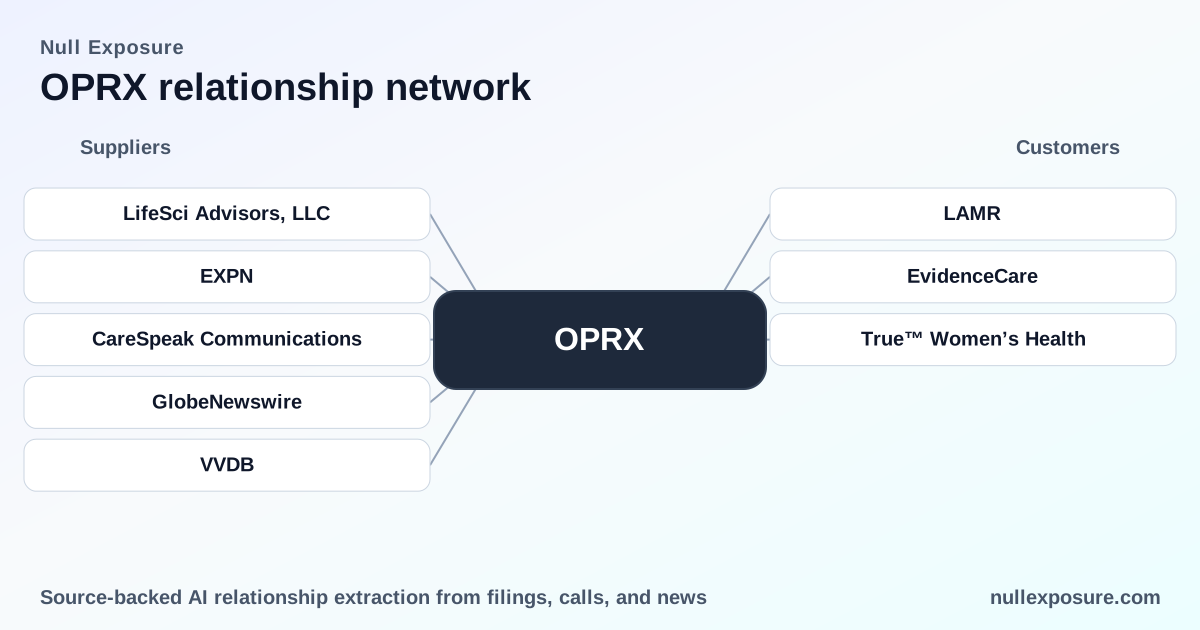
OptimizeRx (OPRX) — customer relationships that shape revenue and risk
OptimizeRx operates a point-of-care and patient engagement platform that delivers sponsored financial, clinical and brand messaging for life sciences customers. The company monetizes through a mix of short-term message-based programs, subscription/hosting agreements and occasional software licenses, charging per message, per redemption or via flat-fee program arrangements. For investors, the business is a high-volume communications engine with concentrated counterparty exposure, largely U.S.-focused end markets, and a commercial model that prioritizes flexibility and transaction-level pricing. For follow-up diligence and data coverage on these relationships, see https://nullexposure.com/.
How OptimizeRx gets paid and why that matters to revenue stability
OptimizeRx’s contracts are primarily short-term and program-based, which compresses customer lock-in and increases revenue variability tied to campaign cadence. Company filings explicitly state: "Our contracts are generally all less than one year and the primary performance obligation is delivery of messages or other forms of content." That disclosure is a core operating signal — revenue is earned when content is delivered, not from long multi-year commitments.
The company also records license revenue when software is delivered, recognizes SaaS revenue over subscription periods, and derives usage-based fees ("price per message, price per redemption, or flat fee"). These mixed monetization modes create a portfolio of cash flows that are billing-event driven rather than front-loaded multi-year contracts.
Other company-level signals relevant for investors:
- Counterparty profile: customers are "primarily large well-capitalized companies" and OptimizeRx reports approximately 100 pharmaceutical customers, with revenue concentrated among the largest pharmaceutical firms.
- Geography: operations and customers are primarily U.S.-based.
- Concentration: top five customers represented ~49% of revenue for the year ended December 31, 2024, a material concentration that increases client-specific risk.
- Commercial maturity: the product set includes point-of-care messaging, RMDY digital health tools and licensing, reflecting a mix of mature program offerings and additive partnerships.
These characteristics indicate a business that is scalable in volume, sensitive to client campaign cycles, and exposed to client concentration and U.S. pharma budgets.
Customer relationships that matter to the revenue story
Lamar Advertising Company (LAMR) — extending reach into out-of-home (OOH) advertising
OptimizeRx has a strategic partnership with Lamar Advertising Company for OOH marketing; the relationship integrates OptimizeRx’s patented Micro-Neighborhood Targeting (MNT) data with Lamar’s national inventory to support clinically relevant out-of-home campaigns across the U.S. The collaboration was publicly reported in March 2026 and was discussed on OptimizeRx’s FY2025 earnings call (investor Q&A highlighted the size of the opportunity). Sources: QuiverQuant press coverage (Mar 10, 2026) and an earnings call transcript reported by InsiderMonkey (FY2025).
- Why it matters: Lamar extends OptimizeRx’s addressability beyond digital point-of-care to physical, location-based media, opening a new channel for life sciences programs and a potential usage-based revenue stream tied to campaign scale.
EvidenceCare — point-of-care integration to reach clinicians
OptimizeRx partnered with EvidenceCare to deliver digital health messaging at the point-of-care, allowing EvidenceCare to distribute OptimizeRx content including financial, clinical and brand messages directly to healthcare providers. This relationship was described in a trade report in 2018 that highlights the point-of-care distribution capability (FY2018 coverage). Source: HIT Consultant coverage (Apr 23, 2018).
- Why it matters: Point-of-care integrations with clinical workflow vendors like EvidenceCare are core to OptimizeRx’s product value, directly connecting life sciences clients with prescribing clinicians and supporting message effectiveness metrics.
True™ Women’s Health — clinic-level RMDY app deployment
In 2020 OptimizeRx powered a Michigan-based clinic, True™ Women’s Health, with a health app built on the company’s RMDY digital health tools, enabling patient-facing engagement tailored for women’s health. This deployment was announced via a press release in May 2020. Source: GlobeNewswire press release (May 13, 2020).
- Why it matters: RMDY deployments demonstrate OptimizeRx’s ability to supply clinic- or practice-level digital tools that can be licensed or hosted, diversifying revenue beyond programmatic message delivery into clinical patient engagement solutions.
Commercial implications and investor takeaways
OptimizeRx’s customer mix and contract architecture create a distinct set of portfolio risks and upside drivers:
- Revenue volatility is structural. Short-term contracts and usage pricing create high correlation between campaign timing and revenue. Quarterly results will reflect marketing budgets and seasonality of pharma campaigns.
- Concentration is material. With nearly half of revenue attributable to the top five customers in 2024, client churn or budget reductions at key pharma customers will materially affect revenue. This is a primary risk for valuation sensitivity.
- Large-enterprise customers improve collections but heighten negotiation leverage. The customer base is well-capitalized, reducing credit risk, but large clients have bargaining power over pricing and program scope.
- Product mix reduces single-mode dependence. Licensing, subscriptions and usage fees diversify monetization, but the short-duration nature of many contracts reduces lifetime revenue certainty.
- Geographic concentration limits diversification. The U.S.-centric customer base focuses regulatory and commercial exposure to a single healthcare market.
Key drivers for upside:
- The Lamar partnership introduces a new OOH monetization vector that leverages OptimizeRx’s targeting data, expanding TAM if advertisers adopt clinically targeted OOH at scale.
- Additional integrations with point-of-care platforms and clinic-level apps can convert program spend into recurring subscription or license revenue streams.
Consider these practical actions:
- Monitor quarterly campaign volumes and commentary on top-client retention to assess revenue sustainability.
- Track the evolution of the Lamar integration for early signs of repeatable program wins that translate into material new revenue.
- Reconcile reported top-five client concentration trends each quarter to measure diversification progress.
For a deeper breakdown of these customer relationships and broader competitive context, visit https://nullexposure.com/ for proprietary relationship mapping and ongoing updates.
Bottom line
OptimizeRx is a transaction-driven platform that leverages clinical targeting to monetize life sciences marketing through message delivery, licenses and emerging channels like OOH. The business offers scalable volume economics but carries material concentration and short-contract risk, making execution on new partnerships and client retention the core value driver. Investors should prioritize monitoring campaign cadence, top-client exposure, and monetization of partnerships such as the Lamar OOH integration when assessing near-term cash flow and valuation.