OptiNose (OPTN): Customer relationships, strategic partners, and what investors should price in
OptiNose commercializes specialty ENT therapeutics through a combined drug-and-device model and monetizes primarily through product sales, licensing and transactional strategic exits. Recent capital raises and a proposed sale to Paratek Pharmaceuticals recast OptiNose from an independent commercial-stage biotechnology operator into an asset being folded into a broader pharmaceutical buyer’s portfolio — a shift that changes revenue durability, counterparty concentration and contracting posture for investors and operators evaluating customer relationships. For a concise company signal snapshot, visit https://nullexposure.com/.
How these relationships define OptiNose’s operating posture
OptiNose runs a focused, commercial-stage but capital-dependent business model. Product revenues come from a narrow therapeutic niche, while equity financings and potential M&A provide the bulk of liquidity events and valuation resets. The company’s contracting posture is transactional: it has engaged institutional investors for bridge and growth capital and is in the late-stage process of a strategic sale that transforms counterparties from financiers to an acquirer.
- Concentration: Product revenue is concentrated by therapy and distribution pathways; strategic capital and exit interest are concentrated among a small set of institutional investors and a single buyer.
- Criticality: Counterparties such as lead investors and an acquirer are highly critical to near-term solvency and shareholder realization.
- Maturity: Commercial maturity is early-to-mid: the company is generating commercial traction but required external financing (registered direct offering) in FY2024 and a proposed sale in FY2025–FY2026 cycles.
The constraints dataset returned no standalone constraint excerpts for customer contracting, so the above are company-level signals derived from the financing and transaction activity disclosed in public filings and press coverage.
Relationship rundown — what each counterpart means for risk and value
Paratek Pharmaceuticals
Paratek has negotiated a transaction to acquire OptiNose for up to $330 million, positioning OptiNose’s product set as a complement to Paratek’s existing portfolio in ENT alongside its antibiotics franchise. According to BioSpace, Paratek’s offer expands the buyer’s therapeutic footprint and establishes a clear exit valuation metric for OptiNose shareholders (BioSpace, May 2026). Separately, a lawyer-led investor alert reported by BizWire/FinancialContent notes that a law firm is investigating the adequacy of the proposed sale price and process, signaling potential governance and process risk around the deal (BizWire/FinancialContent, May 2026).
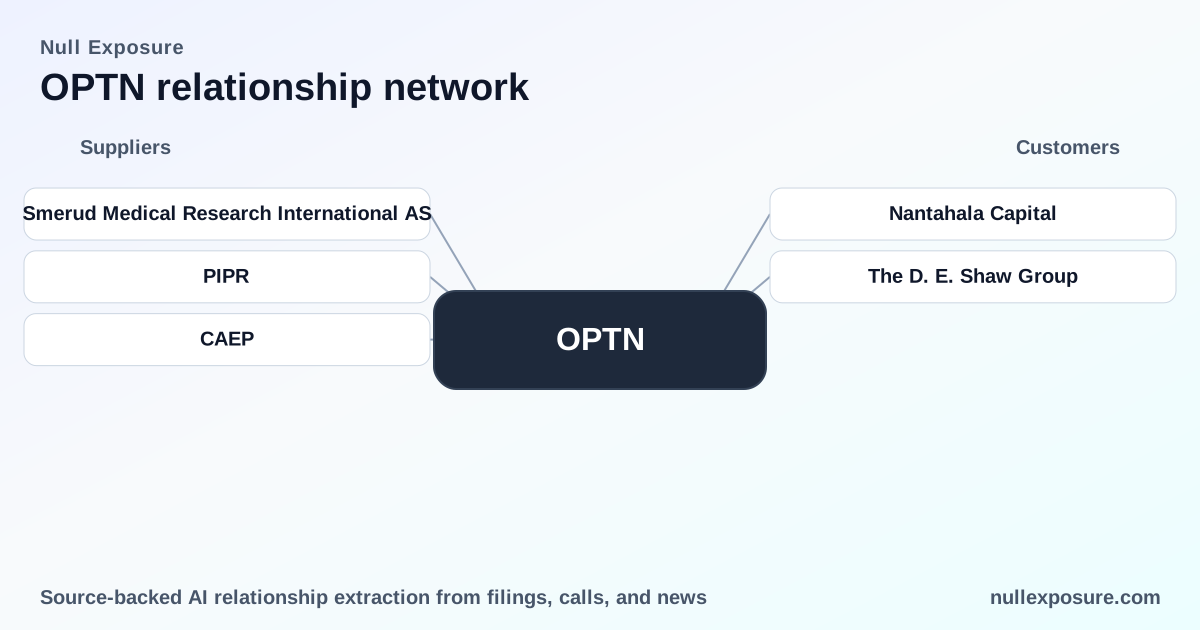
Nantahala Capital
Nantahala Capital led a $55 million registered direct offering for OptiNose in May 2024, providing a material capital infusion and signaling institutional investor confidence in the company’s commercial plan at that financing stage. The GlobeNewswire release documenting the offering identifies Nantahala as a lead investor and demonstrates that OptiNose attracted structured capital from healthcare-focused investors during FY2024 (GlobeNewswire, May 2024).
The D. E. Shaw Group
The D. E. Shaw Group co-led the same May 2024 registered direct financing alongside Nantahala, indicating participation from a major alternative asset manager and adding depth to the company’s financing syndicate. GlobeNewswire reports D. E. Shaw’s role in the transaction, which highlights a lending/ownership dimension to OptiNose’s capital base in FY2024 (GlobeNewswire, May 2024).
What these relationships mean for customer strategy and valuation
The mix of counterparties — institutional financiers and a strategic acquirer — reframes how investors should evaluate OptiNose’s customer relationships:
- From independent commercial risk to transactional realization: The proposed Paratek acquisition changes the lens from long-term end-customer retention to how product fit and IP transfer will be executed in the deal. Revenue continuity post-acquisition depends on integration planning and the acquirer’s commitment to channel support.
- Financing-driven runway and execution risk: The May 2024 registered direct offering led by Nantahala and D. E. Shaw indicates past reliance on concentrated institutional capital to sustain operations. That financing reduced near-term liquidity risk but left OptiNose dependent on future financing or a strategic sale to realize shareholder value.
- Concentration of counterparty influence: A small number of financial counterparties and a single strategic buyer dominate value outcomes, increasing governance and negotiation risk — as the investor alert over the Paratek deal underscores.
- Operational criticality of distribution and integration: For an acquirer like Paratek, OptiNose’s commercial channels and device integration become critical assets; investors should prioritize diligence on channel durability, reimbursement profile, and the ease of integrating device-enabled therapeutics into Paratek’s sales infrastructure.
Governance and process risk: the investor alert matters
The law firm investigation reported in May 2026 into the adequacy of price and process is a direct governance signal that can affect deal timing, potential pricing adjustments, or litigation contingency. Investors must price the potential for deal friction or renegotiation, and operators should prioritize transparent disclosure of the sale process and valuations to mitigate escalation risk (FinancialContent/BizWire, May 2026).
Key takeaways for investors and operators
- The Paratek transaction sets the near-term valuation anchor: Acquirer economics and any contention over deal price are now the dominant value drivers for public investors.
- Capital concentration heightens execution risk: Nantahala and D. E. Shaw’s leading roles in the FY2024 financing make institutional financiers central actors in OptiNose’s capital story.
- Operational continuity post-close is the primary commercial risk: Integration of sales channels and device commercialization into Paratek’s platform will determine revenue durability after any transaction closes.
- Governance frictions are an active risk: The investor alert means contingency planning is necessary for timing and potential litigation costs.
For a strategic summary and deeper signals on counterparties and governance events, see the company snapshot at https://nullexposure.com/.
Bottom line
OptiNose’s investor and acquirer relationships concentrate value in a small number of counterparties and shift the investment thesis from standalone commercial growth to transactional realization and integration execution. Investors should prioritize deal process clarity, integration plans from Paratek, and the operational resilience of OptiNose’s sales channels when assessing downside risk and upside capture.
Sources referenced above: BioSpace (May 2026), FinancialContent/BizWire (May 2026), and GlobeNewswire (May 2024).