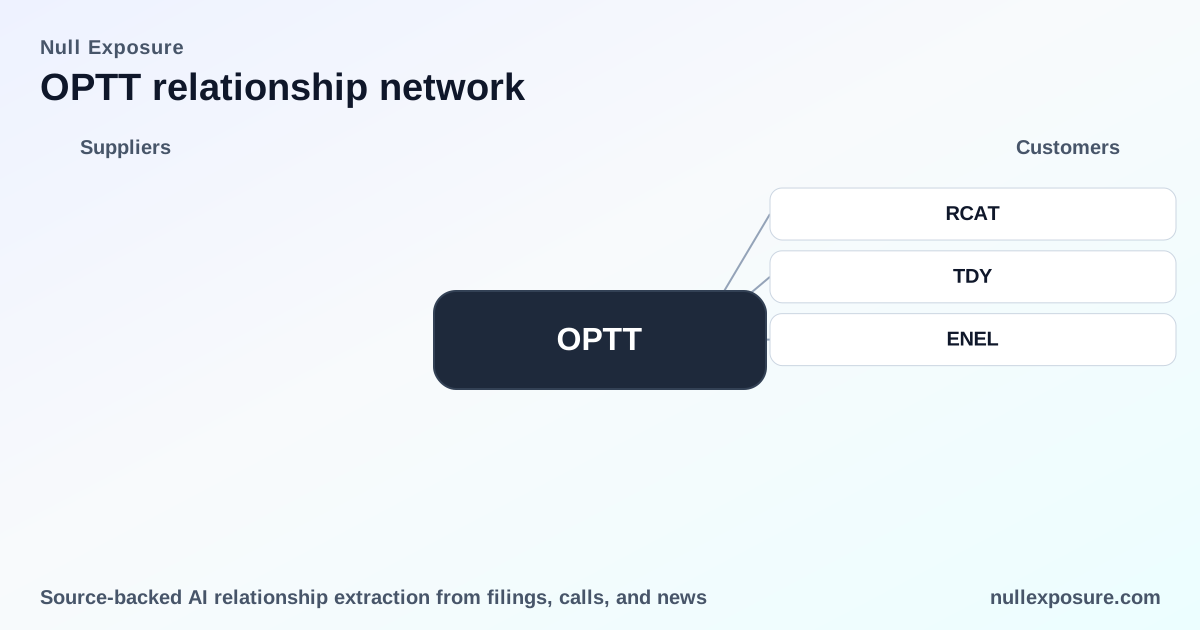
Ocean Power Technologies (OPTT): customer map and commercial implications
Ocean Power Technologies builds and monetizes ocean-facing infrastructure: PowerBuoy wave-energy systems and WAM‑V autonomous surface vehicles, sold, leased, and operated under service contracts and subscription-style offerings (RaaS, PaaS, DaaS). Revenue derives from a mix of direct equipment sales, time‑bound leases and recurring service arrangements; the company’s $12.5 million contract backlog and concentrated customer base drive both near-term cash visibility and revenue concentration risk.
For a concise portal to tracked relationships and signals, visit https://nullexposure.com/.
How OPTT gets paid: a clear commercial profile
OPTT’s business model combines product sales and recurring services. The company manufactures and sells wave-energy and maritime robotics platforms, offers subscription and usage-based access (Robotics as a Service and lease models), and retains ownership under certain deployments where it provides ongoing maintenance and operations.
- Contracting posture: OPTT operates with a blended book — subscription and usage-based contracts are explicit, alongside long‑term service agreements and shorter operating leases (some WAM‑Vs had remaining terms under two years). This mix creates recurring revenue potential while preserving transactional sales upside.
- Revenue concentration and scale: As of FY2025, three customers represented ~53% of revenue, a material concentration that amplifies the impact of contract wins or losses.
- Geography and counterparty mix: The company serves a global customer set and has an explicit focus on government and defense agencies, a channel that produces strategic, higher‑criticality contracts but also procurement timing volatility.
- Backlog and spend band: The reported contract backlog of approximately $12.5 million positions OPTT in a $10M–$100M spend band for committed near-term business, signaling meaningful project pipeline for a company with trailing revenue of roughly $3.4 million.
- Role and stage: OPTT operates as manufacturer, seller and ongoing service provider, with active deployments and ongoing pilots that drive technology validation and future recurring revenue.
These company-level signals explain how customer contracts will shape growth, capital needs, and cash flow — tradeoffs that investors and operators must weigh when assessing valuation and operational risk.
Customer relationships you should know
U.S. Coast Guard — an operational deployment and a purchase order
OPTT received an order of approximately $1.5 million from the U.S. Coast Guard for installation and deployment of operational buoy systems, reflecting a paid government deployment rather than a purely developmental pilot. (MarketScreener news report, May 2026)
U.S. Department of Homeland Security — deployment under contract
OPTT announced the successful deployment of its first PowerBuoy under a previously announced contract with the U.S. Department of Homeland Security, demonstrating progression from award to live operations on a federal security program. (MarketScreener news report, May 2026)
Red Cat (RCAT) — defense and systems integration partnership
OPTT expanded partnerships with defense and drone systems players including Red Cat, positioning its platforms for integration into defense and unmanned systems workflows; this is a strategic channel for broader subsea and unmanned mission profiles. (OPTT Q4 FY2025 earnings call, March 2026)
Teledyne Marine (TDY) — subsea capability partnership
Teledyne Marine was cited alongside other subsea and integrator partners, indicating OPTT’s go‑to-market route through established marine systems integrators for regional and complex subsea projects. (OPTT Q4 FY2025 earnings call, March 2026)
Enel Green Power (ENEL) — commercial renewable-energy reference
OPTT deployed a PB3 PowerBuoy for Enel Green Power off Las Cruces, Chile, supporting an offshore renewable energy objective and providing an early commercial reference in the renewable energy sector. (Offshore‑Energy report referencing FY2021 activity; first reported context March 2026)
What these relationships tell investors about risk and upside
These customer ties spell a straightforward strategic posture: OPTT sells engineered platforms and locks in recurring revenue through service and subscription models while using strategic partnerships and government contracts to scale deployments. Several implications matter for investors and operators:
- Customer concentration is a material risk: With a small number of customers contributing over half of revenue, individual contract outcomes have outsized effect on near‑term results; government awards can simultaneously be stabilizing (multi‑year programs) and lumpy (procurement timing).
- Recurring revenue runway exists but is nascent: RaaS and other subscription offers provide stickiness because OPTT often retains asset ownership and controls maintenance; however, recurring streams are not yet large relative to the company’s market capitalization and cash needs.
- Contract structure is heterogeneous: The company-level signal set includes usage‑based, subscription, long‑term and some short‑term lease arrangements, creating mixed cash flow profiles that require active contract management.
- Commercial maturity is uneven: OPTT runs active deployments and pilots concurrently; government deployments (DHS, Coast Guard) are strong validation events while commercial renewable references (Enel) support a broader market narrative.
- Backlog is meaningful relative to trailing revenue: A $12.5M backlog against ~$3.4M TTM revenue signals short‑to‑medium term revenue acceleration potential if execution and cash conversion follow through.
For a deeper mapping of customer interactions and ongoing signal tracking, visit https://nullexposure.com/.
Bottom line for investors and operators
OPTT is a small‑capitalization engineering and services company with strategic government contracts and targeted commercial references that validate its technology and sales model. The company blends equipment sales and recurring service contracts — the latter offer higher lifetime value but require scale and capital to realize. Revenue concentration, procurement cyclicality, and the hybrid contract mix create both upside (contract wins convert rapidly into backlog) and downside (loss of a major customer or delayed government spending).
Key numeric context: market cap roughly $80.9 million, trailing revenue of about $3.4 million, and a contract backlog near $12.5 million. These figures frame valuation risk and the potential for outsized returns if recurring service revenues and international integrator partnerships scale as expected. Government deployments announced in 2026 (DHS, Coast Guard) are immediate operational catalysts that materially de‑risk the technology commercialization story and support revenue visibility in the short term.
Investors should price in execution risk and customer concentration while monitoring contract replaceability, RaaS adoption rates, and backlog conversion into cash receipts. Operators and partners should treat OPTT as a manufacturer‑operator hybrid that can deliver turnkey maritime platforms while retaining control where recurring service economics are at stake.